No Lower Limit? Strikingly Low LDL-C Levels Boost Cardiovascular Protection With No Added Safety Risk

You write very well and make very valid points.
But your ability to express your opinions in writing (which is great) seems to overcomplicate things while at same time eloquently justifying your position (being against preventative measures, and we do get it you’re not against statins when needed). Why not bring the discussion to a layman’s level (i.e. me) and tell me why I’m wrong, anyone not just you:

For example, I used to only go to the doc once every ten years up till I hit 50 years old and also did main labs once every ten years and my labs always came normal or optimal. But round 55 (i do labs annually) my markers started moving in the wrong direction, ie. LDL-c from 80 to 95-to 105 to130 and fasted glucose from 80 to 90 to 99 to 105, and almost all other markers moved in same direction. Now I don’t need to be a doctor nor a scientist to know that first I’m getting old, and with that my body (markers) are starting to show it. So, the smart thing for me to do is to research as much as I can (thus the purpose of being on these forums) and then come up with a strategy to try and delay the inevitable for as long as possible so I can stay healthy until later years. Therefore, I attacked all those markers that were going in wrong direction with FDA approved drugs, initially starting with only one drug and at a very low doses and assessing for any unwanted side effects, and then introduce another drug same way, and another one and so on. Now, I’m taking 6-7 meds, and all my markers are either normal or optimal again, and I do not have any side effects whatsoever (that I can tell). I feel great, I’m very strong, and feel I’m in excellent health.

How is it wrong what I’m doing? and why would I even bother to dig thousands of research pages on the web when the best research is the one I’m doing on myself and I feel great. Clearly, I must be doing the right thing to feel this good at an advanced age of 60. I could in theory stop everything and say please God take care of me because now I’m on your hands, but I’m afraid he’ll tell me sorry but that’s why I gave you a brain so you can take care of yourself LOL.

Long story short I much rather be proactive than wait and see when it comes to health. Health is almost like glass once it’s broken it’s pretty hard to put it back together the same way as before.

2 Likes

We agree to disagree.

We have different interpretations of multiple factors, which has lead us to different conclusions.

Regarding your imaging claims, I’ve had more than one doctor overtly state that I have no disease based on imaging. You dismissively say those doctors are not worth their salt. Not true. One of those doctors is a highly recognized authority (not naming names), and another has always proven reliable through multiple complex health matters. But you claim none are worth their salt? Seriously?

Edit after the fact: I was really thrown off by your assertions regarding the worthlessness of imaging, in particular the CTCA. If you are right, that would mean an entire segment of conventional medical practice is worthless fraud subject to legal prosecution for spurious claims. I decided to test what you said against the free version of Gemini, and the data couldn’t be more contradictory (like, not even close):

AI Overview

A Coronary CT Angiography (CTCA) imaging test is highly reliable, particularly for ruling out significant heart disease. According to clinical literature published in the National Institutes of Health (PMC), it has an exceptionally high negative predictive value of around 94% to 99%. This means that if your CTCA scan returns a normal result, you can be virtually certain that you do not have significant coronary artery blockages. [1, 2, 3, 4]

Diagnostic Accuracy Breakdown

Medical data published on PubMed highlights how the test performs across key statistical metrics: [1]

  • Sensitivity (~96%): It is excellent at detecting even minor traces of plaque or narrowing.

  • Specificity (~74%): It is slightly less precise at confirming the exact severity of a blockage, sometimes overestimating it.

  • Positive Predictive Value (~83%): If the test shows a severe blockage, there is a moderate chance it may need to be confirmed via invasive testing

David, we obviously don’t know each other, but the research couldn’t be more inconsistent with your claims in this thread. If you believe imaging is so utterly worthless that “the only picture that matters is on a pathologist’s slide after you are dead” then that communicates our differences clearly. We see the facts differently.

If someone else wants to run with the “imaging credibility” discussion, then that is their torch to carry. I’ve got productive work to complete.

We agree to disagree.

1 Like

I’m unclear how you misinterpreted my writing, but alas…

Yes, of course, if all your lipid and metabolic health markers are heading materially in the wrong direction during the decade from 50-60 then using all means available to get them back under control is reasonable.

No disagreement.

The only difference is I would get a CTCA at the same time to see how serious the situation is for my specific biology. I would want to know how aggressively I should treat the problem based on actual evidence. 90% stenosis leads to one protocol, and zero soft/hard plaque leads to something different.

That’s my point. I would never blindly pursue the latest trend of “crushing it” because “no level is too low.” Instead, test to determine your specific situation, and build an appropriate protocol given all the evidence.

I would choose the minimally invasive solution to produce the desired outcome, and that can only be determined through testing, action, and then follow-up testing to determine results from those actions.

There’s really nothing controversial about it, but somehow putting it in the context of the latest statin craze seems to somehow fan the flames of disagreement.

2 Likes

Agreed, all fair points. And yes, it makes sense to collect as much data as possible before deciding on a protocol. The only caveat being the cost of certain procedures, for some people a $1000 may be a lot (to be fair I don’t know how much a CTCA costs, as I have never had one).

Talk all you want about obtuse reasons not to prescribe statins to someone that doesn’t present any symptoms.

In healthcare, especially, the old adage rings true:
An ounce of prevention is worth a pound of cure.

5 Likes

I went over your other points before, so I won’t repeat them.

However, your quote above is interesting. Drugs differ by risk and benefits profiles. You look at statins and see risks, but I do not believe you are fully accounting for the benefits part of the ledger. Why? Because you are limiting the benefits of statins to CVD. Since you think you have no CVD risk (wrongly, as a CT angio scan only asseses one kind of risk - atherosclerosis - whereas there are other CVD risks too, which incidentally are addressed by statins) you therefore conclude that the benefit doesn’t exist (for you) and only risk remains (for you).

But what happens if we take the CVD benefit of statins off the table completely? Why, we still see ACM benefits outside of CVD altogether (see for example the paper I posted in a previous comment)! Now the balance looks like: risks and both CVD and non-CVD pleiotropic benefits. So if you remove the irrelevant to you CVD benefits, you still get non-CVD ACM benefits.

As you like finances, it’s as if you exclusively focused on the risk, but failed to fully account for the upside of the financial instrument. Like a stock that has downside risk, and you are not satisfied with upside potential, except you failed to notice that it also pays dividends. Oops.

But maybe you see the risk potential of statins as greater than even the potential non-CVD upside of statins? Glad to oblige - we actually have an answer (quantified assesment). It’s in the nature of the metric - All Cause Mortality (ACM). The ACM incorporates both the risk of the drug and the benefit - and in this case it comes out as cumulatively lower, thus telling us that the benefits outweigh the risks - what kind of financial analyst would say “I pass on an instrument where the upside potential far exceeds the downside risk”? The kind who gets fired for incompetence. But, you may say, that ACM weights in CVD benefits which you don’t see as relevant. Except we got that covered too - because this is an ACM that’s advantageous even after we take out CVD benefits - non-CVD ACM (paper I posted). Done and done.

I’ve written before about my position vs statins (specifically pitavastatin) - even if my lipids were to be within range (so not assesed as risky) and I had no CVD risk factors (clear scan, BP low, glucose low, inflammation low, high CV fitness, no family history etc.) - I would still elect to take pitavastatin. Why? For two reasons. One, because studies repeatedly show that even with low ApoB/LDL lowering them further with statins continues to lower your risk. But more importantly - because I am looking for pleiotropic non-CVD benefits. Exactly that which you overlooked.

This is a pretty well understood approach. We do it here all the time. Example: SGLT2i. The indication for this class of drugs is diabetic glucose control. But non-diabetics (most people on this site!) take them anyhow, because of the non-diabetic benefits (like statins for non-CVD benefits). These drugs have multiple proven pleiotropic benefits in humans - this even completely discounting the potential slowed aging (per ITP, not proven in humans). There are not only CV benefits in non-diabetics, but proven benefits in kidney health where the age related decline in function is strongly attenuated. Now comes along another “Todd” and says:

these SGLT2i drugs are powerful systemically, I have extensive tests showing conclusively that I have NO DIABETES. Are the risks of SGLT2i justified when no problem exists?

And I say: “I too don’t have diabetes, but I take this drug for multiple other benefits, outside of diabetes!”

ACM is an incredibly powerful metric. Statins lower ACM even outside of CVD. I want my pitavastatin even outside of CVD, just as I want my empagliflozin outside of diabetes. That’s where the risk/reward lands. You get to choose. I elect to go with the better odds and not with the worse odds. I think it’s rational, but hey, we are not always guided by rationality in life, and that’s fine - I’m not perfectly rational, just human. Good discussion, even as we agree to disagree!

2 Likes

The negative predictive value is not 100%. For proof it would need to be 100%. Also, that is as compared to the gold standard which is also not 100%. At some point it is all probabilities and risk taking. I would just suggest that you shouldn’t use the word proof as a result of an imaging study.

You are looking at late manifestations of a long disease process either way. Vascular changes start way before imaging can see anything - you can ask your cardiologists about that. Cronos spelled this out well.

Smart doctors say things all the time and maybe some people hear what they want to hear. I have come to believe there is some breakdown somewhere that I can’t explain or doctors sometimes say things to make the customer happy.

I have this friend who lives among doctors in Westchester county. He had an LDL of 150, is 57 years old and his father died of CVD at 59. He has never had imaging - so a very different case than you. Somehow he thinks his neighbor cardiologist (well respected or some such doctor specific terminology) - who sees him as a patient - said that was just fine. Now he does exercise and doesn’t get chest pain but he is also high 20s BMI. Somehow when I pressured him, he went back to same doctor and got put on 40 of lipitor. I cringe at such a high starting dose but whatever - cardiologist knows best. How one can go from - don’t worry about it - to 40 lipitor is strange. Seems like somewhat of a communication problem to me or maybe appeasing the customer who came in with a certain attitude about meds?

Doctors spend their entire career making definitive statements that aren’t true because we learn early on that this is the easiest path forward and what people want to hear.

You discuss unknown risks of statins but have 100% confidence in imaging and opinions of expert physicians. At least those describing your imaging and risk and not those making statin recommendations.

You mention a well renowned Doctor. Cardiologist or lipoligist? My concern on the cardiologist side that they may not be taking the dementia side into account. And I think the tendency to want to make customers happy is there even at the highest levels. We all hate the “customers” terminology but I use it to make a point if that isn’t obvious.

Sorry if the salt comment got you salty… I have worked with some very renowned colleagues in my time. All have blinders as we all do. I obviously have blinders on regarding imaging and should acknowledge that the abdomen is notoriously hard to image. And imaging certainly has improved dramatically over time.

I still think you should be on a statin. :smile:

Read this after I made the post. 2 things jumped out to me regarding this discussion. One CTCA is discussed as useful for symptomatic or high risk patients which does mean it probably was never evaluated in low risk and asymptomatic so keep that in mind. The Brigham protocol still uses statins to get LDL below 100 for their “mild” category (zero not discussed) so when you look at that very nice curve of event-free time it includes the use of statins to get LDL below 100. Also note the other chart which has “zero” disease does not have zero events. A small number but not zero in relatively short time line. But all are probably higher risk than you.

I think the guidelines are that statins are indicated regardless of lipid levels or target if there’s atherosclerosis present or something like that. There was a debate awhile back that people with CVD didn’t need drugs if they could lower lipids with diet, and that’s not true. I’ve heard there’s benefits like plaque stabilization from statins independent of lipids.

3 Likes

You take me to task claiming CCTA imaging is worthless and can’t be relied on.

I’m so stunned by your claim that I produce data showing the CCTA has an exceptionally high negative predictive value of around 94% to 99% and sensitivity value of 96%.

You then reply to those numbers - which completely negate all claims of worthlessness that you’ve previously made in this thead - by discussing communication problems between doctors and “customers.” LOL! Yep, that’s exactly what we have here - a massive communication problem.

I can only imagine the communication problems you must see when you challenge my use of the word “proof” of no disease on an imaging study with 99% negative predictive value and 96% sensitivity value while you refer to the same as unreliable and worthless.

I get it. 99% is not “proof.” Exceptions will be found. 96% sensitivity is not definitive. Details will be missed. Please don’t waste my time making that point.

But multiple imaging studies in sequence over years at that level of accuracy is far, far, far, far, far closer to “proof” than your claims of unreliable worthlessness.

This is crazy-making. Stop. Please stop.

You seem like a genuinely nice guy. Nothing personal here. But this is wasting my time, the reader’s time, and your time. Stop.

1 Like

I think you raise an excellent point. I think I overstated the improvements we would see for the reason you mentioned; on the other hand your formulation understates them to some degree. Mathematically I believe the truth lies somewhere between our two “mathematical/qualitative” models.

1 Like

Your most recent post was incredibly telling…

You’re using an analytical framework of ACM analyzed across diverse, large population samples to make your decisions of benefit vs. risk. Of course, the natural outcome is you’re seeing a multitude of benefits (with dividends to boot!).

I wish it were that simple. But, it’s not.

I’ve painstakingly explained the analytical nuances in previous posts, but it’s so different from your worldview that it’s not getting through (or I’m not explaining it well).

I’m clear how you’re looking at it. You’ve communicated clearly. Thank you.

And I disagree.

If your framework was accurate then the small population of deep subject-matter experts in this field would conclude similar to you (they know the same data) resulting in fully loaded personal stacks of statins and SGLT2i’s and everything else in between (similar to yours). But they don’t. Only the lay-influencer crowd does that (likely using similar reasoning to yours to draw the same conclusions). What do the deep subject matter experts know that you and the lay-influencer crowd are not understanding?

Why do the likes of Kaeberlein and Kennedy have small stacks carefully selected with very few additions, often added only after N=1 testing has demonstrated a risk-reward benefit (exactly as I’m advocating here) for their personal biology?

Something is missing from your analytical framework, and I’m apparently not going to be the one to show it to you.

I’ve made my peace with this topic Nothing will be served by further communication. It’s all here for anyone that wants to read carefully.

1 Like

Since we are on the subject of influencer biohackers here is something kind of relevant. Even though I hate people that say I told you so, but in this case, I have to say it. Couple years ago, I said on these boards that you’d have to put a gun to my head to make me do what BJ is doing. IMO you have to apply common sense to everything, you can’t just go by what a study, or a doctor or an influencer says. That’s why I’m totally against lowering LDL-c into sub-50 for preventative purposes (meaning for non-CVD patients), but I’m 100% in favor of keeping it between 60 and 75, and that is purely based on applying common sense to what I’ve read and researched on the subject. Anyway, moral of the story no need to overdo things, just moderation on everything you do, and you’ll go far.

Biohacker Bryan Johnson who wanted to ‘live forever’ now fears he’s taken it ‘too far’ - Daily Star

btw, while you guys keep saying lets “agree to disagree” but actually when I read your posts it’s more like let’s agree to agree because you all are saying about the same thing, and it seems as if you guys are trying really hard to find areas of disagreement where there is none LOL.

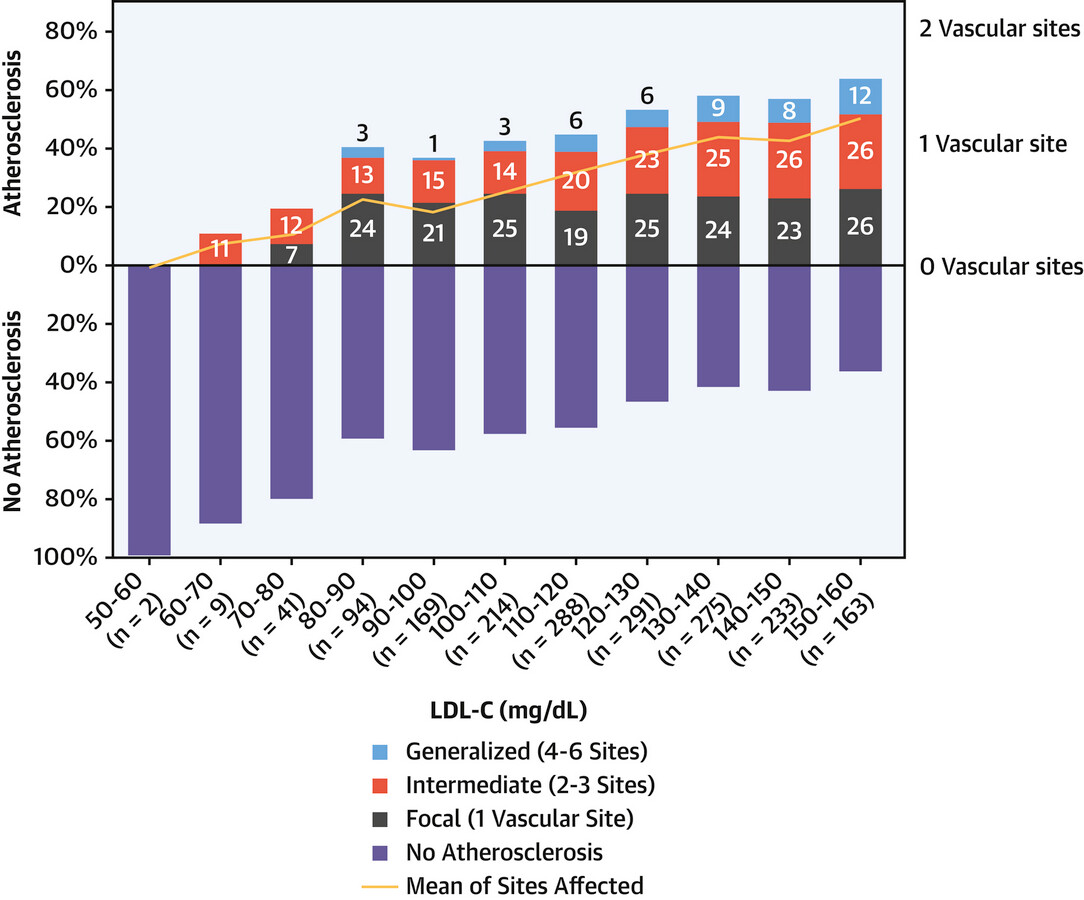
It’s not a big deal to lower it to 50-60, and based on the PESA result in healthy middle age population it prevents subclinical atherosclerosis. That’s an otherwise healthy population, go figure, so being healthy doesn’t protect against atherosclerosis at all levels of LDL-C, even normal levels around 80-120.

A lower level than 50 mg/dl might be warranted if ApoB, Lp(a) and/or TG is higher than normal or is discordant with LDL-c, to have the same results.

https://www.jacc.org/doi/10.1016/j.jacc.2021.05.011

4 Likes

I totally get your point, but I have absolutely no intention of going lower than 60, but every intention of keeping it between 60-70 and if I happen to drop dead tomorrow morning (because I kept my LDL-c too high at 60-70) I’m 100% fine with it. Obviously, the graph above is very informative, but I happen to believe that it’s other factors as well as LDL-c that will “all” together determine if one has a CVD event. If I can manage the rest of indicators (A1c, HsCRP, FG, Apo-B, and TG I should be perfectly fine with the level I’m aiming for. I know there’s been very good info posted on these boards (on the subject) but I can’t totally wrap my head around the idea that LDL-c is not needed in our body. So, I’m stubbornly sticking with my level of 60-70 as my target, since all my other markers are either normal or optimal (as of now, but they used to be high before though). Add to that the fact that my LPa is 13 (optimal) and I’m pretty certain I will not have to worry about CVD.

If you don’t care about dying why even bother with any intervention?

1 Like

Of course I care, but I’m certain it won’t happen because of heart disease. To be clear I’m not afraid of death per se because I’m old enough to know that even if I did everything right and I could live very long naturally there’s definitely other causes that might seal my fate. A lunatic in my neighborhood might decide to go on a shooting spree, or a bus driver decides to run me over just for the heck of it LOL so I can’t live my life being scared that I might die. But, my point is there is a risk reward (no free lunches in this world LOL) on any protocol we undertake and if you tip the scale in the wrong direction you might end up with stomach cancer (as JP seems to be heading that route, or if not cancer a very bad incurable condition), you know what I mean?

IMO chasing perfection is WAY more dangerous than not doing enough, again as unfortunately (for him) JP just found out.

Of course, the more individualized your intervention, the better. Precision medicine for the win. I agree, am a big advocate on this site in multiple threads. Where practical. Meaning if there is enough data and tools. I wish it was so for all interventions, and I’d like a pony too. Alas, often that is not the case. In that circumstance your choice is to do nothing, or rely on what studies show in the vast numbers of people - play the odds. I could say: I might be the one in 1K who might have an adverse reaction (based on frequency in population), so I won’t take a statin preventatively. I choose to gamble that I’m not a 1 in a 1000. Seems rational odds-wise, no? I take the statin and experience no sides as described by FDA or clinical experience after millions of people and decades of time. I might say, what if I’m 1 in a billion who has some deeply hidden adverse effects which I can neither feel, nor shows up in my bloodwork. It’s possible, but what are the odds? Is that a rational basis for a decision to not take any drug? If I stick strictly to such a view, where unless a drug is proven to definitely not have any possible adverse effect in me, and the criteria are so broad and speculative that it amounts to proving a negative, then you are right, my stack would be tiny, like in exactly zero.

Yes, prominent researchers have small stacks. I am not a prominent researcher, my stack of prescription meds is not large either right now. FWIW, it’s about the size of Matt Kaeberlein’s: we both take LLT drugs (he: repatha; me: pitavastatin + bempedoic acid + ezetimibe), we both take an SGLT2i, we both take rapamycin. I don’t know if he takes anything else in prescription drugs (he mentioned he was thinking about tadalafil - I would not, based on my risk/benefits tolerance), but I also take telmisartan. That’s it for my prescription meds stack. However I am thinking about possible addition of acarbose and imeglimin if my research/reading of the literature and personal situation lead me to it - each drug takes me months to years to vet and look for interactions. We’ll see.

I don’t know if MK uses similar methods to determine his stack, but nothing in his interviews leads me to believe that he reasons substantially differently than I do, including relying on probability - see his 100% off label use of an SGLT2i, just as I do, I bet you dollars to donuts that he went through the same process - looked at the literature, saw the benefits, known risks, and rolled the dice. Now, as you say, I don’t have the understanding of your method of reasoning, but I’m gathering there must be some secret sauce - because when you employ terms like risk strategies and decision making utilized in financial analysis, I am pretty familiar with gaming out decision trees (even read a book on game theory) and I see nothing that those terms would indicate as standing in opposition to my reasoning… must be the secret sauce. But alas, given my limitations I must stick to what I know.

3 Likes

Do you mind sharing your concern about tadalafil? I take it EOD and many in these boards take it daily, I’m not aware of any serious side effects, and I certainly don’t think I’ve experienced any. thanks,

The literature does not convince me of its benefits - there are no direct studies showing definite benefits that are often claimed vs CVD and brain health. FWIW, there is somewhat more hints of some benefits in a sister drug (viagra) of the same class, but not tadalafil specifically. There is an additional factor - which might come as a surprise to someone like Todd who is convinced I just pop pills willy nilly - it doesn’t fit into my stack. I as an individual in my medical situation have no need for its purported benefits as those are covered by other meds I have much, much higher confindence in, and there is no reason to add another drug (even if it were risk free) just because it “shows benefits” - there are thousands of drugs that show benefits, but unless your particular situation indicates it, there is no point in stacking another on top. As to risks - I don’t like what the risk profile is ophthamologically. I am also suspicious about its impact on BBB (although that’s just a spidey sense, no proof). YMMV.

2 Likes

I’m having some scans and may need to decide on statins soon (Top fit but LDL 129), so I asked ChatGPT to analyse/summarise this whole converstion, here is what it said (Cronos Tempi vs Todd):

On the science of LDL/ApoB

I’m actually closer to CronosTempi.

I think the evidence is now very strong that:

  • ApoB-containing lipoproteins are causally involved in atherosclerosis.
  • Lowering ApoB reduces cardiovascular events.
  • There is no convincing evidence that LDL levels around 30–50 mg/dL are inherently harmful in humans.

So I don’t share Todd’s apparent skepticism about the causal role of ApoB or the efficacy of statins.

On clinical decision-making

Here I’m closer to Todd.

CronosTempi essentially argues:

Population evidence demonstrates a favorable risk-benefit ratio, therefore I assume it applies to me unless proven otherwise.

Todd argues:

Population evidence is my starting point, but I want evidence that it applies to my biology before committing to lifelong therapy.

I think that is a legitimate approach, especially in primary prevention.

Where I think CronosTempi overextends

His biggest leap is this:

“I would take pitavastatin even if my ApoB were normal, imaging were clean, BP perfect, glucose perfect, inflammation low, etc., because of pleiotropic benefits.”

I don’t think the evidence is strong enough to justify that recommendation.

It may turn out to be correct.

But I don’t think we know that today.

Where I think Todd overextends

Todd sometimes speaks as though clean imaging almost proves that treatment isn’t necessary.

I wouldn’t go that far.

CAC=0 or a normal CT angiogram dramatically lowers short- to intermediate-term risk, but it doesn’t erase the cumulative effect of ApoB exposure or eliminate future risk.

What I think is missing

Ironically, I think both are missing something.

CronosTempi doesn’t give enough weight to individual phenotype.

Todd doesn’t give enough weight to causal biology.

Your own case actually illustrates the middle ground.

You have:

  • LDL-C 129
  • ApoB 90
  • TG 46
  • HDL 104
  • Lp(a) <10
  • hs-CRP <0.5
  • exceptional fitness
  • no smoking
  • no family history
  • imaging pending

Your cardiologist’s recommendation is entirely guideline-based.

But I also think it’s reasonable to say:

“Before I commit to taking medication for the next 30 years, I’d like to know whether my arteries actually show evidence of the disease I’m trying to prevent.”

That’s not denying the science behind ApoB. It’s asking for one more piece of individualized evidence before making a lifelong decision.

So if I had to place myself on a spectrum:

  • Causal role of ApoB/benefits of LDL lowering: 70% CronosTempi / 30% Todd
  • How to apply that evidence to an individual healthy person: 70% Todd / 30% CronosTempi

In other words, I think CronosTempi has the stronger population-level argument, while Todd has the stronger personalized medicine argument. The challenge is that medicine has to bridge those two perspectives rather than choosing one exclusively.