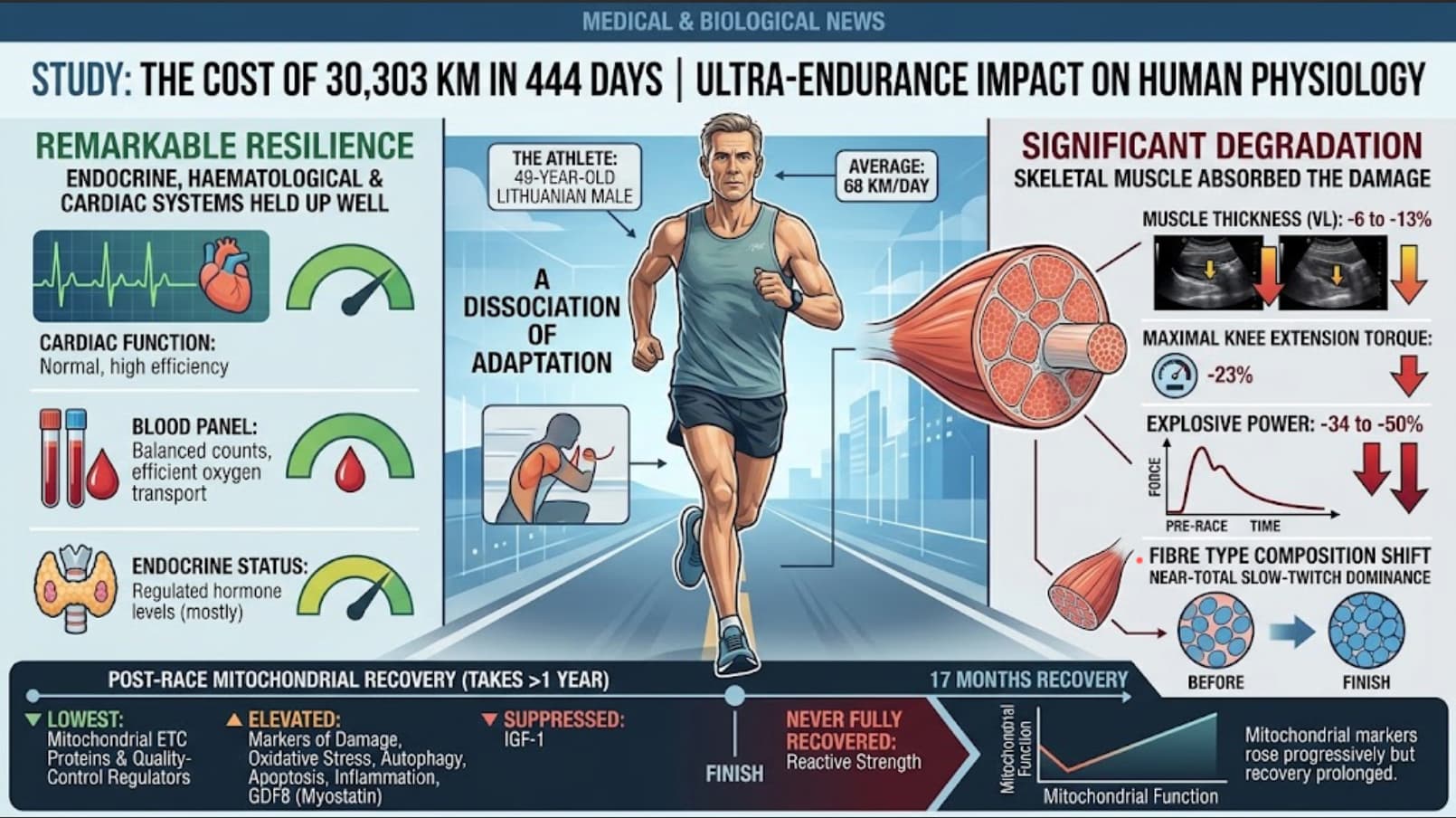
A 49-year-old Lithuanian ultra-endurance runner covered 30,303 km in 444 days, averaging 68 km per day, and a research consortium led by Lithuanian Sports University phenotyped him before, throughout, and for 17 months afterwards using muscle biopsies, ultrasonography, dynamometry, blood panels, and stool microbiome sequencing. The headline result is a dissociation: endocrine, haematological, and cardiac systems held up remarkably well, while skeletal muscle absorbed nearly all the damage. Muscle thickness fell 6 to 13 percent, maximal knee extension torque fell 23 percent, explosive power fell 34 to 50 percent, and fibre composition shifted to near-total slow-twitch dominance. Markers of muscle damage, oxidative stress, autophagy, apoptosis, and inflammation were all elevated at the finish, alongside suppressed IGF-1 and elevated GDF8 (myostatin). Mitochondrial electron transport chain proteins and mitochondrial quality-control regulators were lowest at the finish and rose progressively over the following 17 months, indicating that mitochondrial recovery from this load takes more than a year. Reactive strength never fully recovered.
A 49-year-old Lithuanian runner set out to cover 30,300 km, roughly three-quarters of the way around the planet, and did it in 444 days. That works out to 68 km a day, about nine hours of running, nearly every day, for close to fifteen months. A team based at Lithuanian Sports University tracked him the whole way and for seventeen months afterwards, taking blood at 24 timepoints, stool samples at thirteen, and four muscle biopsies from his thigh.
The big idea in their report is that the body tolerated this far better in some systems than others, and that skeletal muscle was the system that paid. Hormones held steady. Testosterone stayed at or above his pre-run level, which the authors flag as surprising, since polar expeditions and comparable extreme events usually suppress it. Red cell counts, haemoglobin, blood glucose, and heart structure all stayed within normal bounds. He lost only three kilograms, and most of that was fat.
Muscle was another story. Thigh muscle thickness fell by 6 to 13 percent depending on the site. Maximal voluntary knee extension torque dropped 23 percent. Explosive measures collapsed: jump height fell by 44 to 51 percent, and the reactive strength index, which captures how well a leg behaves like a spring, fell from 0.80 to 0.25, a 69 percent loss. His muscle became almost entirely slow-twitch, with type I fibres at 98 percent or more, leaving essentially nothing to generate speed or power.
Creatine kinase, a marker of muscle membrane damage, spiked fifteen-fold in the first month and never returned to baseline, sitting about three times above his starting level for the remainder of the event. Liver enzymes and a marker of lipid peroxidation stayed elevated too. IGF-1, an anabolic signal, was reduced at most timepoints; GDF8, better known as myostatin and a brake on muscle growth, rose. The muscle was being instructed to break down and not rebuild.
Recovery took time. Isometric strength returned to baseline by ten months. Mitochondrial proteins climbed steadily and were still rising at seventeen months, which suggests the biopsy taken at the finish caught a genuinely depleted engine rather than a transient dip. Reactive strength never came back. His gut bacteria shifted as well, with Bifidobacterium enriched during the run and Akkermansia during recovery, and those shifts persisted rather than snapping back.
One runner, no control group, no baseline biopsy. This is a description of what happened to one exceptional man, not a finding about people in general.
Actionable Insights
The lesson here is dose, not direction. Endurance running is good for you; nine hours a day of it for a year is a catabolic stimulus.
The magnitudes, expressed as percentage change from his own pre-challenge values:
- Explosive power fell 34 to 50 percent (squat jump power 40.6 to 26.9 W/kg, drop jump power 42.9 to 21.6 W/kg). Leg power normally declines roughly 3 to 4 percent per year after age 50. He lost the equivalent of about a decade of aging in fifteen months.
- Maximal isometric strength fell 23 percent (278 to 215 Nm), roughly twenty years of typical age-related decline.
- Thigh muscle thickness fell 5.5 to 12.6 percent, and thigh circumference fell 7.7 percent.
- Reactive strength, the springiness of the leg, fell 69 percent and was still 29 percent below baseline seventeen months later. This was the one thing that did not recover.
- Body fat fell from 13 to 9.7 percent during the run, then overshot to 17.1 percent at ten months, a 43 percent relative increase in fat mass above where he started.
Three practical take-homes. First, if you train high volume, keep resistance work and any form of jumping in the program; it is the fast, elastic qualities that vanish first and return last. Second, watch iron: his ferritin stayed low despite continuous oral supplementation and one intravenous infusion. Third, expect fat overshoot after a large sustained deficit and plan the return to normal eating rather than improvising it.
Context and Source
- Open Accesss Paper: Musculoskeletal (Mal)adaptations in Response to a >30 000-km Running Challenge
- Lead institution: Institute of Sport Science and Innovations, Lithuanian Sports University, Kaunas, Lithuania. Co-authoring institutions include Lithuanian University of Health Sciences (Lithuania), Örebro University and Karolinska Institutet (Sweden), and INSERM/Université de Toulouse (France).
- Journal: Journal of Cachexia, Sarcopenia and Muscle (Wiley), 2026.
- Impact evaluation: The impact score of this journal is 9.9 (2025 Journal Impact Factor; the value has ranged from 8.9 to 9.9 over 2022 to 2025), evaluated against a typical high-end range of 0 to 60+ for top general science, therefore this is a High impact journal.