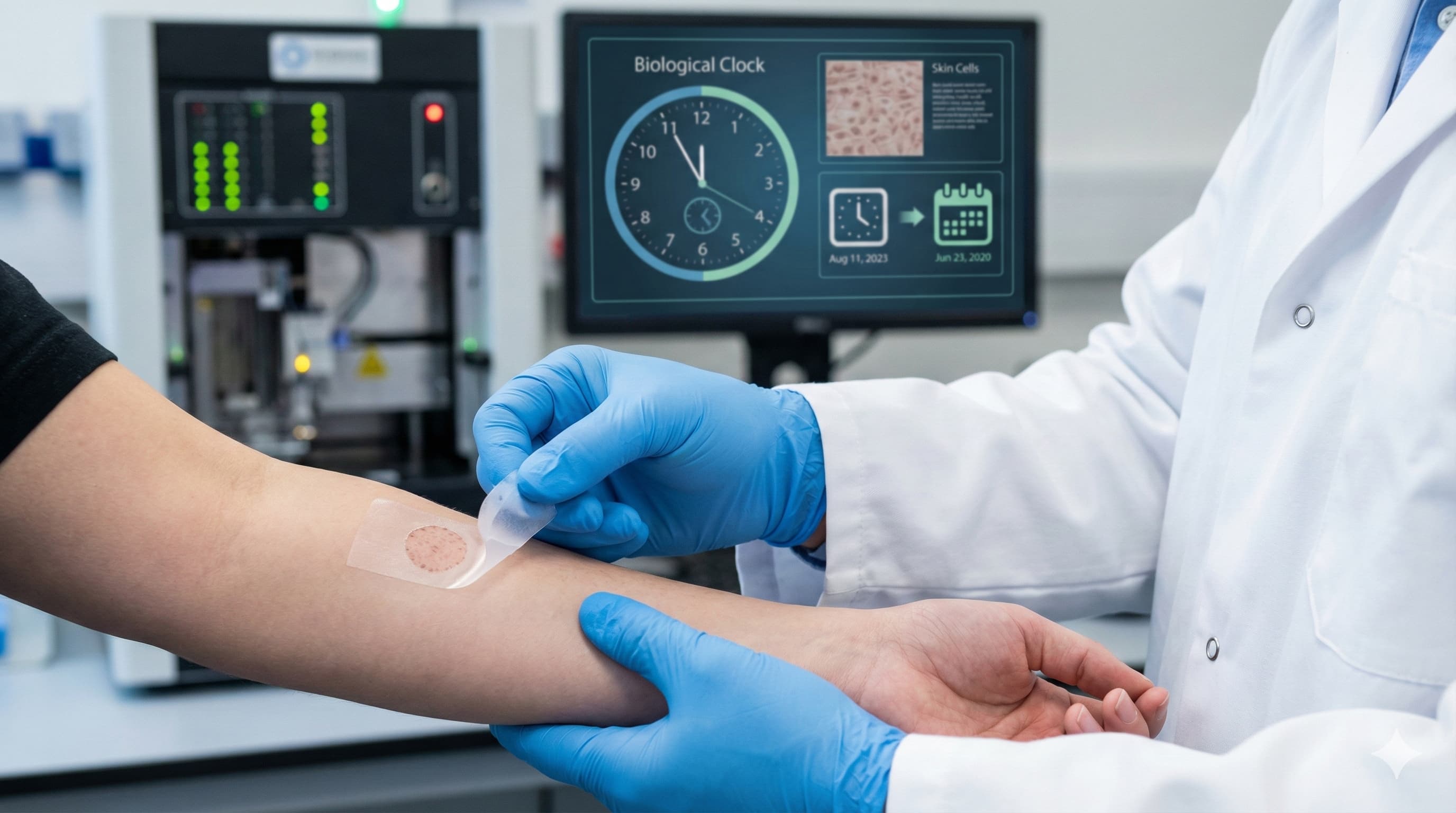
In a significant development for longevity diagnostics, researchers have developed and validated a non-invasive method to measure the biological age of human skin using nothing more than adhesive tape. Historically, assessing the “true” biological age of tissues—as opposed to just chronological age—required invasive biopsies or blood draws, which limited the ability to track organ-specific aging in real-time. This study introduces two new epigenetic clocks, MitraSolo and MitraCluster, which analyze DNA methylation patterns collected via “tape-stripping”—a painless technique that lifts cells from the skin’s surface (epidermis) using medical-grade adhesive tape.
The researchers combined this simple collection method with Enzymatic Methyl-sequencing (EM-seq), a technique superior to the traditional bisulfite sequencing because it does not damage DNA, allowing for high-quality data even from the minuscule amounts of DNA found on a piece of tape. Trained on samples from 462 individuals, the clocks demonstrated a median absolute error of approximately 4 years, a precision that rivals invasive blood-based clocks. Crucially, the team validated the clock’s ability to detect rejuvenation: when human skin cells were treated with Yamanaka factors (OSKM)—a gene therapy known to reverse cellular aging—the Mitra clocks correctly registered a decrease in biological age. This confirms the tool isn’t just measuring time; it’s measuring the biological state of aging and potential reversal.
Why It Matters For the longevity community, this represents a “liquid biopsy” moment for dermatology. It allows for the rapid, repeated testing of anti-aging interventions (like rapamycin creams, retinol, or peptides) without scarring or pain. It moves us away from subjective “before and after” photos toward hard, molecular data.
Source:
-
Open Access Paper: Epigenetic age predictors for non-invasive assessment of human skin
-
Impact Evaluation The impact score of npj Aging is approximately 4.8–5.4 (2024 JIF), evaluated against a typical high-end range of 0–60+ for top general science. Therefore, this is a Medium-High impact journal (Q1 in Geriatrics & Gerontology), reflecting a highly respectable, field-specific publication that validates the methodology before broader commercial application.
Associated Company: Mitra Bio - Website
Part 2: The Biohacker Analysis (Technical & Direct)
Study Design Specifications
-
Type: Methodological Development & Clinical Validation (Human observational + In vitro validation).
-
Subjects: Humans (n = 462 for training; independent validation cohorts).
-
Samples: Epidermal DNA collected via tape-stripping; matched full-thickness biopsies for comparison.
-
Intervention Validation: In vitro human fibroblasts treated with Yamanaka Factors (OSKM) to test the clock’s sensitivity to rejuvenation.
-
Lifespan Data: N/A (Diagnostic tool).
-
Performance: Median Absolute Error (MAE) ≈ 4 years.
-
Reproducibility: Intra-individual variation < 2 years.
Mechanistic Deep Dive
-
Epigenetic Remodeling: The clocks target specific CpG sites (cytosine-guanine dinucleotides) where methylation status correlates with age. Unlike blood clocks (Horvath/GrimAge) which reflect systemic aging, these are tissue-specific.
-
Enzymatic Methyl-sequencing (EM-seq): The study leverages EM-seq over Bisulfite Sequencing (BS-seq). BS-seq uses harsh chemicals that degrade up to 90% of DNA, making it unsuitable for low-input tape samples. EM-seq uses enzymes (APOBEC) to detect methylation, preserving DNA integrity and allowing the clock to work with the trace DNA found on tape.
-
Targeted Pathways: The specific CpG sites utilized in MitraSolo likely map to genes involved in epidermal differentiation, UV damage response, and ECM (extracellular matrix) maintenance, though the paper emphasizes the predictive power over the causative mechanism.
Novelty
-
Non-Invasive Sampling: Validates that superficial epidermis (tape) proxies the deep biological age of the skin, removing the need for 3mm punch biopsies.
-
Rejuvenation Sensitivity: Explicitly proven to detect age-reversal via partial reprogramming (OSKM), distinguishing it from clocks that only measure chronological time.
-
Cost/Scalability: EM-seq allows for “low-pass” sequencing, meaning reliable dates can be generated with fewer reads, significantly lowering the cost per test compared to deep sequencing or large arrays.
Critical Limitations
-
Organ Specificity: This is a skin clock. It does not necessarily correlate with liver, heart, or brain age. You could have “young skin” (due to sunscreen/retinol) but “old arteries.”
-
Proprietary Nature: The specific algorithm and processing pipeline are intellectual property of Mitra Bio. It is not yet an open-source tool for DIY biohackers.
-
Surface Bias: Tape stripping only captures the Stratum Corneum and upper epidermis. It may miss aging signals located deep in the dermis (collagen/elastin layer) or senescent cells residing in the subcutaneous fat.
Related Reading:
From the ARDD Presentation videos:
Cristiana Banila, Mitra Bio,Tracking skin health: non-invasive epigenetic biomarker proxies to asses intervention efficacy
AI Video Summary
Executive Summary
Christiana, representing Mitra Bio, introduces a specialized epigenetic profiling platform for the skin, addressing the “sentinel” role of the skin in human aging. Mitra Bio has developed a non-invasive tape-stripping method as a clinical alternative to painful skin biopsies. This technique captures cells from the stratum corneum down to the stratum granulosum, recovering high-quality DNA methylation data that reflects the biological “imprint” from the basal layer where cell differentiation begins.
The core achievement presented is the creation of the Mitra Solo and Mitra Cluster clocks—the first epigenetic clocks trained specifically on epidermal data. Unlike pan-tissue clocks (e.g., Horvath’s), these specific models offer tighter residuals and higher sensitivity to dermatological changes. Beyond biological age, Mitra Bio has successfully developed epigenetic proxies for visible phenotypes like wrinkles, demonstrating that by removing age-associated “noise” (like circadian genes), they can isolate biomarkers purely associated with structural skin quality.
Validation of these tools was shown through a split-face pilot study using a 1940nm non-ablative fractional laser, where the Mitra wrinkle score accurately quantified improvements on the treated side. Looking forward, the company is expanding into non-invasive melanoma stratification through an EIC-funded multi-stage clinical trial across the UK and EU, aiming to reduce unnecessary biopsies and provide rapid PCR-based cancer diagnostics.
Bullet Summary
-
Skin as a Longevity Model: Skin is the most accessible organ for tracking aging, with a global market of $130 billion driving demand for quantifiable longevity endpoints.
-
The Tape-Stripping Breakthrough: Mitra Bio’s proprietary method extracts high-quality DNA from just 5ng of input, allowing for sampling without a cold chain or invasive needles.
-
Epigenetic Imprinting: Even though surface skin cells are aucleate, they maintain the methylation marks established in the basal layer during differentiation.
-
The “Residual” Advantage: Mitra’s skin-specific clocks outperform standard epigenetic clocks in reproducibility and residual tightness for epidermal tissue.
-
Wrinkle-Only Biomarkers: By filtering out generic “aging” genes, the lab created a biomarker that correlates specifically with wrinkle severity rather than chronological age.
-
Laser Validation: In a split-face trial, the Nordlys 1940nm laser decreased the Mitra wrinkle score and slowed epigenetic aging on the treated side compared to the control.
-
Cellular Reprogramming: The clocks successfully tracked age reversal in primary keratinocytes treated with Yamanaka factors in vitro.
-
Melanoma Stratification: A major upcoming clinical milestone involves using non-invasive sampling to distinguish benign moles from melanoma, potentially saving lives through earlier, easier detection.
-
The 28-Day Lag: Biological changes (like fasting or new skincare) take approximately 28 days to show up in the sampled layer due to the skin’s natural turnover cycle.
-
Future Proxies: The lab is developing metrics for hydration (TEWL), elasticity (Cutometry), and sun damage to power decentralized clinical trials.
Claims & Evidence Table (Adversarial Peer Review)
| Claim from Video |
Speaker’s Evidence |
Scientific Reality (Best Available Data) |
Evidence Grade (A-E) |
Verdict |
| Tape-stripping captures basal methylation |
Logic of DNA maintenance through differentiation. |
Methylation patterns are highly stable during keratinocyte maturation. Li et al., 2020. |
C (Mechanistic) |
Strong Support |
| Mitra clocks are more accurate for skin than Horvath’s |
Internal benchmarking showing tighter residuals. |
Pan-tissue clocks are known to lose precision in specific tissues like the epidermis. Horvath et al., 2013. |
B (Comparative Study) |
Strong Support |
| Wrinkles can be predicted purely via epigenetics |
Model validation using laser-intervention data. |
While correlation exists, environmental factors (UV) cause stochastic damage that may be harder to capture than programmed aging. |
D (Pre-clinical/Pilot) |
Plausible (Emerging) |
| Yamanaka factors reduce epigenetic age in keratinocytes |
Benchmark against public data sets. |
Established in “partial reprogramming” literature, though clinical safety for skin remains unproven. Lu et al., 2020. |
C (In Vitro) |
Verified |
| Non-invasive melanoma testing via PCR is viable |
Upcoming multi-stage trial with Guy’s Hospital. |
Epigenetic markers for melanoma (e.g., RASSF1A) are known, but clinical sensitivity/specificity is still being validated. |
D (Ongoing Trial) |
Speculative |
Technical Deep-Dive
The Stratum Basel Imprint
The Mitra Bio technology relies on the biological fact that DNA methylation is a stable covalent modification. The DNMT (DNA Methyltransferase) activity occurs in the basal layer. As keratinocytes move upward to form the stratum corneum, they lose their nuclei, but the fragmented DNA trapped in the skin cells retains the methylation “barcode” of the parent cell.
Enzymatic Sequencing (EM-seq)
Mitra Bio uses Enzymatic Methyl-seq instead of traditional Bisulfite sequencing. EM-seq is gentler on the DNA, preventing the massive degradation associated with acid-based bisulfite treatment. This is what allows them to generate full profiles from as little as 5 nanograms of DNA.
Actionable Insights (Pragmatic & Prioritized)
Top Tier (High Confidence):
-
The 28-Day Rule: When starting a new longevity protocol (e.g., Rapamycin, Vitamin A, or Fasting), do not evaluate skin changes for at least 4 weeks. This is the minimum time required for newly “reprogrammed” basal cells to reach the surface for measurement.
-
Personalized Skincare Validation: Use epigenetic testing to determine if your expensive “anti-aging” regimen is actually reversing cellular age or just providing temporary surface hydration.
Experimental (Risk/Reward):
-
Laser for Epigenetic Rejuvenation: Non-ablative fractional lasers (like the 1940nm used in the study) may act as a “mechanical” geroprotector by inducing a wound-healing response that resets some epigenetic marks.
Avoid:
-
Ignoring Suspicious Moles: While non-invasive testing is coming, the current “Gold Standard” remains a physical biopsy. If you have a high-risk mole, do not wait for consumer epigenetic tests; see a dermatologist immediately.