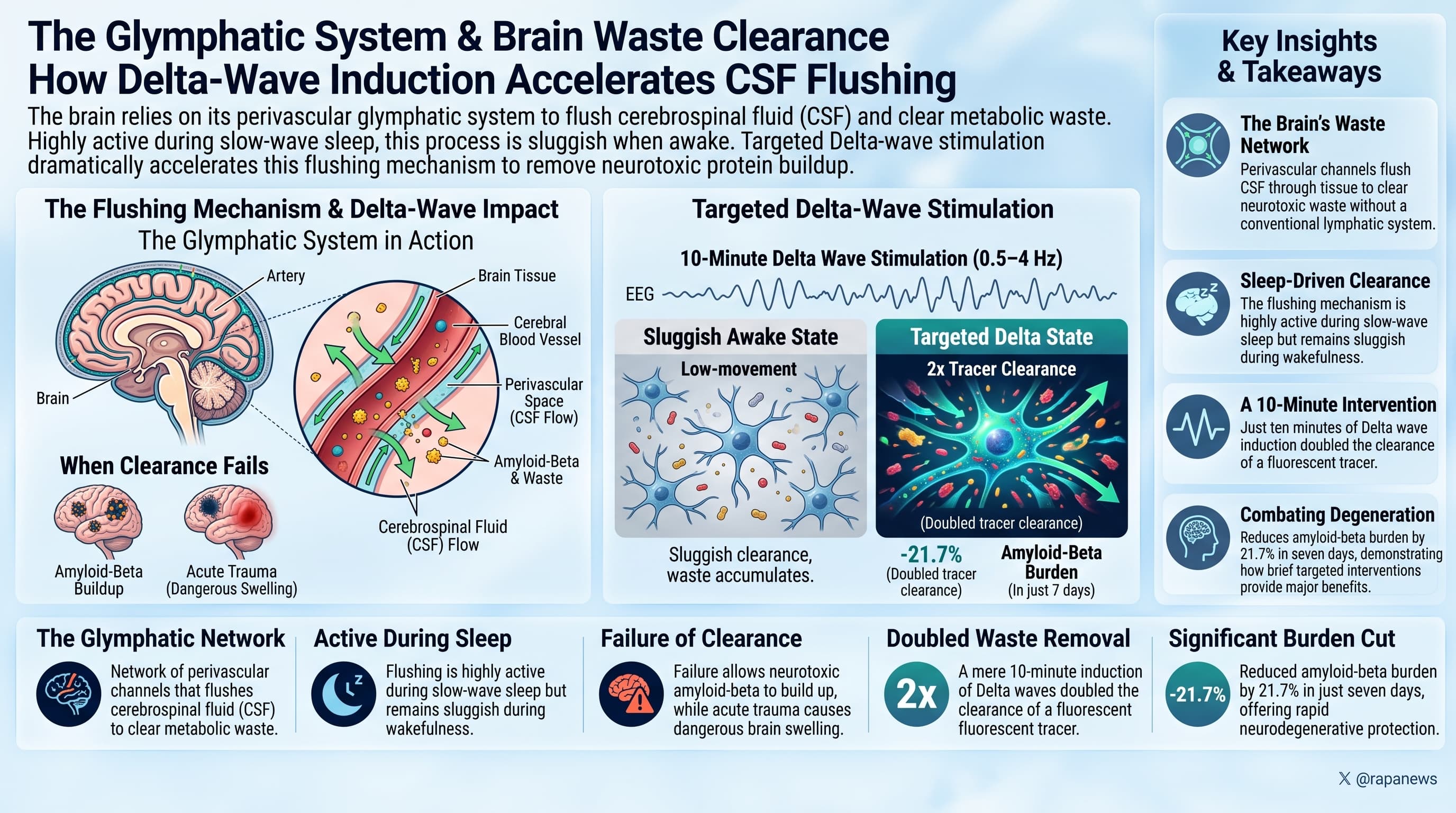
Researchers demonstrated that a 10 minute application of 40.68 MHz ultrashort wave therapy rapidly enhances glymphatic bulk flow in awake mice. This noninvasive stimulation synchronizes neuronal firing into Delta waves, polarizes aquaporin-4 channels, and significantly accelerates the clearance of neurotoxic proteins and cerebral edema in models of Alzheimer’s disease and traumatic brain injury.
The brain lacks a conventional lymphatic system to clear metabolic waste. It relies instead on the glymphatic system, a network of perivascular channels that flushes cerebrospinal fluid through brain tissue. This flushing mechanism is highly active during slow-wave sleep but remains sluggish during wakefulness. When this system fails, neurotoxic proteins like amyloid-beta accumulate, accelerating neurodegeneration. In acute injuries like head trauma, impaired glymphatic clearance leads to rapid, dangerous brain swelling.
Researchers recently investigated whether electromagnetic stimulation could manually override this sleep-dependent cleaning cycle. They utilized a 40.68 MHz ultrashort wave therapy device to treat mice. Within just ten minutes of noninvasive exposure, the animals exhibited a massive surge in Delta wave neuronal synchronization. Delta waves (0.5 to 4 Hz) are the low-frequency brain oscillations typically only seen during deep, restorative sleep.
This electrically induced pseudo-sleep state triggered a structural shift in the brain’s plumbing. Specifically, it caused aquaporin-4 (AQP4) water channels located on the endfeet of astrocytes to polarize and align along blood vessels. This alignment is the critical bottleneck for fluid exchange in the central nervous system. By forcing these channels into their optimal configuration, the ultrashort wave treatment doubled the rate of metabolic waste clearance into the cervical lymph nodes. The research team proved this mechanism by utilizing chemogenetics to silence hippocampal neurons; when neuronal firing was suppressed, the ultrashort waves could no longer enhance glymphatic flow. Furthermore, when they pharmacologically blocked the AQP4 channels using the drug TGN-020, the clearance benefits completely vanished.
The therapeutic effects were substantial across two distinct disease models. In a mouse model of traumatic brain injury, applying the waves immediately after the trauma significantly reduced acute brain swelling and improved subsequent motor recovery. In a genetic mouse model of Alzheimer’s disease, ten minutes of daily treatment for seven days reduced amyloid-beta plaque accumulation by over twenty percent. This plaque reduction correlated with a major improvement in spatial memory performance.
The central paradigm shift here is the decoupling of glymphatic clearance from actual sleep. While previous interventions like 40 Hertz light flickering required hours of daily exposure to achieve similar results, this method achieved structural fluid dynamic changes in a fraction of the time. The preliminary data strongly suggests that manipulating brain wave states via physical modalities can directly control the organ’s waste disposal infrastructure.
Actionable Insights
While 40.68 MHz ultrashort wave devices are not yet calibrated or approved for human cognitive enhancement, the underlying biological principles offer immediate value. The study proves that Delta wave synchronization is the master switch for polarizing AQP4 water channels and flushing brain waste.
For individuals seeking to maximize brain clearance, optimizing deep slow-wave sleep remains the most validated natural intervention. Biohacking interventions that reliably increase Delta wave power during sleep (such as aggressive bedroom temperature regulation, acoustic pink noise stimulation, and vigorous cardiovascular exercise) directly support this exact glymphatic mechanism. Furthermore, emerging neurotechnology such as EEG-guided neurofeedback or targeted transcranial electrical stimulation may eventually allow users to explicitly trigger these Delta-dominant brain states on demand.
The absolute effect sizes observed in this study highlight the sheer volume of waste the brain can move when properly stimulated. A mere 10-minute induction of Delta waves doubled the clearance of a fluorescent tracer and reduced amyloid-beta burden by 21.7% in just seven days. This demonstrates that even brief, targeted interventions that increase low-frequency neuronal synchronization yield compounded, clinically significant benefits for neurodegenerative disease prevention.
Context and Source
- Title: Noninvasive ultrashort wave neuromodulation enhances glymphatic clearance to alleviate traumatic brain edema and Alzheimer’s pathology
- Institution: Chinese PLA General Hospital
- Country: China
- Journal: Science Advances
- Impact Evaluation: The impact score of this journal is 11.7, evaluated against a typical high-end range of 0–60+ for top general science, therefore this is a High impact journal.