Every human being alive today is the product of a biological miracle that geroscience has largely ignored: you began life biologically young, even if your mother was forty. Somewhere in the chain of events between egg and embryo, decades of accumulated molecular damage were erased and reset to zero. A new essay published in PLoS Biology argues that understanding precisely how the oocyte pulls off this trick may be the most underexploited opportunity in aging research.
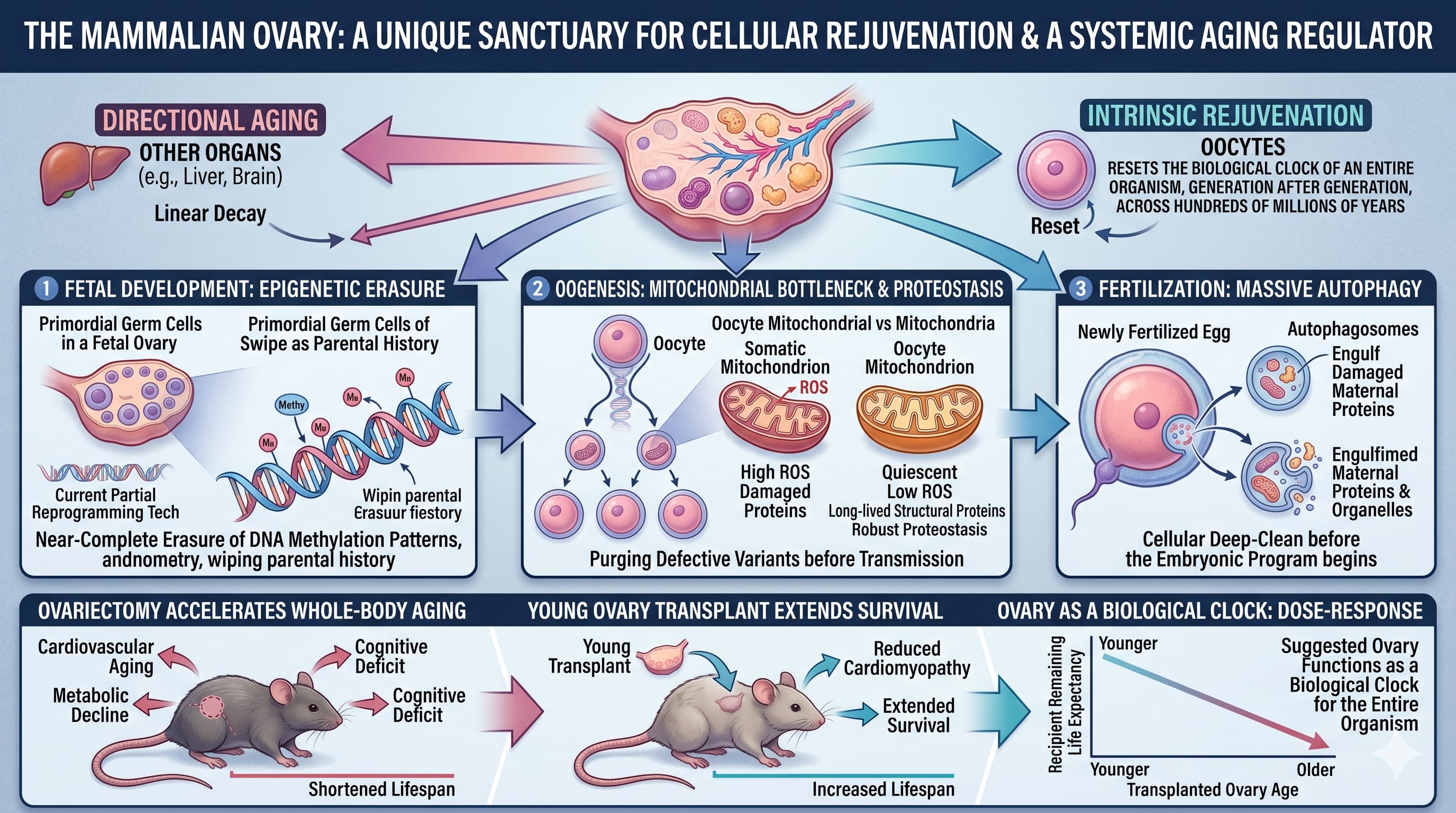
The case made by Priscila Chiavellini and Vittorio Sebastiano of UC Irvine and Stanford University is deceptively simple: the mammalian ovary is the only adult tissue in the body that naturally preserves a complete, intrinsic capacity for cellular rejuvenation. Every other organ ages in one direction. The oocyte routinely does something no somatic cell can — it resets the biological clock of an entire organism, generation after generation, across hundreds of millions of years of vertebrate evolution.
The mechanism is not a single switch. It operates across three interlocking layers. First, when primordial germ cells form during fetal development, they undergo near-complete erasure of DNA methylation patterns — wiping parental epigenetic history and re-establishing a youthful regulatory landscape from scratch. This is deeper and more comprehensive than anything achieved by current partial reprogramming technologies. Second, oocyte mitochondria are subject to a rigorous genetic bottleneck during oogenesis: only a subset of mitochondrial genomes is amplified, purging defective variants before transmission. These mitochondria remain quiescent, low in reactive oxygen species, and are enriched with exceptionally long-lived structural proteins — a proteostatic strategy unlike anything found in somatic cells. Third, at the moment of fertilization, autophagy is massively upregulated to clear damaged maternal proteins and organelles, completing a cellular deep-clean before the embryonic program begins.
The essay goes further. It proposes that the ovary is not merely a source of rejuvenating cells — it is a systemic aging regulator for the whole female body. Ovariectomy in mice accelerates cardiovascular, metabolic, and cognitive aging and shortens lifespan. The inverse experiment — transplanting young ovaries into aged, ovariectomized mice — extends survival and reduces cardiomyopathy. Critically, each additional month of age of the transplanted ovary reduced the recipient’s remaining life expectancy in a dose-response relationship, suggesting the ovary functions as a kind of biological clock for the entire organism.
The translational implications, while still largely speculative, are real: extending ovarian healthspan may not be a reproductive intervention. It may be a systemic one.
Actionable Insights
This is a conceptual essay, not an interventional trial, so direct clinical translation is premature. That said, several evidence-backed signals are worth tracking.
Ovarian healthspan is systemic healthspan in women. The data from mouse ovariectomy and transplant studies — while not directly translatable — make a strong case that preserving ovarian function beyond natural menopause, or preserving its signaling output, matters for cardiovascular, metabolic, and cognitive trajectories well beyond fertility. Hormone replacement therapy remains the most accessible proxy, but the essay argues the active ovarian secretome extends far beyond classical estrogens and progestins. Non-hormonal ovarian factors are understudied and underutilized.
The ovarian stroma is an emerging therapeutic target. A 2026 Science paper cited in this essay showed that the anti-fibrotic drug finerenone restores fertility in premature ovarian insufficiency — framing ovarian fibro-inflammaging as a modifiable process, not an inevitable one. For clinicians and biohackers, this signals that anti-fibrotic and anti-inflammatory strategies may have reproductive and systemic aging benefits beyond their current indications.
Autophagy and mitochondrial quality control are the oocyte’s core tools. The essay reinforces that timed autophagy induction and mitochondrial bottleneck selection are how nature achieves rejuvenation. This aligns with existing longevity interventions targeting these pathways — fasting protocols, mitophagy inducers, urolithin A — though none replicate the germline’s precision. Understanding the oocyte’s molecular toolkit may yield better targets for somatic interventions.
Source:
- Open Access Paper: From germline immortality to somatic rejuvenation: Unlocking the ovarian blueprint for longevity
- Institution: University of California, Irvine (Center for Epigenetics and Metabolism; Stem Cell Research Center) and Stanford University (Department of Obstetrics and Gynecology; Institute for Stem Cells Biology and Regenerative Medicine)
- Country: United States of America Journal: PLOS Biology
- Impact Evaluation: The impact score of this journal is 7.2 (Journal Impact Factor, 2025; CiteScore 14.9), this is a High impact journal and is among the most selective in its tier.