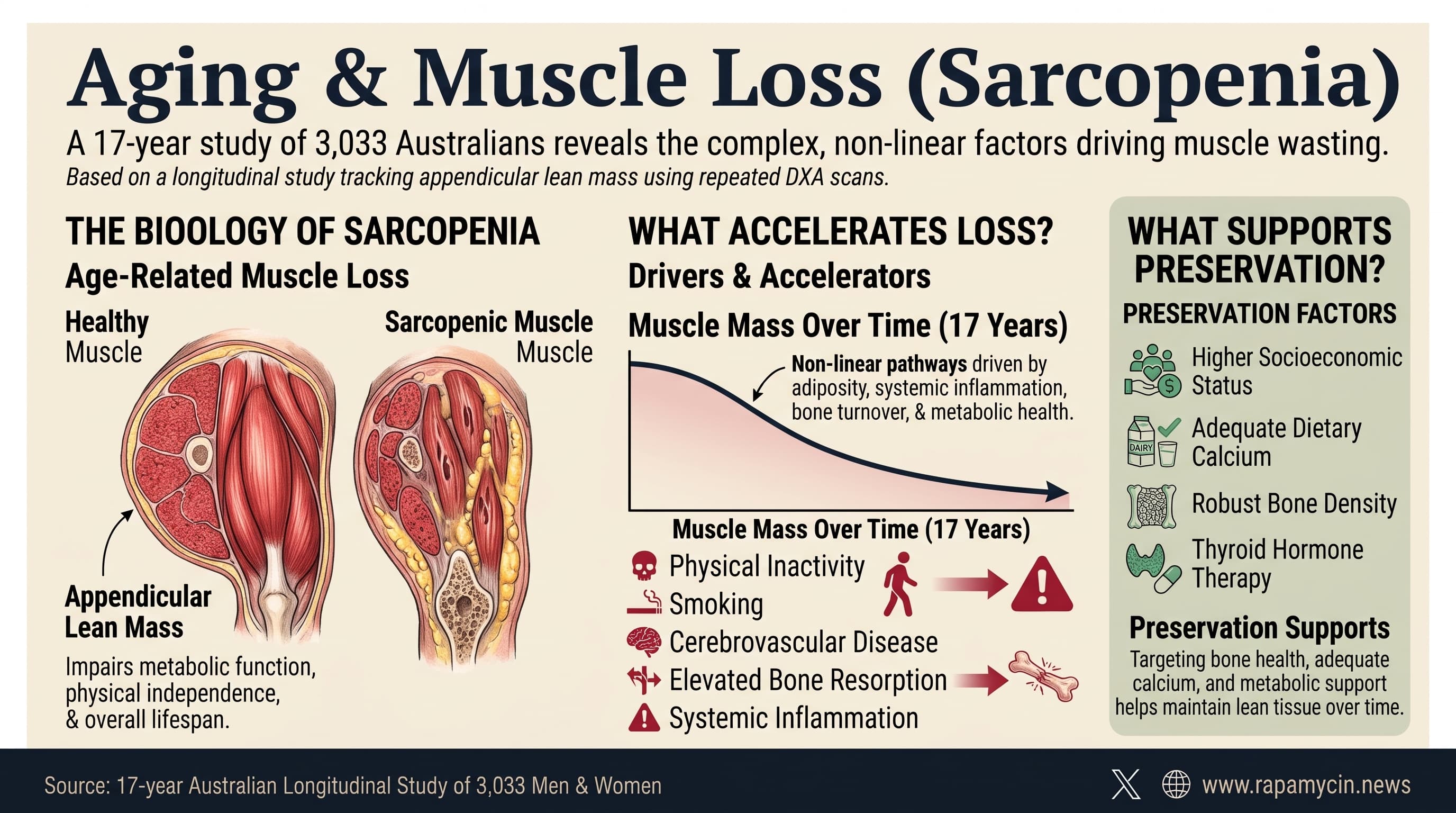
Age-related muscle wasting, known as sarcopenia, impairs metabolic function, physical independence, and overall lifespan. In a 17-year longitudinal study evaluating 3,033 Australian men and women, researchers tracked appendicular lean mass using repeated dual-energy X-ray absorptiometry scans. The analysis showed that muscle loss follows non-linear pathways driven by complex interactions between adiposity, systemic inflammation, bone turnover, and metabolic health. Physical inactivity, smoking, cerebrovascular disease, and elevated bone resorption accelerated muscle loss. Conversely, higher socioeconomic status, adequate dietary calcium, robust bone density, and thyroid hormone therapy supported the preservation of lean tissue.
Preserving skeletal muscle mass is one of the most reliable strategies for extending human healthspan. As muscle atrophies, metabolic efficiency declines, glucose clearance drops, and the risk of physical frailty rises. Sarcopenia is widely recognized as a major geriatric syndrome, yet medical science has struggled to map out the long-term, moving variables that determine who maintains muscle into late adulthood and who wastes away. Most existing studies rely on single-point, cross-sectional snapshots that fail to account for how biological markers and lifestyle shifts interact over decades.
To address these gaps, researchers analyzed data from the Geelong Osteoporosis Study, tracking 3,033 community-dwelling adults aged 20 to 96 across an average duration of nearly 17 years. By performing repeated whole-body dual-energy X-ray absorptiometry scans, the investigators tracked changes in appendicular lean mass, the muscle tissue located in the arms and legs. They applied time-varying linear mixed models to determine how dynamic changes in lifestyle, blood biochemistry, body composition, and disease states govern muscle preservation over time.
The findings confirm that muscle loss is not a steady, uniform slide. While chronological age and female biological sex predicted lower overall lean mass, the longitudinal trajectory showed distinct non-linear dynamics. Physical inactivity imposed an immediate penalty, correlating with a sustained reduction in lean mass. Tobacco exposure and a history of stroke similarly accelerated tissue depletion. Conversely, higher dietary calcium intake and greater femoral neck bone mineral density were independently associated with preserved muscle volume.
The study also revealed the nuanced relationship between body fat and muscle. While higher body mass index initially showed a positive association with lean mass due to larger absolute skeletal size, isolating dual-energy X-ray-measured fat mass revealed a different outcome. Increasing adiposity was steadily associated with progressive muscle loss, supporting the clinical definition of sarcopenic obesity, where excess adipose tissue exerts catabolic, lipotoxic strain on neighboring muscle beds.
Biochemical markers told a matching story. High-sensitivity C-reactive protein, a standard marker of systemic inflammation, displayed a U-shaped association with lean mass, while elevated levels of C-terminal telopeptide, a marker of bone breakdown, mirrored a continuous downward trend in muscle mass. Furthermore, participants receiving thyroid hormone treatment maintained higher lean mass, highlighting the essential role of endocrine regulation in sustaining skeletal muscle.
Ultimately, the study demonstrates that muscle retention in aging is governed by an integrated network of systemic forces. Preventing sarcopenia requires moving past crude weight metrics to simultaneously address chronic low-grade inflammation, skeletal turnover, physical activity, and visceral adiposity.
Actionable Insights
Sustaining muscle mass requires an integrated lifestyle strategy focused on metabolic, skeletal, and endocrine health. The practical takeaways from this 17-year cohort include:
-
Remain physically active: Eliminating physical inactivity preserves approximately 0.48 kg of limb muscle, representing a standardized effect size of 0.084 standard deviations (roughly 2.2% of average adult limb mass).
-
Meet dietary calcium requirements: An increase of 1.0 gram per day of dietary calcium associates with 0.46 kg greater lean mass, yielding an effect size of 0.081 standard deviations (a 2.1% preservation effect).
-
Control adiposity: High fat mass drives non-linear muscle wasting. Preventing excess fat accumulation eliminates the metabolic penalties of sarcopenic obesity.
-
Screen bone turnover and inflammation: Manage chronic systemic inflammation (hsCRP) and elevated bone resorption (CTx), as high bone breakdown correlates with a 1.0 to 2.0 kg loss in limb mass across extreme biological ranges.
-
Treat thyroid dysregulation: Monitored thyroid hormone replacement in clinical deficiency associates with a 0.52 to 0.75 kg lean mass advantage (effect size 0.091 to 0.132 standard deviations).
Individual lifestyle modifications demonstrate modest single-variable effect sizes (under 0.15 standard deviations), confirming that preserving muscle across decades requires their simultaneous combination.
Context/Source
- Open Access Paper: Long-Term Determinants of Lean Mass in Ageing Adults: A 17-Year Longitudinal Cohort Study With Repeated Measures
- Institutions: Deakin IMPACT (The Institute for Mental and Physical Health and Clinical Translation), School of Medicine, Deakin University, Geelong, Victoria, Australia; Barwon Health, Geelong, Victoria, Australia; School of Public Health and Preventive Medicine, Monash University, Melbourne, Victoria, Australia
- Country: Australia
- Journal Name: Australasian Journal on Ageing
- Impact Evaluation: The impact score of this journal is 1.8, evaluated against a typical high-end range of 0–60+ for top general science, therefore this is a Low impact journal.