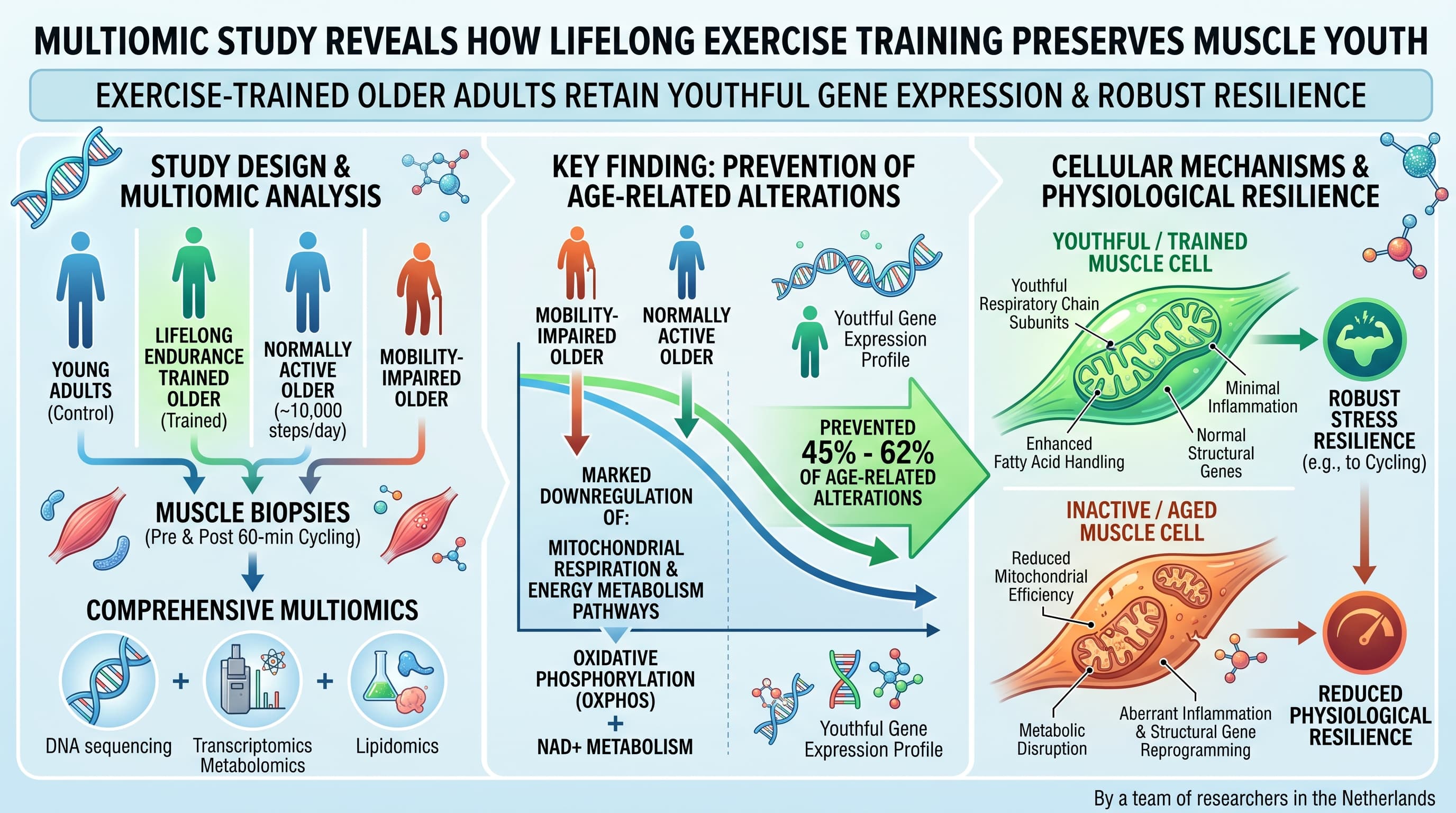
A multiomic study reveals that lifelong exercise training prevents more than half of the normal age-related transcriptional alterations in human skeletal muscle. While inactive aging results in a marked downregulation of mitochondrial respiration and energy metabolism pathways, exercise-trained older adults retain a youthful gene expression pattern and exhibit robust physiological stress resilience when challenged with acute physical exertion.
Narrative Skeletal muscle undergoes an unrelenting functional decline over time, typically characterized by loss of mass, reduced mitochondrial efficiency, and metabolic disruption. A team of researchers in the Netherlands evaluated how sustained physical training interacts with these cellular aging pathways. They recruited young adults alongside three groups of older adults: individuals who engaged in structured endurance training for years, normally active individuals who matched the young cohort in daily steps, and mobility-impaired individuals. Muscle biopsies taken before and after a 60-minute stationary cycling test were subjected to comprehensive transcriptomics, metabolomics, and lipidomics.
The big discovery centers on the divergence between passive aging and muscular health. Sedentary behavior did not drive the primary baseline defects in older muscle; even older individuals taking approximately 10,000 steps per day showed marked declines in genes governing cellular respiration, oxidative phosphorylation, and NAD metabolism. However, in trained older adults, between 45% and 62% of these classic aging alterations were completely absent. Their muscle tissue displayed youthful levels of mitochondrial respiratory chain subunits, enhanced fatty acid handling, and a lack of aberrant inflammatory and structural gene reprogramming.
Furthermore, the molecular response to an acute bout of physical exercise served as a diagnostic test of biological resilience. Exercise triggered a burst of protective cellular stress pathways, including heat shock factors and transient cytokine expression. The vigor of this response was directly proportional to baseline fitness: highly trained older adults mounted an acute stress signal that closely matched the profile observed in young adults, whereas physically impaired individuals failed to activate these essential homeostatic repair mechanisms. Integrating these multiomic datasets also uncovered an unexpected negative association between ubiquitin-mediated protein degradation pathways and intracellular NAD pools, which was confirmed in cell models where proteasomal inhibition directly elevated NAD concentrations.
These findings reshape the narrative surrounding muscle aging. A large fraction of what clinical medicine has historically accepted as inevitable metabolic decay represents an avoidable consequence of sub-optimal physical conditioning. While specific neurodevelopmental shifts and synaptic alterations continue to unfold with age regardless of fitness, the bioenergetic collapse of skeletal muscle can be substantially prevented through chronic, structured exercise.
Actionable Insights
Maintaining regular, structured endurance training preserves cellular energy production into late life. Casual daily walking is insufficient to safeguard mitochondrial capacity; older participants logging 9,600 steps per day still experienced widespread bioenergetic decline, whereas individuals completing at least three 1-hour structured exercise sessions weekly maintained youthful muscle profiles.
The magnitude of this protective benefit is substantial. Exercise prevented 55.9% of normal age-related gene upregulations and 57.1% of age-related gene downregulations. For mitochondrial respiratory complex I and complex V gene expression, training kept median transcript counts within approximately 5% to 10% of young levels, contrasting with a 30% to 50% decrease seen in untrained older adults. Standardized effect sizes across respiration markers and clinical stamina indices between trained and untrained individuals regularly exceeded 1.2 standard deviations (Cohen’s d).
Practical guidance highlights the necessity of reaching genuine cardiovascular exertion rather than merely accumulating low-intensity steps. In addition, practitioners must be cautious with non-specific, long-term anti-inflammatory interventions: the transient inflammatory and stress response provoked by exercise is an indispensable signal that drives tissue remodeling and cellular resilience in aging muscle.
Context/Source
- Paywalled Paper: Delayed molecular aging, preservation of energy metabolism and enhanced exercise response in exercise-trained human muscle
- Principal Institutions: Amsterdam UMC, University of Amsterdam; Maastricht University Medical Center+
- Country: The Netherlands
- Journal: Nature Aging
- Impact Evaluation: The impact score of this journal is 25.0, evaluated against a typical high-end range of 0 to 60+ for top general science, therefore this is an Elite impact journal.