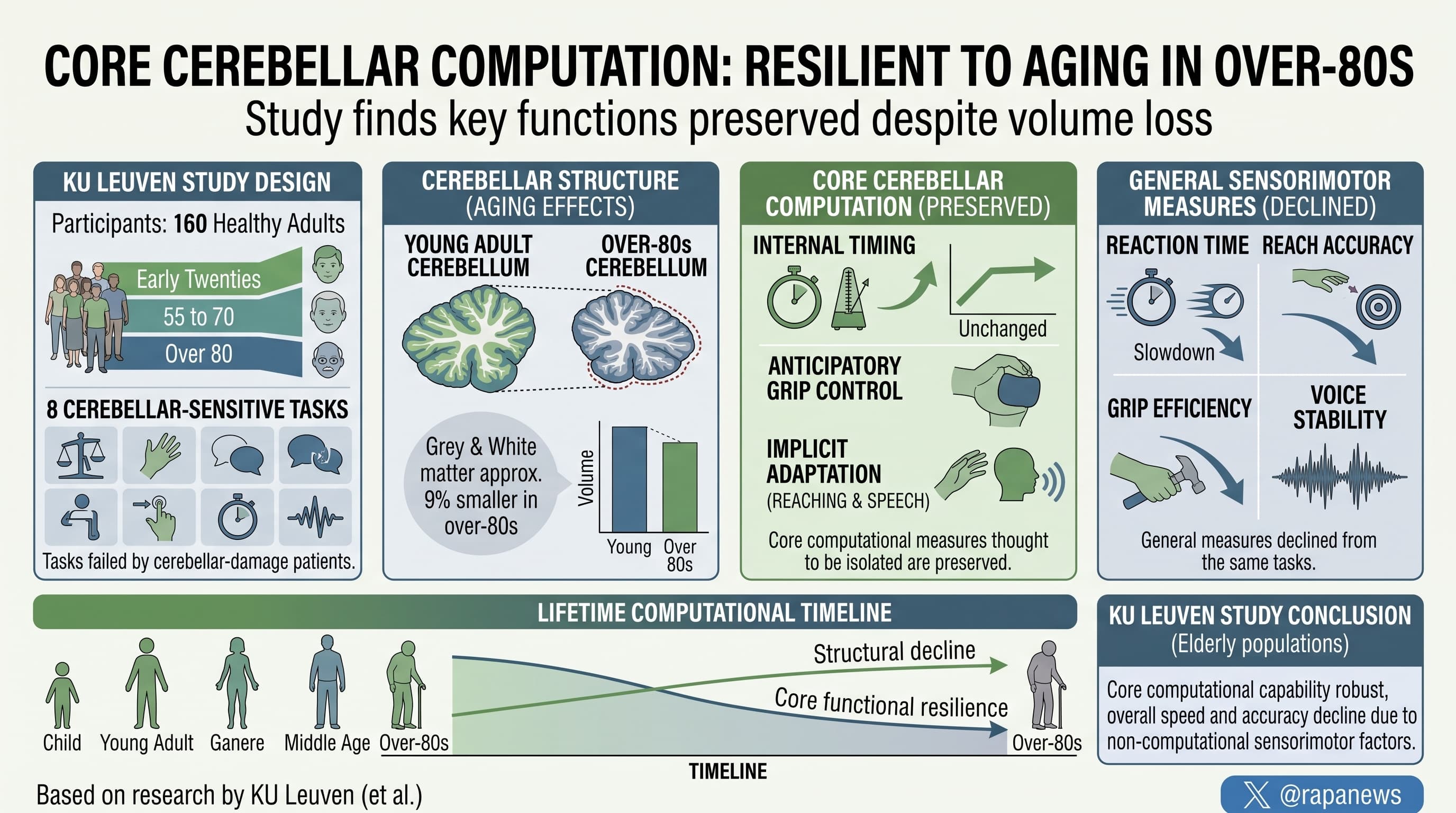
A KU Leuven team tested 160 healthy adults in three age bands (early twenties, 55 to 70, and over 80) on eight tasks chosen because patients with cerebellar damage fail them. Cerebellar grey and white matter were about 9 percent smaller in the over-80s than in the young. Even so, the measures thought to isolate cerebellar computation (internal timing, anticipatory grip and shoulder control, implicit adaptation of reaching and speech) were unchanged or slightly better with age. What declined were general sensorimotor measures taken from the same tasks, such as reaction time, reach accuracy, grip efficiency and voice stability. The exceptions were mental rotation speed in the over-80s and eye movement coordination in the 55 to 70 group.
Brain scans of older people show a cerebellum that is visibly smaller than it was in youth, and the usual assumption is that balance, coordination and motor learning suffer as a direct result. A study published in eLife argues that this assumption is wrong for most of what the cerebellum actually does.
The researchers recruited 50 young adults, 80 adults aged 55 to 70, and 30 people over 80. Each completed about five hours of testing across seven motor tasks and one cognitive task, plus an MRI scan. The tasks were picked from the clinical literature on cerebellar disease: tapping a rhythm after the metronome stops, tightening grip just before an object’s load changes, firing the shoulder muscle ahead of an elbow movement, tracking a target with the eyes, matching a force on one’s own finger, and unconsciously adapting reaches and vowel sounds to distorted feedback.
The design feature that sets the study apart is that every task yielded two numbers. One was meant to capture the cerebellum’s specific contribution, usually a prediction or timing signal. The other captured overall sensorimotor performance on the same task.
The two sets of numbers diverged. On the cerebellar measures, older adults matched the young, and Bayesian statistics gave positive evidence of no decline for most of them. Internal clock variability was no worse. Grip force still led load force. The shoulder still anticipated the elbow. Implicit reach adaptation was slightly larger in the old. Older adults also showed stronger sensory attenuation of self-generated touch, which the authors read as heavier reliance on cerebellar prediction to offset noisier sensation.
On the general measures, age showed clearly. Choice reaction time was 24 percent slower at 55 to 70 and 79 percent slower past 80. The over-80s gripped with more than twice the force of the young, reached less accurately and had far more unstable voices.
Meanwhile, the MRI confirmed the expected shrinkage: cerebellar grey matter was 4.6 percent smaller in the older group and 9 percent smaller in the over-80s.
The authors interpret this as a cerebellar reserve, meaning that the circuit has enough redundancy to lose tissue without losing function. That is an inference. The study did not measure brain activity, and it did not test whether individuals with smaller cerebellums performed worse.
Two results cut against a clean story. Mental rotation, the one cognitive task, slowed by 37 percent in the over-80s. And coordination between smooth pursuit and saccadic eye movements was weaker in the 55 to 70 group; the over-80s were not tested on this.
The study is cross-sectional and its volunteers were healthy, cognitively screened and able to sit through five hours of testing. The over-80 group averaged just under 82. The finding is that well-functioning older people retain cerebellar-type motor prediction and learning. It does not show that everyone does, or that it lasts indefinitely.
Actionable Insights
This is an observational study with no intervention, so there is nothing to take or do on its basis. It does change how to read some signals about ageing.
- A smaller cerebellum on MRI did not mean worse cerebellar function. Grey matter was 9 percent lower past 80, a very large group difference statistically, with no matching functional loss on most measures.
- Unconscious motor learning held up. Reach adaptation was 13 to 15 percent larger in older groups than in the young. This supports the view that learning new movement skills stays feasible late in life, though the study did not test training.
- The real losses were elsewhere. Reaction time slowed by about 0.2 seconds at 55 to 70 and about 0.6 seconds past 80. Grip force rose from 2.7 to 6.1 newtons for the same object. Reach error roughly tripled. These are large effects.
- Internal timing did not degrade. Rhythm-keeping variability was about 12 percent lower in older adults.
- Fast spatial reasoning did slip in the over-80s, by 37 percent in speed, with accuracy falling from 93 to 81 percent.
If one wanted to target what actually declines, the data point toward reaction speed, sensory acuity and movement precision, and away from the predictive timing machinery. That is a reasonable inference from the data, not a tested recommendation.
Context/Source
- Open Access Paper: Preserved cerebellar functions despite structural degeneration in older adults
- Institutions: Department of Movement Sciences and Leuven Brain Institute, KU Leuven; Waisman Center and Department of Communication Sciences and Disorders, University of Wisconsin-Madison.
- Countries: Belgium and United States
- Journal: eLife
- Impact evaluation: eLife has no current Journal Impact Factor.