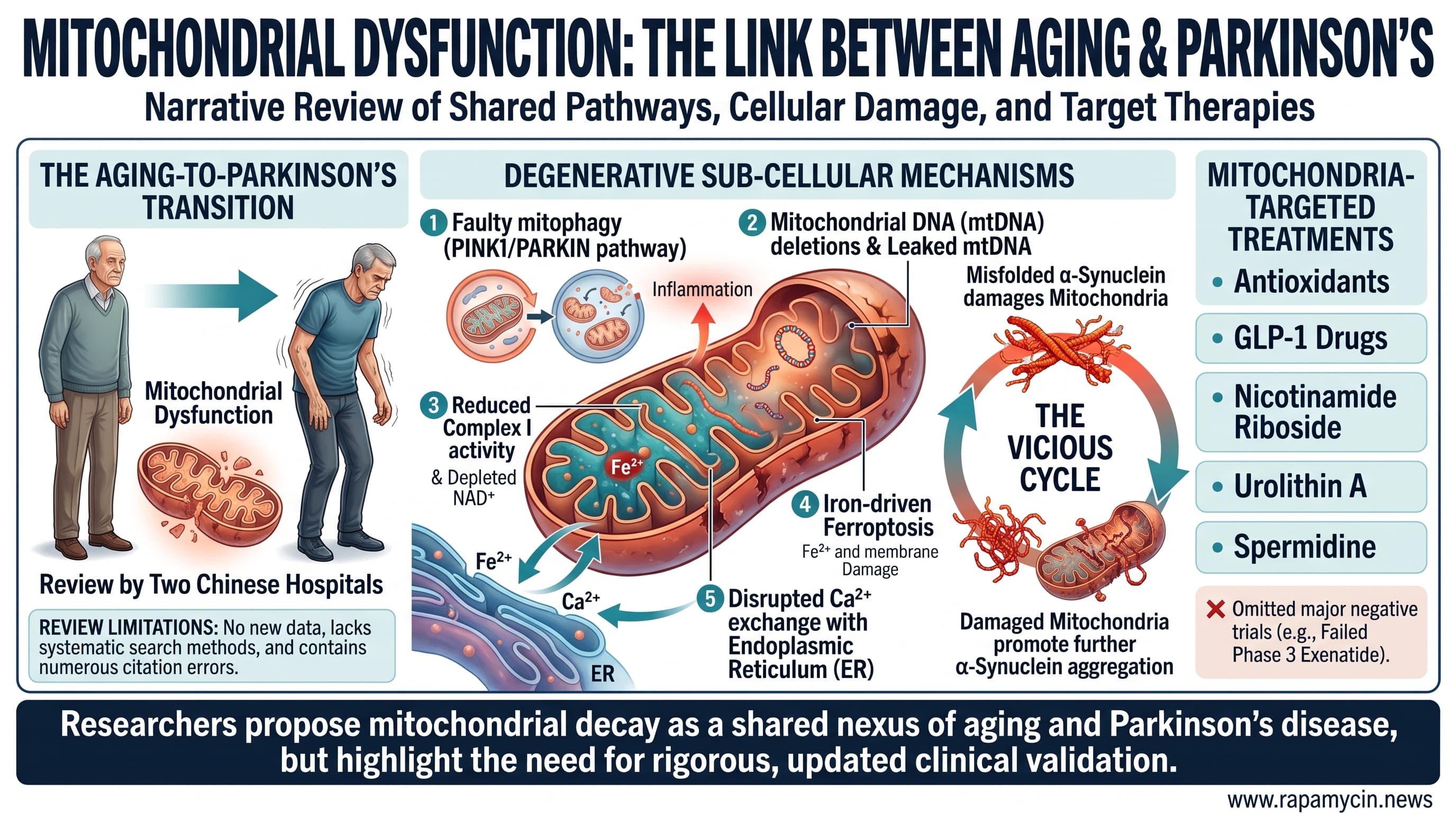
This narrative review from two Chinese hospitals argues that mitochondrial dysfunction is a shared mechanism linking normal aging to Parkinson’s disease. The authors summarize evidence that both conditions involve faulty mitochondrial quality control through the PINK1/PARKIN mitophagy pathway, along with accumulating mitochondrial DNA deletions, reduced Complex I activity and depleted NAD+. They also describe disrupted calcium exchange with the endoplasmic reticulum, iron-driven ferroptosis and inflammation triggered by leaked mitochondrial DNA. They describe a vicious cycle in which misfolded alpha-synuclein damages mitochondria, which in turn promotes more alpha-synuclein aggregation. A short final section lists mitochondria-targeted treatments, including antioxidants, GLP-1 drugs, nicotinamide riboside, urolithin A and spermidine.
Age is the strongest risk factor for Parkinson’s disease. Prevalence roughly triples between the late 60s and the 80s. That raises a natural question: does Parkinson’s represent an accelerated or derailed version of something that happens to every aging brain? A new review in Frontiers in Aging Neuroscience argues that the answer lies largely inside our mitochondria.
Dopamine neurons in the substantia nigra are extraordinary energy consumers. Each one sends out a sprawling axonal network with hundreds of thousands of connections and fires continuously in a rhythmic pattern that draws heavily on calcium. That combination makes them unusually dependent on healthy mitochondria and unusually vulnerable when mitochondria falter.
The review walks through the ways mitochondria decline with age and the matching problems seen in Parkinson’s. Damaged mitochondria are normally tagged for disposal by two proteins, PINK1 and PARKIN, in a recycling process called mitophagy. Mutations in either gene cause inherited early-onset Parkinson’s. Mitochondrial DNA accumulates deletions over a lifetime, and these deletions are especially common in the substantia nigra of people with Parkinson’s. The first step of the energy-producing chain, Complex I, loses activity with age and is markedly impaired in Parkinson’s brains. Toxins that block Complex I, such as MPTP and the pesticide rotenone, can produce parkinsonism in humans and animals.
The authors also describe newer threads. Iron accumulates in the aging substantia nigra and can drive ferroptosis, an iron-dependent form of cell death. Mitochondrial DNA that leaks out of damaged organelles can trigger inflammatory alarms in microglia, the brain’s immune cells. Misfolded alpha-synuclein, the protein that clumps into Lewy bodies, binds to mitochondria and impairs them. Damaged mitochondria in turn promote more misfolding.
This is a coherent and largely mainstream picture, and the mitochondrial hypothesis of Parkinson’s has strong roots in human genetics and toxicology. The weaker part of the review is its treatment section. It presents GLP-1 receptor agonists such as exenatide as promising without mentioning that the large phase 3 Exenatide-PD3 trial, published in early 2025, found no benefit. It lists the mitochondria-targeted antioxidant MitoQ as tested in a clinical trial without noting that the trial was negative. It omits the 2022 FAIRPARK-II trial, in which an iron-chelating drug lowered brain iron but made patients worse. Several other large negative trials of mitochondrial and calcium-targeted strategies also go unmentioned.
That pattern matters. The history of Parkinson’s research is littered with mitochondrial strategies that worked in mice and failed in people, including coenzyme Q10, creatine and calcium channel blockers. The one recent GLP-1 success, a 2024 trial of lixisenatide, produced a modest effect at the cost of frequent nausea.
The big idea is that mitochondrial decline may be the soil in which Parkinson’s grows, which would make mitochondrial maintenance a plausible prevention target. Whether any current intervention can deliver on that promise in humans remains unproven.
Actionable Insights
This is a review of mechanisms, mostly from animal and cell studies. It offers no direct evidence that any intervention prevents or slows Parkinson’s in people.
- Avoid known mitochondrial toxins. Complex I inhibitors, including the pesticide rotenone, can cause parkinsonism. Reducing pesticide exposure is the most defensible takeaway.
- Be skeptical of antioxidant supplements marketed for brain protection. The one human trial of MitoQ in Parkinson’s showed no benefit. Coenzyme Q10 also failed in a 600-person trial.
- GLP-1 drugs are not proven for Parkinson’s. Lixisenatide slowed motor decline by about 3 points on a 132-point scale over a year, roughly the smallest change patients notice. Exenatide showed zero benefit over two years.
- Do not self-treat with iron chelators. Deferiprone worsened symptoms by about 9 points on a 260-point scale.
- NAD+ precursors such as nicotinamide riboside raise brain NAD+ in small studies, but clinical benefit is unestablished.
Context and Source
- Open Access Paper: Mitochondrial dysfunction in Parkinson’s disease and aging
- Institution: Taizhou Hospital of Chinese Traditional and Western Medicine (Department of Neurology), Taizhou, Zhejiang; First Affiliated Hospital of Zhejiang Chinese Medical University, Hangzhou
- Country: China
- Journal: Frontiers in Aging Neuroscience (Frontiers Media)
- Impact evaluation: The impact score of this journal is 4.5 (Journal Impact Factor; CiteScore 8.6), evaluated against a typical high-end range of 0 to 60+ for top general science, therefore this is a Medium impact journal.