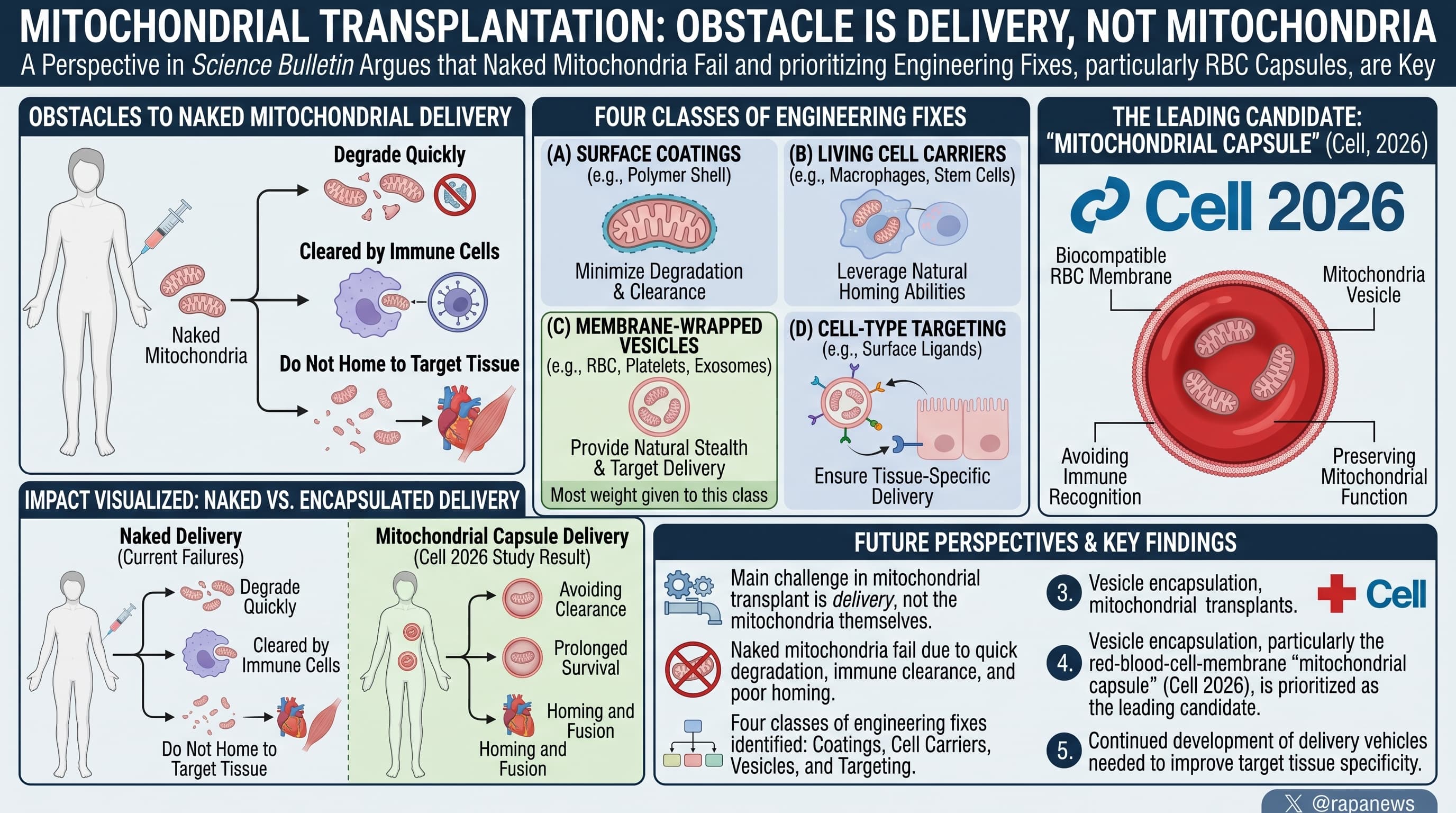
A four-page Perspective in Science Bulletin argues that the main obstacle to mitochondrial transplantation is delivery, not the mitochondria themselves. Naked mitochondria injected into the body degrade quickly, get cleared by immune cells and do not home to target tissue. The authors sort the engineering fixes into four classes: surface coatings, living cell carriers, membrane-wrapped vesicles, and cell-type targeting. They give most weight to vesicle encapsulation, in particular a red-blood-cell-membrane “mitochondrial capsule” published in Cell in 2026 by their own group.
The idea behind mitochondrial transplantation is simple: if a cell’s power plants are broken, give it new ones. It has a real biological basis, because cells naturally pass mitochondria to damaged neighbors. Since 2009, researchers have injected isolated mitochondria into injured heart tissue in animals, and in 2017 a Boston team tried it in a handful of critically ill children after heart surgery.
The problem, as this new Perspective from the Guangzhou Institutes of Biomedicine and Health lays out, is that a mitochondrion outside a cell is in a hostile environment. Calcium levels in blood are far higher than inside cells. Isolation and storage damage the membrane. The membrane potential that drives ATP production collapses. Immune cells eat the remains. And nothing steers a free mitochondrion to the organ that needs it.
The authors describe four engineering answers. The first is to coat the mitochondrion with artificial lipids or polymers so that cells take it up more readily. This helps uptake but leaves the organelle exposed. The second is to let living cells do the delivery, for example macrophages or stem cells engineered to overproduce Miro1, a protein that moves mitochondria along cellular tracks. This improves homing to injured tissue but adds all the complications of a cell therapy.
The third approach, which the paper clearly favors, is to wrap mitochondria in a membrane. Options include vesicles from stem cells that have had their nuclei removed, extracellular vesicles from “super donor” cells, and capsules made from red blood cell membranes. The authors report that the red cell capsule raised the share of recipient cells taking up donor mitochondria to nearly 80 percent and improved disease signs in mouse models of Leigh syndrome, mitochondrial DNA depletion syndrome and Parkinson’s disease.
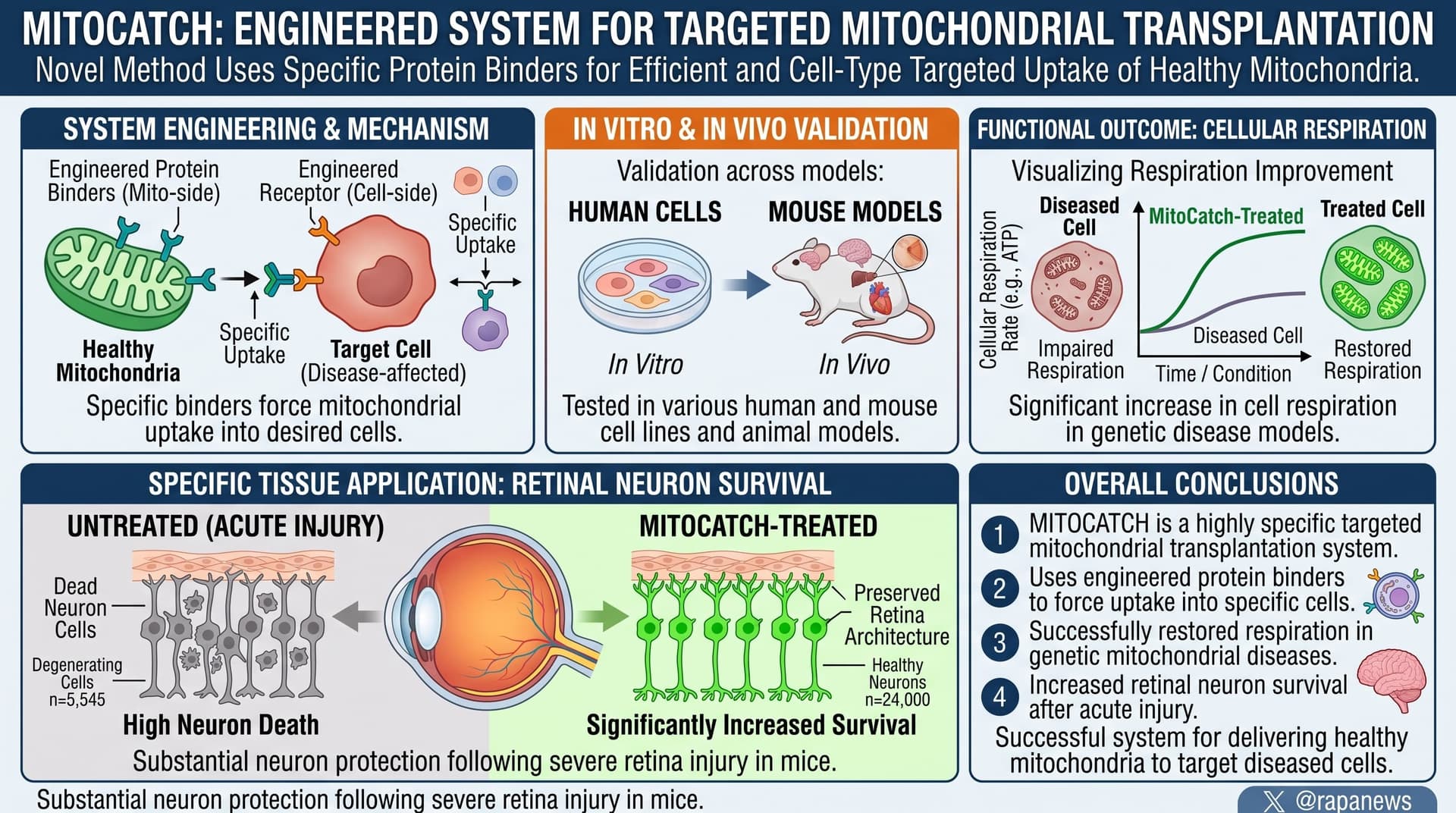
The fourth approach is targeting. A 2026 Nature paper described MitoCatch, a set of engineered protein adaptors that link donor mitochondria to chosen cell types such as neurons and retinal cells.
The second half of the paper is a list of what still has to be solved: manufacturing standards, potency assays, dose units, tracking where transplanted mitochondria go, how long they last, and whether dying ones trigger inflammation. Regulators have no category for an organelle product yet.
Readers should know one thing the paper does not state. The capsule study that anchors the argument comes from the same laboratory, and four of the Perspective’s authors are also authors on it. This is an informed position statement from a group with a stake in one of the four approaches. It is useful as a field map, and it is not an independent assessment. Nothing in it concerns aging in healthy people, and every efficacy result cited is from cell culture or animal disease models.
Insights
- No approved mitochondrial transplant product exists yet. The only human use cited is a 2017 report in a few children with heart injury after surgery, with no control group. Any clinic selling mitochondrial infusions for anti-aging is operating ahead of the evidence.
- The one number in the paper, “nearly 80 percent efficiency”, means about 8 in 10 cells in a dish picked up at least some donor mitochondria. It does not say how many mitochondria per cell, how long they lasted, or what happens in a living human.
- The paper’s own safety section explains why unengineered mitochondrial infusions are a concern: damaged mitochondria release DNA and other molecules that can provoke inflammation and cell death.
- The realistic first uses are severe inherited mitochondrial diseases and acute organ injury, not general aging.
- For now, the evidence-backed ways to improve your own mitochondria remain endurance and resistance exercise. That is my addition, not a claim made by the paper.
Context/Source
- Open Access Paper: Engineering mitochondrial delivery for efficient and precise mitochondrial transplantation
- Institutions: Guangzhou Institutes of Biomedicine and Health, Chinese Academy of Sciences (lead); Guangzhou Medical University; Shenzhen Institutes of Advanced Technology; University of Chinese Academy of Sciences; Qilu Hospital of Shandong University; Hong Kong Institute of Science and Innovation
- Country: China
- Journal: Science Bulletin (Elsevier and Science China Press), 2026
- Impact evaluation: The impact score of this journal is approximately 21, evaluated against a typical high-end range of 0 to 60+ for top general science, therefore this is a High impact journal.