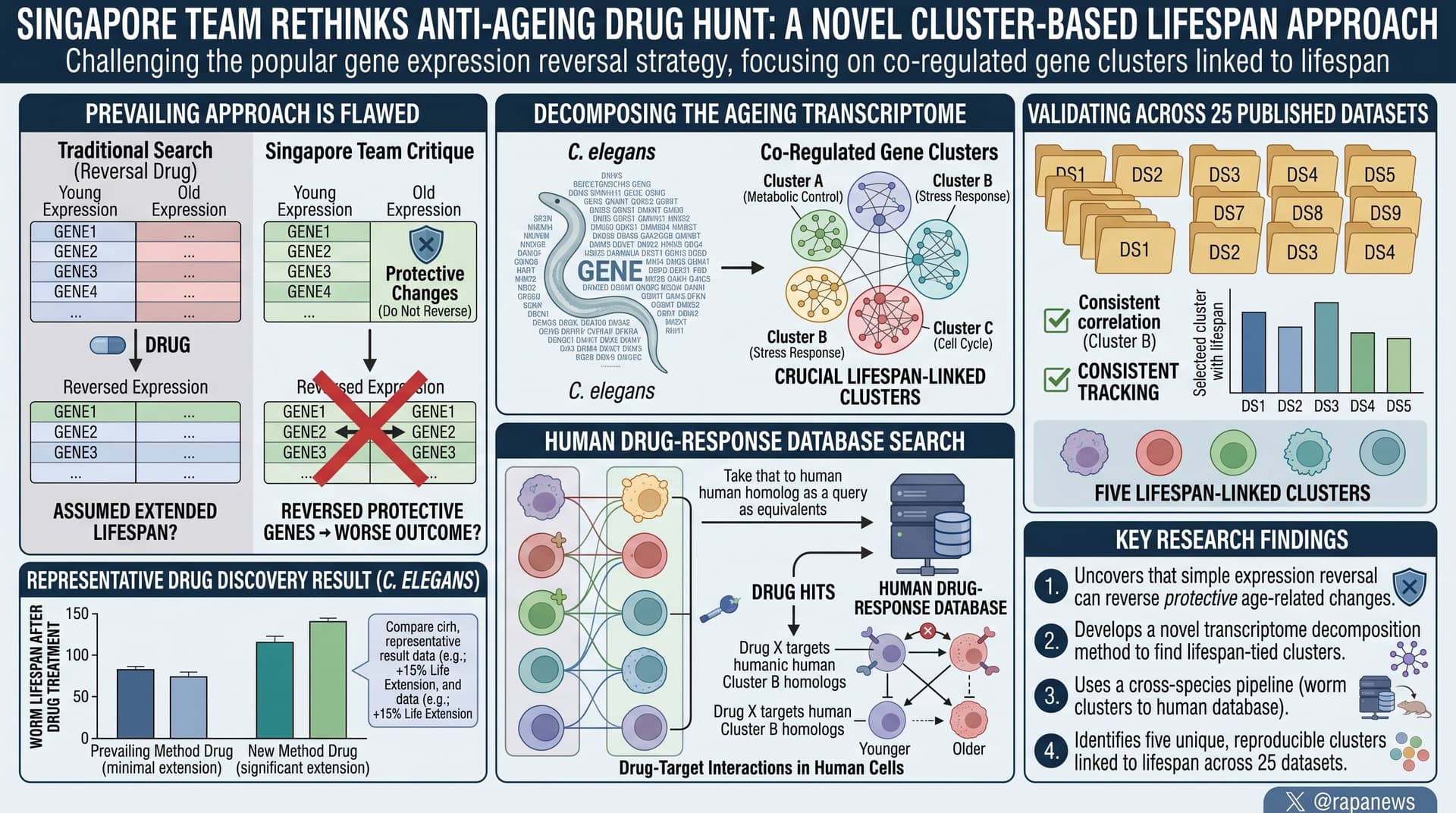
A Singapore team argues that a popular way of hunting for anti-aging drugs, finding compounds that reverse age-related gene expression, is flawed because some of those changes are protective. They broke the ageing worm transcriptome into clusters of co-regulated genes, identified clusters tied to lifespan across 25 published datasets, and used five of them to search a human drug-response database. Of 15 compounds picked, 10 extended lifespan in C. elegans, seven of them previously unreported. Some gene clusters were also found in ageing mouse muscle and tracked with frailty. The new compounds have been tested only in worms.
Many attempts to find drugs that slow ageing rest on a simple rule: work out which genes change their activity with age, then look for compounds that push them back. Brian Kennedy, Jan Gruber and colleagues at the National University of Singapore report that this rule breaks down in practice, and they propose a replacement that produced a run of hits in worms.
The group first built a “transcriptomic clock” for the nematode C. elegans, a model that estimates biological age from gene activity. It worked on untreated worms and correctly rated a long-lived mutant as younger. When applied to worms given known life-extending drugs, it rated most of them as older than their true age. Only rapamycin made worms look younger. Long-lived worms with reduced insulin signalling also read as old.
The explanation the authors offer is that ageing animals switch on defensive programmes, and life-extending drugs switch on the same programmes early. A clock cannot distinguish damage from defence. Published mouse liver data showed the same thing: at six months, treatments such as rapamycin produced an “older” gene profile, which faded or reversed by twelve months.
To separate the two, the team grouped worm genes into 62 clusters, or modules, that rise and fall together. They compared how each module behaved in ageing and in worms lacking daf-16, a master stress-response gene. Modules that moved in opposite directions were treated as candidate protective responses. A meta-analysis of 25 public datasets then showed which modules tracked lifespan. Lower activity of mitochondrial and ribosomal modules went with longer life, as did higher activity of stress-defence modules.
Five of these modules were converted to their human gene equivalents and used to query the Connectivity Map, a catalogue of how human cell lines respond to thousands of compounds. From 223 matches the team chose 15 to test. Eleven lengthened worm lifespan in a first screen and ten held up in a stricter repeat. The team sequenced RNA from worms given the two best performers, the cough medicine ingredient bromhexine and the plant compound genipin, and both shifted the modules roughly as predicted.
Several worm modules also appeared in ageing mouse soleus muscle. One mitochondrial and ribosomal module rose with frailty in old male mice. Dietary alpha-ketoglutarate, a compound Kennedy has studied before, suppressed it.
There are several reasons for caution. The comparison behind the headline hit rate is not like for like, and no randomly chosen drugs were run through the same assay. Five of the 15 candidates were already known to extend worm lifespan. Bromhexine made the worms smaller and delayed their reproduction, a pattern that often signals reduced feeding. None of the new compounds has been tested for lifespan in a mammal.
Actionable Insights
Nothing in this study supports taking any of the newly identified compounds for longevity. The evidence is from worms only.
- Size of the effect. In worms, the best compounds raised median lifespan by roughly 20 to 37 percent in the first screen. In the stricter repeat the authors report gains of up to 4 days. Control worms in those experiments lived about three weeks, so that is closer to 20 percent by my reading of the survival curves.
- Worm results translate poorly. Hundreds of compounds extend worm lifespan and very few have done so in mice. Treat these as leads for researchers.
- Several hits are prescription drugs with real risks (clopidogrel, prednisolone, riluzole, atenolol, indapamide). Riluzole shortened worm life at the highest dose.
- Be sceptical of “biological age” readouts after starting an intervention. In this work, effective treatments made gene-expression clocks read older in the short term. This was shown for transcriptomic clocks in worms and mouse liver. It has not been shown for human epigenetic clocks.
- Alpha-ketoglutarate improved frailty scores in old male mice only at the 4 percent dietary dose. Scaled by body surface area, 2 percent of diet corresponds to something like 15 to 20 grams a day for an adult human by my estimate, far above typical supplement doses. [Confidence: Low]
Context/Source
-
Open Access Paper: Predicting and finding geroprotective compounds through modulating conserved longevity-associated aging modules,
30 Sep 2026. - Authors: Weihan Huai and Li-Fang Ng (joint first), with Brian K. Kennedy and Jan Gruber as corresponding authors
- Institution: Yong Loo Lin School of Medicine, National University of Singapore; Centre for Healthy Longevity, National University Health System; Yale-NUS College
- Country: Singapore
- Journal: Science Advances, 2026; 12:eaee3657 (published 30 September 2026)
- Competing interests: Kennedy is scientific advisor and board member of PDL Health. To my knowledge that company (Ponce De Leon Health) markets a calcium alpha-ketoglutarate supplement, which is the compound used in the mouse experiments here. [Confidence: Medium]
- Impact evaluation: The impact score of this journal is 13.9, evaluated against a typical high-end range of 0–60+ for top general science, therefore this is a High impact journal.