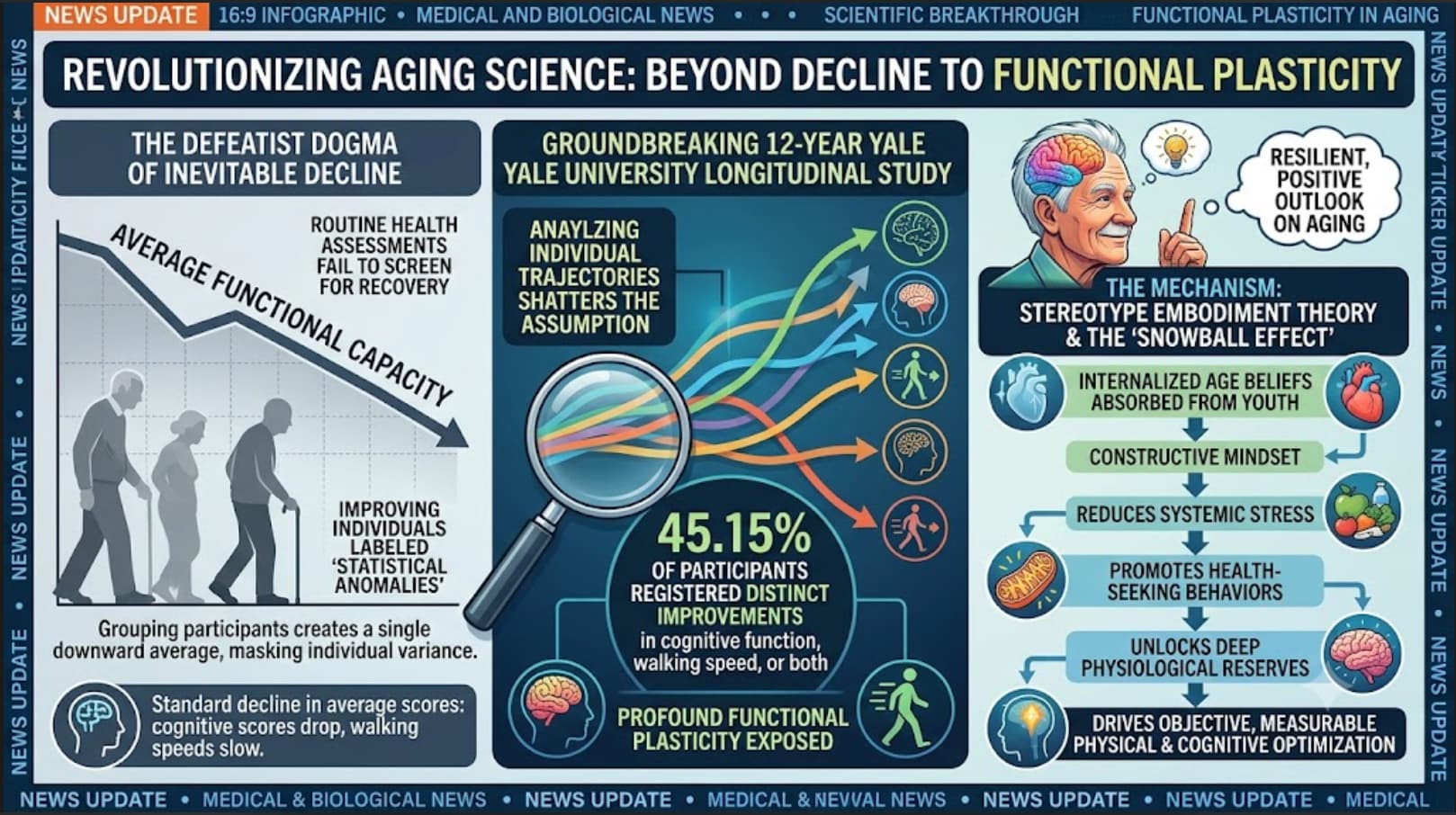
Traditional clinical metrics and standard health assessments have routinely failed to even screen for functional recovery, reinforcing a defeatist dogma that views any aging individual who improves as a statistical anomaly. However, a groundbreaking longitudinal study tracking thousands of older Americans over a 12-year period has shattered this assumption.
By analyzing individual trajectories instead of grouping participants into a single downward average, researchers from Yale University exposed a profound degree of functional plasticity in the aging population. When treated as a homogenous mass, the cohort’s average scores reflected standard decline: cognitive test scores dropped and walking speeds slowed. Yet, beneath this average lay an entirely different reality: 45.15% of participants actually registered distinct improvements in cognitive function, walking speed, or both over the course of the study.
The primary differentiator governing whether an individual fell into the decline or improvement trajectory was not a genetic lottery or a pharmaceutical intervention, but rather their internalized age beliefs. According to Stereotype Embodiment Theory, individuals absorb cultural age stereotypes from youth, which eventually become self-relevant as they cross into older adulthood. Those who maintain a resilient, positive outlook on aging essentially trigger a “snowball effect”. Their constructive mindset reduces systemic stress, promotes health-seeking behaviors, and unlocks deep physiological reserves that drive objective, measurable physical and cognitive optimization.
Remarkably, the study also revealed that physical and cognitive aging trajectories are largely decoupled, exhibiting an incredibly low correlation. Improving in a cognitive domain did not automatically dictate improvement in gait speed, and vice versa. This finding challenges the concept of uniform systemic aging and underscores the need for targeted, multi-domain longevity protocols. Ultimately, this research repositions aging not as an unmitigated process of loss, but as a dynamic period capable of stabilization and functional rejuvenation, provided the psychological terrain is optimized.
Actionable Insights
Longevity optimization requires a deliberate psychological retraining protocol alongside metabolic interventions, given that psychological mindsets directly alter long-term physical and cognitive trajectories. Individuals must actively audit and reprogram negative, culturally conditioned age assumptions to prevent the biological assimilation of decline.
The real-world magnitude of this intervention is underscored by its extracted effect sizes:
-
Holding positive age beliefs increases the odds of long-term cognitive improvement by 4% per unit scale increase (OR: 1.04, 95% CI: 1.00–1.08).
-
Physical function shows an even higher sensitivity, with positive mindsets delivering a 9% increased likelihood of objective walking speed acceleration over a decade (OR: 1.09, 95% CI: 1.02–1.17).
-
For high-functioning individuals who enter older age with completely normal baseline parameters, the protection is amplified: a positive mindset yields a 14% increased odds of physical improvement (OR: 1.14) and a 17% higher chance of substantial functional optimization when conservative performance thresholds are applied (OR: 1.17, 95% CI: 1.07–1.29). Mindset intervention must be prioritized as a clinical lever on par with standard physical therapeutics.
Source:
- Open Access Paper: Aging Redefined: Cognitive and Physical Improvement with Positive Age Beliefs
- Institutions: Yale School of Public Health, Yale University, and Yale School of Medicine.
- Country: United States.
-
Journal Name: Geriatrics (MDPI).
Impact Evaluation: The impact score of this journal is 2.6, evaluated against a typical high-end range of 0–60+ for top general science, therefore this is a Low impact journal.