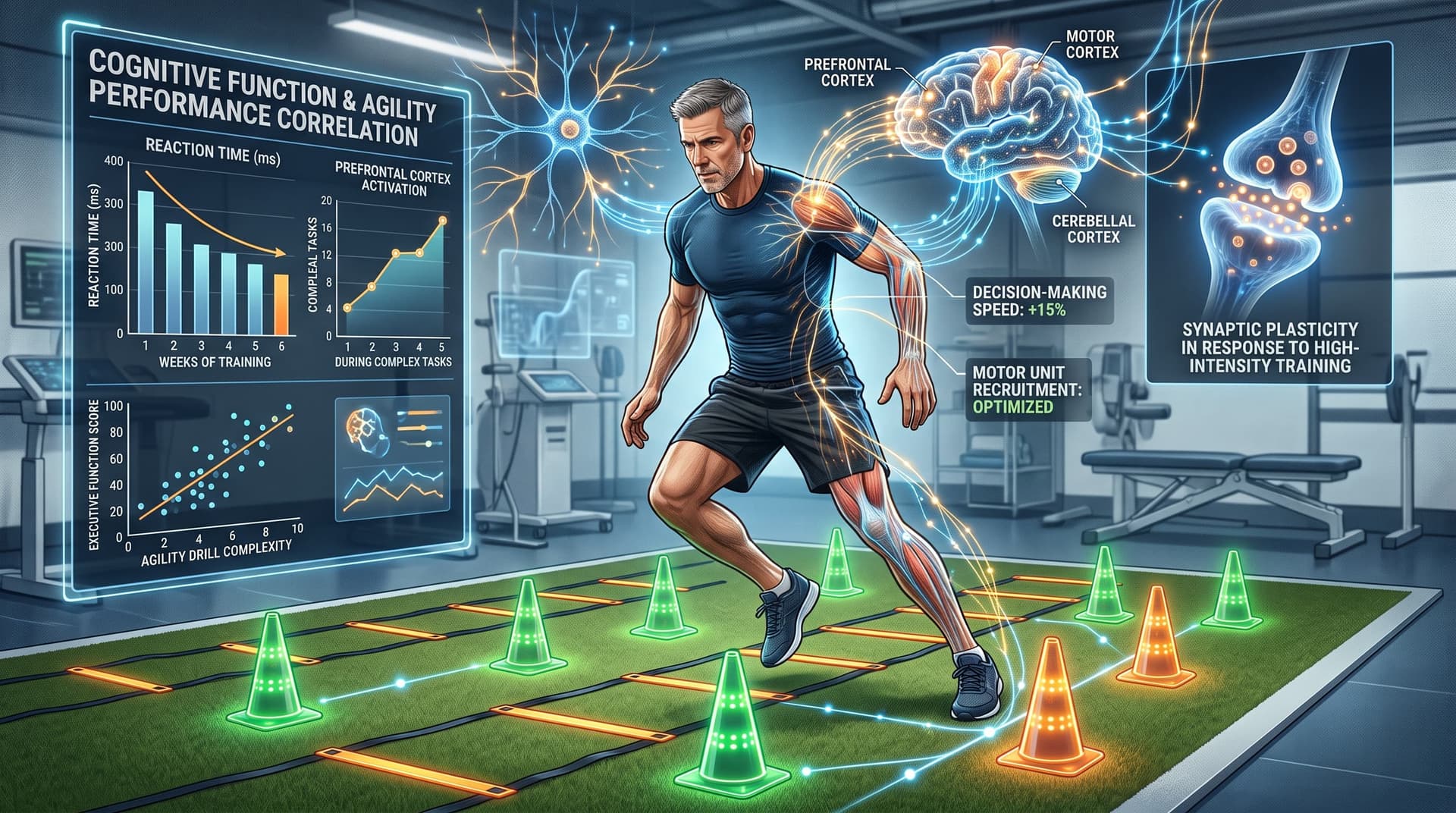
Physical and cognitive decline are tightly coupled, but standard medical tests fail to detect this connection in middle-aged adults because the tests are too easy. A new study reveals that challenging the nervous system with complex, high-intensity movements successfully unmasks early, subclinical cognitive deficits in people aged 40 to 64. By identifying these vulnerabilities early, individuals can deploy targeted lifestyle interventions before structural brain aging becomes irreversible.
Most cognitive aging research focuses on the elderly when overt dementia and severe functional deficits have already set in. This study shifts the focus to midlife, a critical window of opportunity where lifestyle interventions remain highly effective. The central hypothesis is that simple motor tasks, like balancing on one leg or stepping on a low box, fail to detect early cognitive decline because healthy adults easily max out the tests through sheer physiological reserve. To find hidden cognitive deficits, the nervous system must be stressed with complex, multi-directional, and physically demanding movements that force the brain to recruit higher-order executive functions.
Researchers tested 181 healthy individuals using a battery of cognitive tests measuring executive function, paired with simple and complex physical tasks. The simple tests included a unipedal stance with eyes closed and a basic step endurance test. The complex tests required agility, rapid level changes, and multi-step coordination, specifically utilizing the Four Square Step Test and a one-minute Burpee challenge.
The results show a clear divergence. Simple motor tasks showed zero statistical correlation with cognitive scores. Conversely, the complex motor tasks were significantly associated with cognitive executive function. The Four Square Step Test was the strongest independent predictor of cognitive status among the physical tests.
When a physical movement requires rapid sequencing, sudden changes of direction, and active error monitoring, its successful execution draws heavily on the exact same executive machinery used for high-level cognitive processing. Simpler tasks run smoothly on the brain’s automatic, subcortical autopilot. As people age, they must recruit additional cortical regions to meet rising motor complexity, indicating that physical performance becomes progressively more cognitively mediated over time. When the brain is forced to multitask a complex physical movement under pressure, the lack of available neurological reserve is exposed, revealing early cognitive decline.
Actionable Insights
You cannot rely on simple daily movements like walking or standing on one leg to gauge your neurological aging trajectory. To truly assess central nervous system decline, you must incorporate complex, coordinated movements that force the brain and body to work together under time pressure. The Four Square Step Test, which requires stepping in multiple directions rapidly, and the Burpee test, which requires full-body level changes, successfully stress this mind-muscle connection.
The statistical correlation between physical agility and cognitive function in this study is moderate but highly significant. The Spearman correlation coefficient for the Four Square Step Test is -0.29. In statistical terms, this translates to a Cohen’s d effect size of approximately 0.6, representing a moderate, clearly visible difference in real-world performance. The linear regression model indicates that 17 percent of the variance in cognitive scores is predicted by age and performance on this specific agility test. If you want to build a functional buffer against cognitive decline, training your body with multi-directional agility drills and complex coordination exercises is likely superior to straightforward cardiovascular exercise like jogging on a treadmill.
Context and Source
- Open Access Paper: Complex, but not simple, motor tasks assessment improves detection of motor-cognitive interaction in midlife, Published: 21 September 2026.
- Institution: University of Haifa, Sheba Medical Center, Max Stern Yezreel Valley College.
- Country: Israel.
- Journal: GeroScience.
- Impact Evaluation: The impact score of this journal is 5.3, evaluated against a typical high-end range of 0–60+ for top general science, therefore this is a Medium impact journal.