I have over 4 years of weekly liver markers and it has generally been quite good on the ALP/ALT/AST front (where good is normally lower). Here are the last few weeks:
I am not sure why this is relevant, however. Not all citrate is converted by the liver, some is excreted in urine, some is processed by cells. The citrate cellular membrane transporters in the SLC13 series are expressed by a wide range of cells.
The normal citrate serum figures are the normal ones.
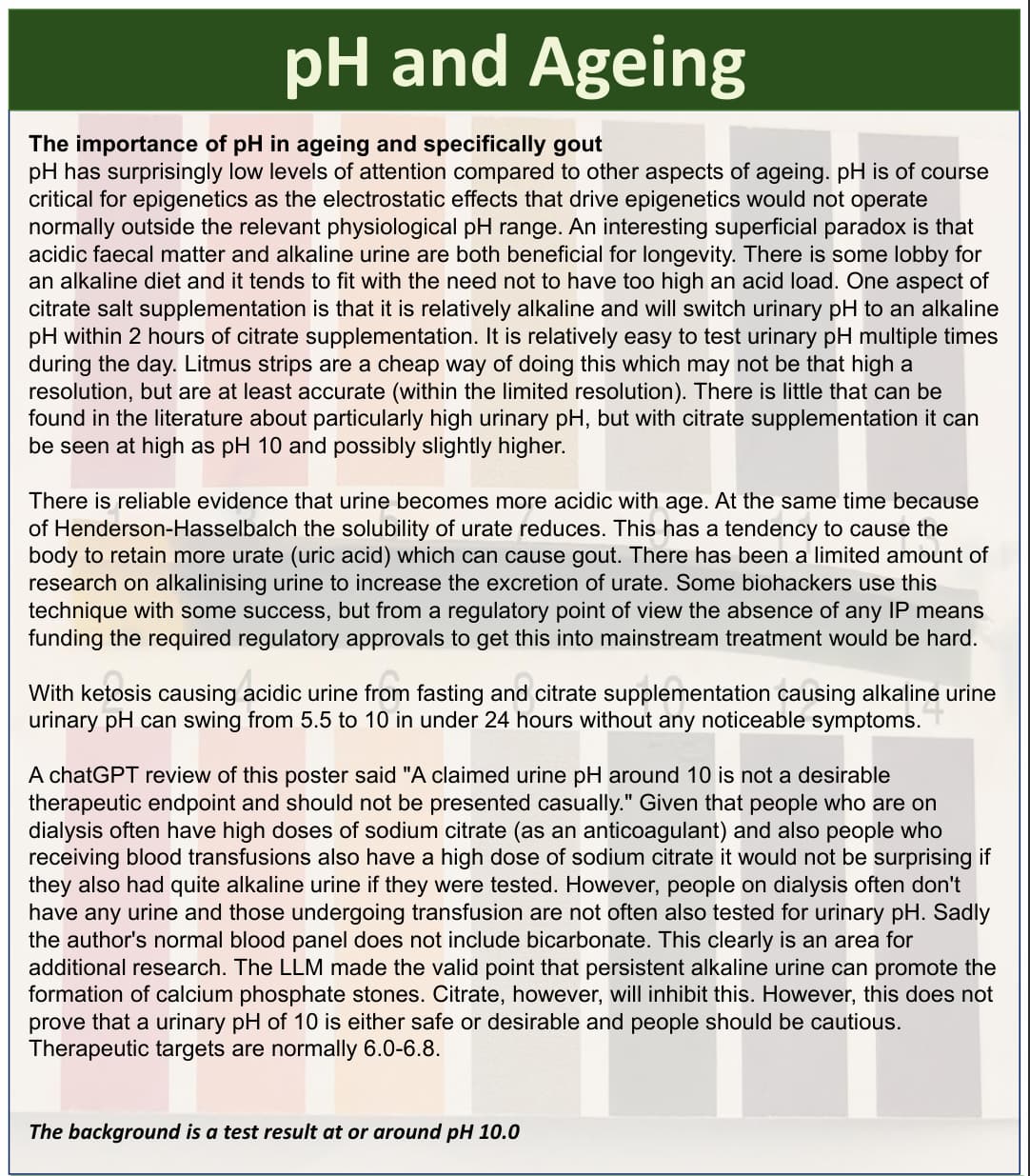
I have written about the alkalinising effects of citrate in my BSRA 2026 poster
I take about six half-teaspoons of sodium citrate per day, which, as you say, has an alkalizing effect on the body’s pH. I have found it to be an excellent treatment for both acid reflux and metabolic acidosis. The liver is relevant because of the biomechanics.
I accept that the liver processes some of the citrate into bicarbonate and that SLC13A5 is expressed strongly in the liver. However, I don’t understand where this is relevant to the odd results in the original paper.
Good numbers, though I’m not surprised. I’m sure you would rank high on the conscientiousness index. It might be helpful if you listed here, in one place, all your peptides, supplements, and other protocols, as well as your age, diet, and fitness routine, if that is not too much to ask.
tesamorelin 0.6mg daily (for TRIIM-X, will likely stop it in 6 months)
empagliflozin 10mg daily
I’m in my 40s. My current diet is mostly high protein (meat, protein shakes) and high fiber (a lot of beans, vegetables, fruits). I used to be more disciplined in my diet, but because now I’m satiated more easily by food, I can eat anything I want and not worry about eating too much.
These days I only work out only 3 times a week, but I do everything during those 3 sessions: lift weights and a cardio session right after. My lifting focus is mainly on lower body movements, and on doing unlilateral training. Unlilateral training helps me in 2 things: general balance, and ability to effectively lift more weights per limb.
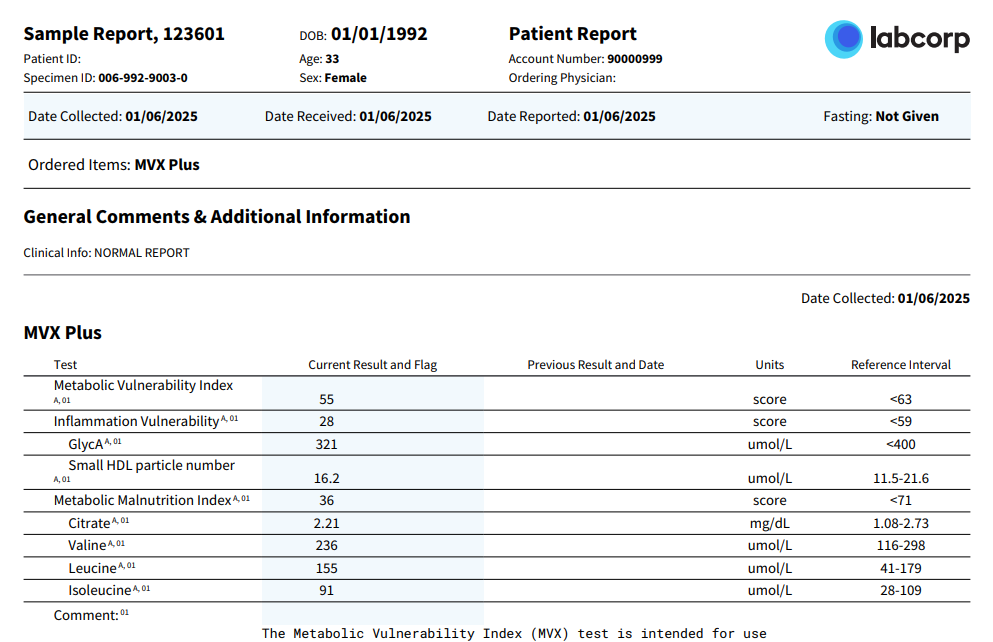
I got my numbers back from Labcorp and I only got 3 values in total. One for the Metabolic Vulnerability Index, Inflammation Vulnerability, and Metabolic Malnutrition Index. Unfortunately, I didn’t get back any of the subcomponents for each of those indexes.
There are some confusions here in part because of the novel developmental history of MVX. Too much to summarize in a short post but it is all unpacked in detail in Attia’s podcast.
There is no alternative vendor. Labcorp owns and developed the MVX (Metabolic Vulnerability Index) test. The test was created by Labcorp using their proprietary nuclear magnetic resonance spectroscopy technology, including highly adapted spectrometers used and software to analyze specific serum metabolites. While the underlying NMR platform was pioneered by LipoScience (which Labcorp acquired), Labcorp holds the patents for the multi-variable metabolic vulnerability index evaluations and performs the analysis for both the standard MVX and the MVX Plus variants.
IMO, the real value of the MVX parameters – and not so much the specific metrics but developmental process – derives from the few hundred thousand cases it has been analyzed agains in various ways. Much of this value is in process.
With this in mind, if you are looking for a gero metric to manage to, this is definitely not it at this point.
On the citrate issue, I don’t think we should conflate the MVX citrate signal and supplemental citrate. They differ in compartment, timescale, mechanism, and quite possibly in the sign of their biological meaning. MVX measures fasting, steady-state serum citrate, an endogenous readout of your metabolic set-point. Oral citrate is a transient absorbed dose that is disposed of in a few hours in ways that do not elevate fasting plasma citrate. For this and other reasons, we should not be comparing the two citrate metrics. You can “supplement citrate” and leave fasting plasma citrate unmoved.
The evolution of the NMR diagnostic platform, culminating in the commercialization of the Metabolic Vulnerability Index (MVX), spans four decades beginning in a public university lab in the 1980s. The organizational structure transitioned from a university research lab to a venture-backed startup, a publicly traded diagnostic firm, and ultimately (in 2014) an integrated enterprise product within Labcorp. At the time and through to today, Labcorp had the vision to retain key scientists even though doing so likely degraded their financial profile for the product. The scientists acknowledge Labcorp’s contributions but hope to find funding to resume the scientific arm of the venture since Labcorp functions as a clinical lab and not a research facility.
Importantly, Labcorp is the sole owner of everything associated to MVX and NMR LP. They do not license the Vantera hardware, the software algorithms, or proprietary diagnostic assays like the Metabolic Vulnerability Index (MVX) and NMR LipoProfile to third-party clinical laboratories and have no public plans to do so. (As I understand it, there are dozens or more patents involved.) Therefore, make certain that any lab requisition you purchase is an authentic Labcorp document and that the sample will be either drawn at a Labcorp authorized facility or transmitted to them in an acceptable form.
Yes, besides a pronounced effect on metabolic acidosis, a complication of kidney disease, I am running faster with greater ease, probably because of a reduction in lactate.