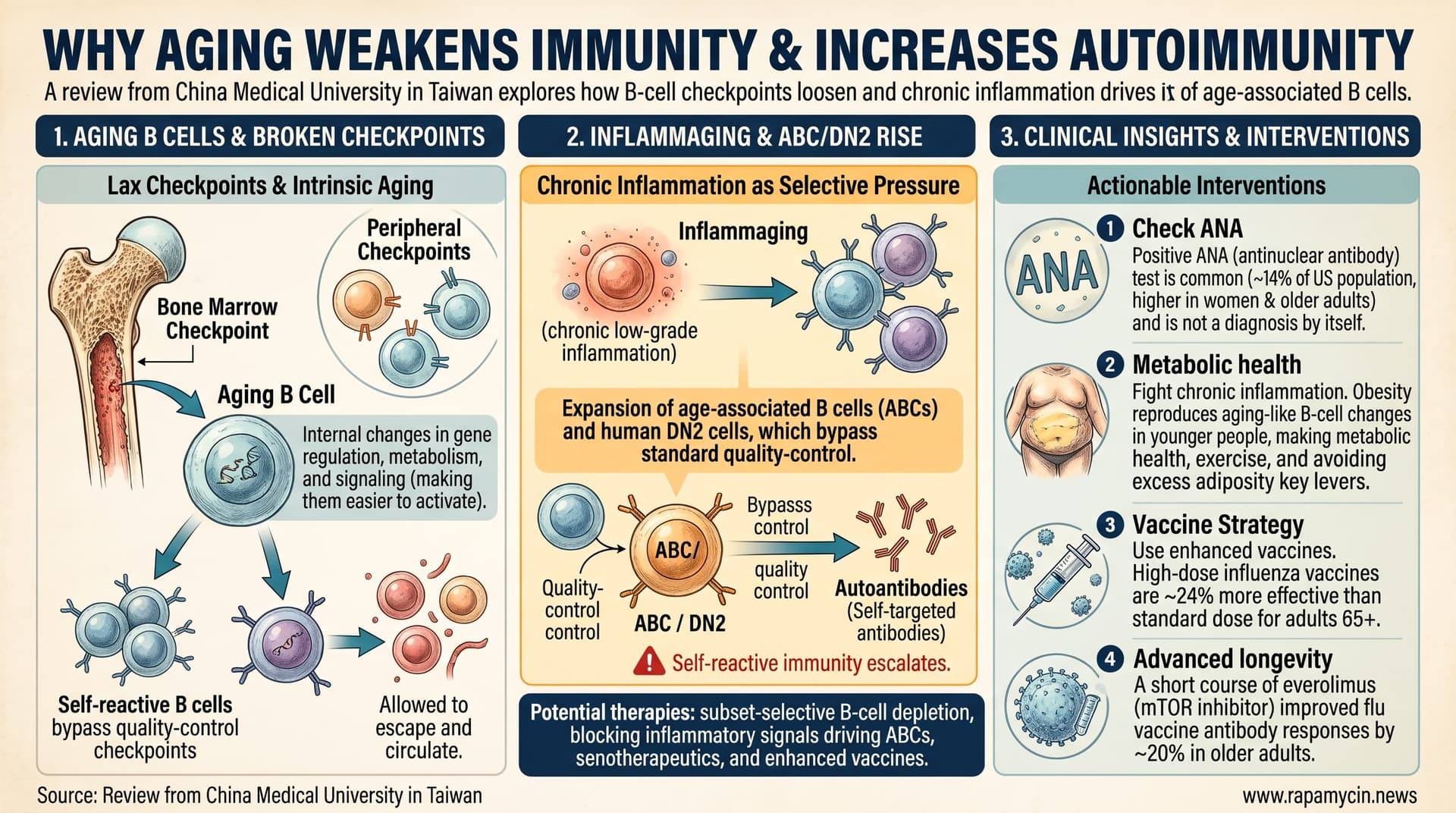
This single-author review from China Medical University in Taiwan proposes a model for why aging weakens protective immunity while increasing autoimmunity. The focus is B cells, the immune cells that make antibodies. The author argues that aging first loosens the checkpoints that normally remove or silence self-reactive B cells, both in the bone marrow and in the rest of the body. Changes inside aging B cells in gene regulation, metabolism and signaling then make them more easily activated. Second, chronic low-grade inflammation, often called inflammaging, acts as a selective pressure. It favors a subset called age-associated B cells (ABCs), and their human counterparts known as DN2 cells, which tend to bypass quality-control steps and produce autoantibodies. The review closes with therapeutic ideas: subset-selective B-cell depletion, blocking the inflammatory signals that drive ABCs, senotherapeutics, and better vaccines for older adults.
Aging creates an immune paradox. Older people respond less well to infections and vaccines, yet they are more likely to carry autoantibodies, and several autoimmune diseases either appear for the first time or worsen later in life. This review tries to explain both sides of that paradox through B cells.
Every person makes enormous numbers of B cells with randomly assembled antigen receptors, and many of them recognize the body’s own tissues. In youth, a series of checkpoints catches most of these. In the bone marrow, self-reactive cells either edit their receptors or are eliminated. In the periphery, survivors are kept quiet through anergy, exclusion from follicles and competition for survival signals. The author argues that aging erodes each of these safeguards. Bone marrow output falls, long-lived clones crowd the pool, receptor diversity shrinks, and more self-reactive specificities slip through. Many healthy older adults carry autoantibodies without any disease, which fits this picture.
The review’s central claim is that this erosion happens first and inside the B cells themselves. Aging B cells show durable changes in chromatin, gene expression, metabolism and signaling: they run “hotter” at rest yet respond less crisply to real stimulation. In the author’s view, these intrinsic changes create a primed, vulnerable population.
The second step is inflammaging. Rather than activating all B cells equally, chronic inflammation selects for a specific group: age-associated B cells. These cells express the transcription factor T-bet and the surface marker CD11c, lose the receptor that guides them into germinal centers, and respond strongly to innate signals from Toll-like receptors 7 and 9. These receptors detect nucleic acids, including those released from the body’s own dying cells. Signals such as interferon-gamma and interleukin-21 push activated B cells toward this fate. The cells then take a shortcut, maturing into antibody-producing cells outside germinal centers, where much of the usual quality control happens. The result is a growing reservoir of cells primed to make autoantibodies.
The model also helps explain why obesity, chronic viral infections such as cytomegalovirus, and even tumor environments produce similar B-cell populations. All are chronic inflammatory settings that reward the same adaptations.
On treatment, the author points to existing drugs that deplete B cells broadly, such as rituximab, and argues for more precise tools that target only age-associated B cells. Other options he discusses include blocking Toll-like receptor or cytokine signals, reducing inflammaging with senolytic drugs, and restoring B-cell metabolism or epigenetic programming. He also notes that the same processes weaken vaccine responses.
The framework is coherent and well-informed built mainly on mouse work and selected human studies. Its key claim about ordering, that intrinsic change comes first and inflammation only amplifies, is asserted rather than demonstrated. Some evidence actually points the other way. Several citations also do not support the statements attached to them.
For readers, the big picture is useful: immune aging is not just weakness but miscalibration, and chronic inflammation is a plausible lever for keeping it in check.
Actionable Insights
- A positive ANA (antinuclear antibody) test in an older person without symptoms is common and not, by itself, a diagnosis. About 14% of the US population is ANA-positive, with higher rates in women and older adults.
- Chronic inflammation is the most modifiable part of this model. Obesity reproduces aging-like B-cell changes in younger people, so metabolic health, physical activity and avoiding excess adiposity are reasonable levers. No study has measured their effect on age-associated B cells in humans.
- Older adults should favor enhanced vaccines where available. High-dose influenza vaccine was about 24% more effective than standard dose in people 65 and older. That is an established, practical response to B-cell aging.
- For longevity enthusiasts: a short course of the mTOR inhibitor everolimus improved influenza vaccine antibody responses by roughly 20% in older adults. That is consistent with the review’s metabolic arguments, though not discussed in it.
Context and Source
- Paywalled Paper: A two-step model of age-associated autoreactivity: B cell-intrinsic aging meets inflammaging
- Institution: Graduate Institute of Biomedical Sciences, China Medical University, Taichung
- Country: Taiwan
- Journal: GeroScience (Springer), published online 21 September 2026
- Impact evaluation: GeroScience has a 2025 impact factor of 5.4 and is ranked Q1. The impact score of this journal is 5.4, evaluated against a typical high-end range of 0 to 60+ for top general science, therefore this is a Medium impact journal.