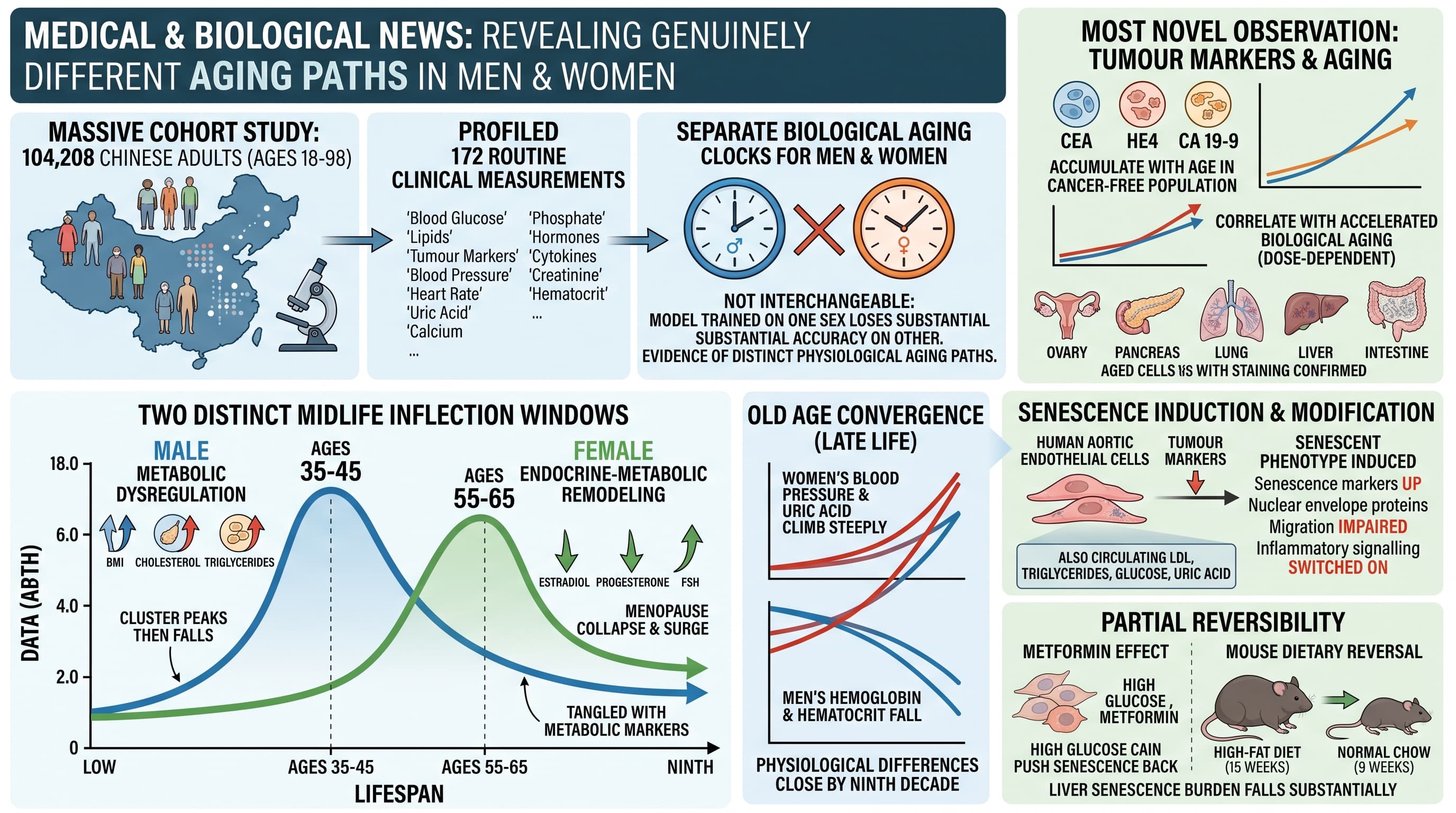
Researchers profiled 172 routine clinical measurements in 104,208 Chinese adults aged 18 to 98 and used them to build separate biological aging clocks for men and women. The clocks are not interchangeable: a model trained on one sex loses substantial accuracy when applied to the other, which the authors treat as formal evidence that male and female physiology age along genuinely different paths. Mapping each measurement across the lifespan revealed two distinct midlife inflection windows, a male metabolic dysregulation phase at ages 35 to 45 and a female endocrine-metabolic remodeling phase at ages 55 to 65, after which the sexes physiologically converge in late life. The most novel observation is that conventional tumour markers such as carcinoembryonic antigen (CEA) and human epithelial protein 4 (HE4) accumulate with age in a cancer-free population, correlate with accelerated biological aging in a dose-dependent fashion, and, when applied to human aortic endothelial cells in culture, are sufficient to induce a senescent phenotype. Circulating LDL, triglycerides, glucose and uric acid did the same. A high-fat-diet mouse model with dietary reversal indicated that the resulting liver senescence burden is partly modifiable.
A team working across three Chinese hospitals has done something the aging field has discussed for years but rarely delivered: they built a biological age calculator out of the blood and urine tests a doctor already orders, then showed that men and women need entirely different calculators.
The dataset is the reason to pay attention. Researchers under the X-Age Project pulled 172 routine clinical measurements from 104,208 people aged 18 to 98 attending standard health checkups in Beijing, Quzhou and Nanchang. No methylation arrays, no proteomics, no expensive assays. Cholesterol, blood pressure, liver enzymes, urine chemistry, hormones, blood counts, and 17 tumour markers.
The first result is a mapping problem solved. When the team trained an age predictor on men and applied it to women, accuracy fell off sharply, and the same happened in reverse. That failure is the finding. It means the physiological signature of a 55-year-old man and a 55-year-old woman is not the same object measured with noise. They are different objects.
Tracking the measurements across the lifespan produced two distinct midlife crunch points. In men, a cluster of metabolic measures including body mass index, cholesterol and triglycerides peaks between 35 and 45, then falls away. In women, a later peak arrives between 55 and 65, dominated by the collapse of estradiol and progesterone and the surge in follicle-stimulating hormone that defines menopause, tangled together with the same metabolic markers. Two clocks, two alarm times.
Then, in old age, the sexes converge. Blood pressure and uric acid in women climb steeply through midlife until they approximate male levels. Hemoglobin and hematocrit in men fall until they approach the steadier female baseline. By the ninth decade much of the physiological difference between the sexes has closed.
The most unexpected result concerns tumour markers. These are proteins oncologists track in cancer patients: carcinoembryonic antigen, human epithelial protein 4, CA 19-9 and others. In a population screened as cancer free, these proteins rose steadily with age, and the more of them a person had elevated, the older their body tested relative to their birthday. Staining tissue from young and old donors confirmed the pattern: these proteins accumulate in aging ovary, pancreas, lung, liver and intestine.
The team then went past correlation. They took human aortic endothelial cells, the lining of arteries, and exposed them to those tumour marker proteins. The cells turned senescent. They also exposed the cells to LDL, triglycerides, glucose and uric acid at concentrations chosen to reflect real blood, and got a consistent result: senescence markers up, nuclear envelope proteins down, migration impaired, inflammatory signalling switched on.
Two things partly reversed it. Metformin, added alongside high glucose in the dish, pushed several senescence markers back toward normal. And mice fattened on a 60 percent fat diet for 15 weeks, then returned to regular chow for 9 weeks, showed liver senescence markers fall substantially, though not all the way back to control levels.
The claim the authors land on is that metabolic burden is not merely a correlate of aging but a driver of it, and that the driving is reversible.
Actionable Insights
Four things follow from this paper.
First, sex matters when interpreting a biological age result. A clock built on one sex misreads the other. If you use a biological-age service (which we don’t recommend because they are generally not validated at the individual level), ask whether the underlying model was sex-stratified.
Second, systolic blood pressure separates fast agers from slow agers more sharply than anything else measured here. Comparing the fastest-aging 5 percent against the slowest-aging 5 percent in Beijing, systolic pressure differed by roughly 22 mmHg in men and 38 mmHg in women. Expressed as Cohen’s d, that is approximately 1.2 and 1.9. A d of 1.0 means the average person in one group sits above about 84 percent of the other, so this is a wide separation. The caveat is that blood pressure is one of the clock’s own inputs, so part of that gap is built in.
Third, tumour markers carry aging information even after cancer is excluded, but the individual signal is weak. Two or more elevated markers shifted median biological age by only about 2 to 4 years against a spread of roughly 20 years, a Cohen’s d near 0.4. One elevated CEA is not a verdict on your aging rate.
Fourth, the metabolic damage looks partly reversible. Mice removed from a high-fat diet cut liver senescent cell burden by roughly 60 percent in 9 weeks.
Context and Source
- Paywalled Paper: Sex-specific aging clocks from a large-scale human phenome reveal distinct aging transitions and circulating signatures
- Institutions: Beijing Institute of Genomics and China National Center for Bioinformation, Chinese Academy of Sciences; Quzhou People’s Hospital / Quzhou Affiliated Hospital of Wenzhou Medical University; Xuanwu Hospital Capital Medical University; First Affiliated Hospital of Nanchang University; West China Hospital of Sichuan University; Institute of Zoology, Chinese Academy of Sciences; Beijing Anzhen Hospital.
- Country: China (multicentre: Beijing, Quzhou, Nanchang; tissue samples from Chengdu)
- Journal: Nature Aging (Springer Nature). published online 25 August 2026.
- Impact evaluation: The impact score of this journal is 25.0 (2025 two-year Journal Impact Factor; 5-year JIF 26.0, SJR 9.500, SNIP 3.978), evaluated against a typical high-end range of 0 to 60+ for top general science, therefore this is a High impact journal.