It is a natural substance made by the body, but dosing and timing matters. Also what sort of autoimmune disease is likely to matter. Hence i cannot give a useful answer.
https://onlinelibrary.wiley.com/doi/10.1111/jpi.12334
10 micromolar
==
Doris Loh
 Favorites · ·
Many of my readers ask me why they would experience fatigue and sleepiness after taking melatonin, especially in the daytime?
Most of these readers are taking doses less than 100 mg/24 h.
In my 2023 April video presentation hosted by Jay Campbell, I talked about how melatonin can enhance ATP production in high doses that exceed 1000 mg /24 h.
The question then becomes: What if you have mitochondria dysfunction where mitochondria are unable to produce optimal levels of ATP?
Would you be surprised that melatonin can attenuate mitochondria dysfunction?
A newly-published peer-reviewed study explains how melatonin can help in the elimination of damaged mitochondria and enhance recovery of mitochondrial energy supply by regulating mitochondrial quality control, providing yet another exciting, new strategy for clinical treatment of mitochondria-related diseases [Ref].
3 Likes
I don’t know if this has been discussed before. I personally take max 6 mg of melatonin per night.
“Romanenko (134) administered melatonin subcutaneously
into C57BL/6 mice (both males and females) at a single dose
2.5 mg/mouse (∼80 mg/kg) twice a week for 5 months, start-
ing at the age of 1.5 months. The mean life span of 25 control
mice was 22 months, whereas it was 19 months in the mela-
tonin group (n = 45). Almost 98% of melatonin-treated mice
and 32% of control mice developed leukemia. In another set
of experiments, C57BL/6 and C57Br mice (both males and
females) were subjected to the same treatment, but its dura-
tion was restricted to 2.5 months. The treatment reduced the
mean life span of C57BL/6 mice from 17 to 13.5 months,
and of CC57Br mice from 17 to 15 months. Leukemia was
detected in 70% of melatonin-treated C57BL/6 mice versus
14% of the control mice, and in 78% C57Br mice versus 38%
of the control mice (135).”
"Thus, melatonin has two faces:it is both a potent gero-
protector, anticarcinogen, and inhibitor of tumor growth
Vol. 31, No. 6, 2003 EFFECTS OF EXOGENOUS MELATONIN 599
in vivo and in vitro, and in some models it may induce tu-
mors and promote tumor growth. There are no contradictions
between data on the carcinogenic and anticarcinogenic poten-
tial of melatonin. Some antioxidants, including natural ones
(e.g., α-tocopherol), have both geroprotector and tumorigenic
potential and could be potent anticarcinogens as well (see
3, 5). "
https://journals.sagepub.com/doi/pdf/10.1080/01926230390257885
5 Likes
Not sure if the gut microbiome effects of melatonin have been discussed. But Ithis is worth reading. The gut produces melatonin, and the gut microbiome is affected by exogenous melatonin. Melatonin may turn out tbe a post-biotic?
The gut represents one of melatonin’s most abundant extra pineal sources, with a 400-times-higher concentration than the pineal gland.
Melatonin–Microbiome Two-Sided Interaction in Dysbiosis-Associated Conditions - PMC.
1 Like
Pretty well all cells produce melatonin. Normally it stays in the mitochondria.
Melatonin is synthesized in the pineal gland at night. Since melatonin is produced in the mitochondria of all other cells in a non-circadian manner, the amount synthesized by the pineal gland is less than 5% of the total. Melatonin produced in mitochondria influences glucose metabolism in all cells.
1 Like
This has been posed before in another thread.
As posting get buried and forgotten.
Reposting
2 Likes
I am trying to understand your melatonin protocol. I think it might have some benefits. Some naturopathic doctors are prescribing (180 -200mg) to be taken throughout the day
Wouldn’t this have some negative effects such as daytime sleepiness? As far as I can tell, they think it is a cancer-preventative.
1 Like
My protocol starts with using melatonin to extend sleep. It is not about taking a specified amount each night.
To expand on this now I have a keyboard and can type rather than a phone.
None of this is a recommendation to anyone. Other people may have different effects from melatonin. Advice should be taken.
When I take melatonin I try to calculate what stage I am in the sleep cycle (about 90mins) and ensure that given the half life of melatonin (about 30 mins) at the end of the sleep cycle the serum level of melatonin will be either essentially constant or rising. This keeps my autonomous nervous system in a parasympathetic state so I can sleep.
I also want to vary the amount of melatonin I take, but keep it high so that I can top up the mitochondrial melatonin in all of my cells via blood serum.
Because there is not much good research on really high dosing (although there is some) I like to be cautious and make sure I can drop back to zero or a really low dose without negative impacts.
Also I am experimenting with taking melatonin when I return home from drinking, but at least a sleep cycle before I go to bed. That is because I want the melatonin to protect me from the effects of acetaldehyde. Although I take acetaldehyde metabolism accelerators (Pantethine, DHM, Bae, Molybdenum) I still wish to further reduce any harm from CH3CHO. The reason I take it a sleep cycle away is that I wish it to have stopped falling in my serum when I want to sleep.
What I have found at night is that a good dose of melatonin will clear the remaining signs of a hangover - during the night so I have no noticeable negatives when waking.
1 Like
Studies are referenced in the comments.

3 Likes
Is the half-life really around 1 h or lower?
@Guywholikessleep
It should take a bit to reach peak maximum concentration as well.
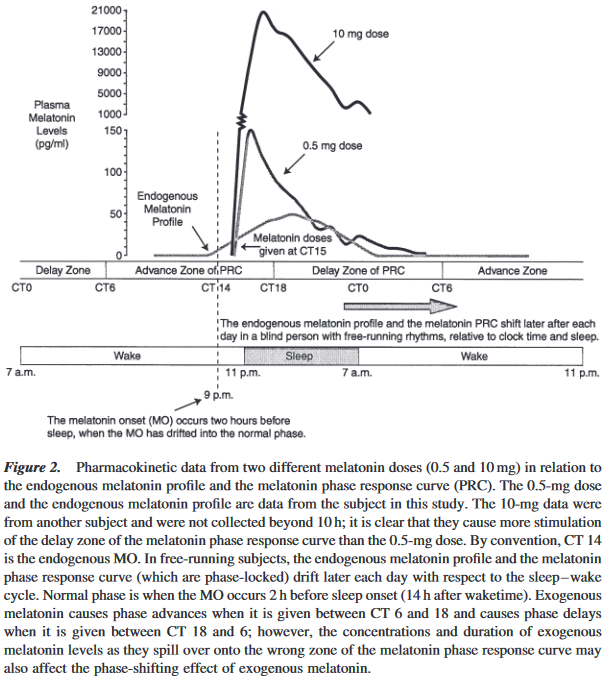
Higher dosages might mess up chronobiology.
In other words, the larger the melatonin dose, the more likely it will “spill over” onto the “wrong” zone of the PRC [melatonin phase–response curve]. After the treatment failures with high doses (10- and 20-mg) of melatonin, we became concerned about spillover and elected to use a low dose that proved to be successful.
lewy2002.pdf (168.6 KB)
The half life for low doses is about 30mins AFAIK.
When you take a really high dose it probably spreads around a lot faster rather than being metabolised.
However, I am not aware of any measurements as to the pharmacology at doses around 1g.
Over the past year I have experimented with Melatonin megadoses of 60mg. For a while a took one a day. Then I experimented with a pulsed dose. My experience is this:
If it was a week or more since my last dose, one night’s dose of 60mg makes me sleep deeply, but not oddly. I wake up as normal and have no lingering effects.
If I take 60mg several days in a row I find that somewhere between 2-4 days in, I become groggy and lazy through the day. It seems that the effects stack somehow. I’m aware that the half-life shouldn’t make it work this way, but it does. I imagine that perhaps my cells get full of melatonin and then become over-dosed, but I’m not a doctor so this is an imaginative model not a medical one.
I don’t notice positive effects from lots of melatonin. When I was taking it daily I didn’t feel more healthy and certainly not more motivated. Taking it once a week (an hour before bed) also didn’t seem to affect my next day or sense of self.
I’ve now finished 4 bottles of 60mg capsules, taken over the course of about a year.
My plan is to forego these large doses for now. I recall a video I watched by a melatonin specialist: he said to take as little as needed, and that the dose would likely increase as you age. At a healthy 50 years of age I don’t think I need 60mg doses. I’m planning to buy a more standard 2-6mg dose and try that from time to time.
Tangentially, I have found Magnesium Threonate to dramatically affect my sleep for the better. I’m not sure it did this at first, or maybe it was because I was taking it with the melatonin along with a Zyrtec an hour before bed, but this magnesium supplement gives me extraordinarily vivid dreams that often help me fall back asleep after mid-night waking and make me sleep longer in the morning if I don’t set an alarm. I LOVE this effect and plan to keep taking a nightly MagThre/zyrtec for the foreseeable future.
4 Likes
I think Melatonin like Rapamycin has a general effect on mitochondria and, therefore, although you can identify specific outcomes in terms of sleep cycles etc it also has more general implications.
2 Likes
Well, Ryker Black is doing something right. His skin is amazingly free of wrinkles and looks great in general.
FWIW: I have been taking what I considered to be high-dose melatonin (5-20) nightly for many decades with no discernable ill effects. I must now reconsider what a high dose is.
Time to up the game.
One of the benefits of my old age is the luxury of self-experimenting. No one is dependent on me, and if I accidentally do myself in, it is no big deal. Also, at my age, I am willing to try something that looks promising before the results of some long-term RCT.
I have been taking between 100 -140 mg nightly for several weeks now. This has not resulted in any daytime sleepiness. My bedside lamp is a 40-watt warm white incandescent reading lamp. Turning off all of the lights except this one and reading for a while triggers the onset of sleepiness.
BTW: Doris Loh is the author or co-author of more than 300 published papers. I haven’t been able to determine her age, but it seems that she is retired.
9 Likes
Yeah, the half life has shown ranges from 20 minutes to hours, so literature is very mixed.
Example:
Again melatonin supplementation can mess up your chronobiology depending on timing of dose and your chronotype(hence why some may experience that groggy hangover feeling), and when it comes to sleep, it acts more as a starting signal to cause the brain to begin to enter sleep activity(hence thats why melatonin improves sleep onset latency), but doesn’t really impact duration of sleep(some studies claim it does but when you look at those studies its not very convincing.
It also is involved in other signaling pathways outside of sleep, so hard to know how exogenous melatonin may be impacting those pathways whether in a positive or negative way.
2 Likes
The big signalling thing I encounter is with sleep cycles and the autonomous nervous system. I think more broadly the anti-oxidant effect and implication with mitochondria is key although Doris Loh made some interesting points about phase separation.
For those looking into or presently taking daytime especially large doses of melatonin, you may want to research its effect on prolactin secretion. Then elevated prolactins effect of HTPA i.e sex hormone feedback control. Natural melatonin release is photoperiod specific. And as such has defined window. When taken outside that context especially in large doses it can create untoward effects. Such as effects on BG and IR. The latter is the effect of most concern to me with daytime high dose use. Tge other quotes and info are just wwarness of the broad reaching effects some may not be aware of.
I personally do not use melatoinin outside the sleep window effect and with a max dosage of 5mg sustained released.
" On the one hand, melatonin was tested with some success as a contraceptive [5]. In a controlled trial, 3 mg. melatonin at bedtime evidently suppressed LH in younger women as compared to placebo,"
"Several conditions of inadequate gonadal function or amenorrhea may be associated with enhanced endogenous melatonin production, "
“Melatonin decreased LH in men in one study, [13] and melatonin impaired sperm production in two young men studies”
"The current study was planned as an expanded test of the hypothesis that melatonin could suppress LH and relieve hot flashes by suppression of the hypothalamic pulse generator. "
Point being melatonin during the night time sleep period has a positive overall effect but daytime there are clear side effects that I personally would not want unless I had some condition that made the trade off acceptable. This seems especially true when the elevated melatonin levels is concurrent with food intake. Its this latter one that got my attention especially as we age.
**“Exogenous melatonin at doses of 1–10mg has been shown to worsen glucose tolerance and insulin sensitivity compared to placebo in men as well as in pre- and post-menopausal women after a single dose and persisting after up to 3 months of treatment.**75–77 However, as melatonin is usually not administered during the waking hours when food is consumed, the risk of clinically significant effects on glucose tolerance is likely to be minimal.”
My context of research was specifically male targeted. In women its much more complex between pre post menopausal. As with female reproduction timing has avsignificant and even opposing effects. Day reltive to cycle as well as time of day and curve duration. I have not dug too deep into it.
I want people to be aware of the melatonin prolactin relationship and the latters effects when chronically supplemented during waking/light hours. But specifically its effect with daytime adminstration and food intake on blood glucose and hepatic insulin senstivity. There are certainly many benefits from adjusting sleep start end (wake) cycle period to inflammation antioxidant etc. All the negative effects seem associated with daytime use.
Melatonin effects on luteinizing hormone in postmenopausal women: a pilot clinical trial
2 Likes
I wonder myself if melatonin increases SHBG.
I did spend some time studying the literature on whether melatonin is likely to affect puberty in older human beings. Although it is higher prior to puberty I don’t think the literature support it having a causal effect.
I do think it acts to reduce mitochondrial heteroplasmy.
The most I have taken in a night is around 1.4g. I may experiment with Doris Loh’s approach. I do weekly blood tests so should see any impact reasonably quickly.
In the end keeping heteroplasmy under control is IMO a good idea.
Age might be a factor in regards to sleep cycles, as melatonin has helped combat some of the age related issues one experiences with sleep.
This is due to some depletion of melatonin receptors or decrease sensitivity of these receptors,