I follow the work of Doris Loh here is a link to her
I. Executive Summary
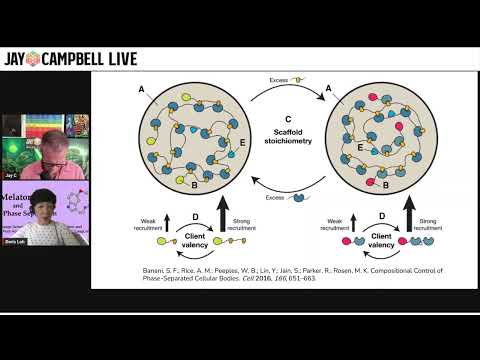
Dr. Doris Loh’s presentation addresses a biophysical framework that repositions melatonin from a simple circadian signaling molecule to a master therapeutic coordinator of macromolecular condensation and mitochondrial integrity. The core thesis argues that liquid-liquid phase separation (LLPS), the fundamental thermodynamic process responsible for organizing membraneless organelles (MLOs), becomes pathological during aging and disease states. When these dynamic biomolecular condensates lose their fluid state, they transition into irreversible gels and toxic solid aggregates, forming the amyloid fibrillation (such as tau, alpha-synuclein, and TDP-43) characteristic of Alzheimer’s disease and other dementias. Loh posits that melatonin, operating within an evolutionary triad alongside light and water, directly regulates this phase behavior by lowering water viscosity and stabilizing protein hydration shells, preventing the entropic changes that drive protein compaction.
Furthermore, the presentation links this biophysical control to mitochondrial bioenergetics. Under conditions of age-related oxidative stress, electron transport chain leakage generates excessive reactive oxygen and nitrogen species, causing cardiolipin peroxidation and a collapse in Cytochrome c Oxidase (COX) activity. Melatonin, actively imported into the matrix via PEPT1 and PEPT2 transporters, neutralizes this cascade through its unique antioxidant degradation pathway. Loh provides preclinical evidence demonstrating that melatonin counteracts severe mitochondrial viscosity increases and direct COX inhibition induced by classic inhibitors like cyanide and ruthenium red. Additionally, she outlines a mechanism where melatonin synergizes with adenosine triphosphate (ATP), binding to its adenosine moiety to enhance ATP’s native hydrotropic capacity to dissolve pathological protein gels.
From a critical peer-review perspective, while the preclinical and in vitro evidence concerning melatonin’s mitochondrial protection is deeply established, the translation of these molecular mechanics into an overarching clinical protocol represents a massive speculative leap. No human clinical trials or meta-analyses currently show that oral administration of melatonin directly shifts phase-separated networks or stabilizes protein hydration boundaries in vivo. The clinical utility of these findings remains limited by a translational gap, and multi-gram dosing frameworks are burdened by unquantified safety risks, such as receptor desensitization and potential cardiovascular signals highlighted in modern cohort reviews. Thus, while the underlying biochemistry is compelling, the therapeutic framework remains preclinically constrained.
II. Insight Bullets
- Liquid-liquid phase separation (LLPS) represents a highly conserved, fundamental thermodynamic process utilized by living systems since prebiotic evolution to rapidly manage cellular partitioning.
- Membraneless organelles (MLOs) like stress granules, nucleoli, and nuclear bodies assemble rapidly via LLPS to isolate specific biochemical reactions without lipid boundaries.
- Eukaryotic complexity requires a high density of intrinsically disordered regions (IDRs) within corporate proteins to manage flexible, multivalent signaling interactions.
- Aberrant phase transitions cause dynamic, fluid liquid droplets to undergo phase compaction into highly viscous gels and solid, irreversible aggregates.
- In neurodegenerative landscapes, pathological phase separation underlies the amyloid fibrillation of tau, alpha-synuclein, TDP-43, and FUS.
- Phase-separated oncogenic condensates act as biophysical sanctuaries that stabilize transcriptional survival programs and protect cancer cells from pharmaceutical degradation.
- Water molecule expulsion from protein hydration shells into bulk solvent provides the negative free energy change and entropic drive that facilitates aberrant phase separation.
- High viscosity in interfacial waters surrounding biomolecular condensates destabilizes fluid phases and accelerates solid macromolecular crystallization.
- Light, water, and melatonin constitute an ancient, synergistic tri-axis engineered to maintain adequate protein hydration barriers and prevent toxic aggregation.
- Melatonin possesses a unique molecular geometry featuring five separate hydrogen-bonding coordination sites, allowing it to modify water network dynamics.
- In bulk water configurations, the carbonyl oxygen group of melatonin forms strong, stable hydrogen bonds that alter local solvent viscosity landscapes.
- Melatonin acts to lower the viscosity of interfacial and bulk water, freeing water molecules to expand and reinforce protein hydration shells.
- Elevated free water availability prevents the entropic drive toward protein compaction, keeping biomolecular condensates in a fluid, functional state.
- Adenosine triphosphate (ATP) acts at millimolar concentrations as a biological hydrotrope to prevent the aggregation of intrinsically disordered proteins independent of energy transfer.
- At lower physiological ranges, ATP stimulates the nucleation of MLOs, while at higher macro-concentrations, it acts to dissolve phase-separated droplets.
- Melatonin physically associates with ATP, binding selectively near or with the adenosine moiety of the nucleotide.
- The binding interaction between melatonin and ATP reinforces the hydrotropic capacity of the adenosine moiety, protecting against water removal from protein surfaces.
- Mitochondria function as the primary cellular factories for both ATP synthesis and baseline melatonin production within peripheral somatic tissues.
- Aging triggers a structural degradation of mitochondrial networks, shifting the electron transport chain (ETC) toward severe electron leakage.
- Chronic electron leakage drives the elevated generation of intramitochondrial reactive oxygen species (ROS) and reactive nitrogen species (RNS).
- Excessive mitochondrial ROS/RNS induces lipid peroxidation of cardiolipin within the inner mitochondrial membrane, dismantling respiratory supercomplexes.
- Melatonin is actively localized to the mitochondrial matrix via active transport driven by the PEPT1 and PEPT2 oligopeptide transporter systems.
- In the matrix, melatonin acts as a multifunctional Type I-IV free radical scavenger that breaks down into a continuous cascade of active antioxidant metabolites.
- Melatonin’s antioxidant metabolite cascade includes cyclic 3-hydroxymelatonin, AFMK, and AMK, each capable of neutralizing subsequent free radicals.
- Mitochondrial viscosity fluctuates dramatically in response to environmental toxins, oxidative stressors, and structural damage, directly indicating organelle health.
- Cyanide acts as a potent mammalian cytotoxic agent that explicitly binds and blocks Cytochrome c Oxidase (COX / Complex IV) of the electron transport chain.
- In vitro assays using rat brain mitochondria confirm that 5 micromolar potassium cyanide induces a 50% inhibition of baseline COX activity.
- Co-administration of 100 micromolar melatonin nearly completely counteracts cyanide-induced COX inhibition in a strict dose-dependent manner.
- At extreme 100 micromolar cyanide exposures, even 5 millimolar concentrations of melatonin fail to reverse a 100% inactivation of Complex IV.
- In vivo intraperitoneal administration of melatonin at 10 mg/kg in rat models significantly upregulates time-dependent COX activity across brain and liver tissues.
- Melatonin administration completely reverses the mitochondrial membrane potential collapse and oxidative stress induced by ruthenium red.
- Ruthenium complexes trigger apoptotic cascades by drastically increasing local mitochondrial viscosity and generating excessive ROS.
- Melatonin dampens lines of tension across cell membranes, actively preserving the negative curvature and fluidity of lipid bilayers.
- The structural stabilization of lipid raft domains by melatonin prevents the aberrant nucleation of pathological protein condensates at the cell boundary.
- Post-translational modifications (PTMs) dynamically govern the charge profiles of IDPs, determining whether a condensate stays liquid or shifts to a solid gel.
- Melatonin influences the balance of mRNA- and RNA-binding protein composition by regulating N6-methyladenosine (m6A) epitranscriptomic modifications.
- A distinct clinical deficit in modern pharmacology is the absolute absence of approved therapeutics designed to target aberrant phase separation.
- Melatonin’s localized actions within mitochondria prevent the induction of the pro-inflammatory NLRP3 inflammasome caused by membrane depolarization.
- The evolutionary discovery of the SNAT gene in ancient archaea confirms that melatonin’s protective relationship with biomolecular condensates predates advanced eukaryotes.
- Recalibrating allometric interspecies dosing is mandatory to bridge the massive translational gap between rodent metabolic kinetics and human clinical trials.
III. Adversarial Claims & Evidence Table
| Claim from Video | Speaker’s Evidence | Scientific Reality (Current Data) | Evidence Grade | Verdict |
|---|---|---|---|---|
| Melatonin regulates liquid-liquid phase separation (LLPS) to prevent toxic amyloid fibrillation in dementia. | Theoretical models and biophysical hypotheses co-authored with Russell J. Reiter. | Mechanism is entirely restricted to in vitro simulations and computational biophysical modeling. No human in vivo trials exist confirming that oral melatonin alters biomolecular condensates. Loh & Reiter, 2023 | Level D (Translational Gap) | Speculative |
| Melatonin physically complexes with ATP to reinforce its hydrotropic effect and prevent protein aggregation. | Molecular docking data and biochemical commentaries. | While ATP is clinically proven to act as a hydrotrope at millimolar concentrations, the direct physical synergy where melatonin binds the adenosine moiety to enhance this in human tissue remains unverified in vivo. Loh & Reiter, 2021 | Level D (Translational Gap) | Speculative |
| Melatonin counteracts 50% of Cytochrome c Oxidase (COX) inhibition induced by cyanide and reverses ruthenium red toxicity. | In vitro rat brain mitochondria assays and in vivo rodent intraperitoneal (IP) tracking models. | Preclinical data strongly support melatonin’s role in protecting Complex IV and reversing mitochondrial membrane potential collapse in animal tissue. Human trials confirm that melatonin improves mitochondrial respiratory chain complex function and lowers oxidative stress in neurodegenerative cohorts, though direct human cyanide challenge data are absent. Melatonin Matrix Profile, 2024 | Level B (Human Trial) / Level D (Preclinical) | Strong Support (Mitochondrial Guarding) / Plausible (COX Rescue) |
| Melatonin drops bulk and interfacial water viscosity to free water molecules for protein hydration shell stabilization. | Theoretical biophysical fluid dynamic frameworks and commentaries. | Melatonin modifies redox-driven water dynamics indirectly via ROS clearance, but direct physical manipulation of interfacial water viscosity to govern phase state remains an unproven theoretical model in human biology. Loh & Reiter, 2022 | Level D (Translational Gap) | Speculative |
IV. Actionable Protocol (Prioritized)
High Confidence Tier (Level A/B Evidence)
- Mitochondrial Bioenergetic Support: To enhance mitochondrial respiratory chain complex efficiency and suppress systemic lipid peroxidation in neurodegenerative or high-oxidative stress states, utilize verified clinical oral ranges (20 mg to 40 mg daily). This application is supported by double-blind randomized controlled trials showing restored mitochondrial complex activity and enhanced catalase markers.
- Standard Circadian Resynchronization: Restrict sleep onset interventions to standard low-dose ranges (0.3 mg to 5.0 mg), administered 30 to 60 minutes prior to nocturnal rest, to prevent receptor saturation while securing core chronobiotic alignment.
Experimental Tier (Level C/D Evidence)
- Preclinical Biomarkers Scale-Down: In translating animal mitochondrial rescue protocols (such as the 10 mg/kg IP rodent dose used to counteract ruthenium red toxicity), utilize strict allometric interspecies scaling equations. This ensures human equivalent doses remain within calculated, safety-monitored ceilings, while explicitly acknowledging that human in vivo phase-separation modification remains unproven.
- Epitranscriptomic and Membrane Fluidity Optimization: Rely on standard physiological dosing to support lipid bilayer fluidity and suppress microglial NLRP3 inflammasome activation via mitochondrial membrane potential preservation.
