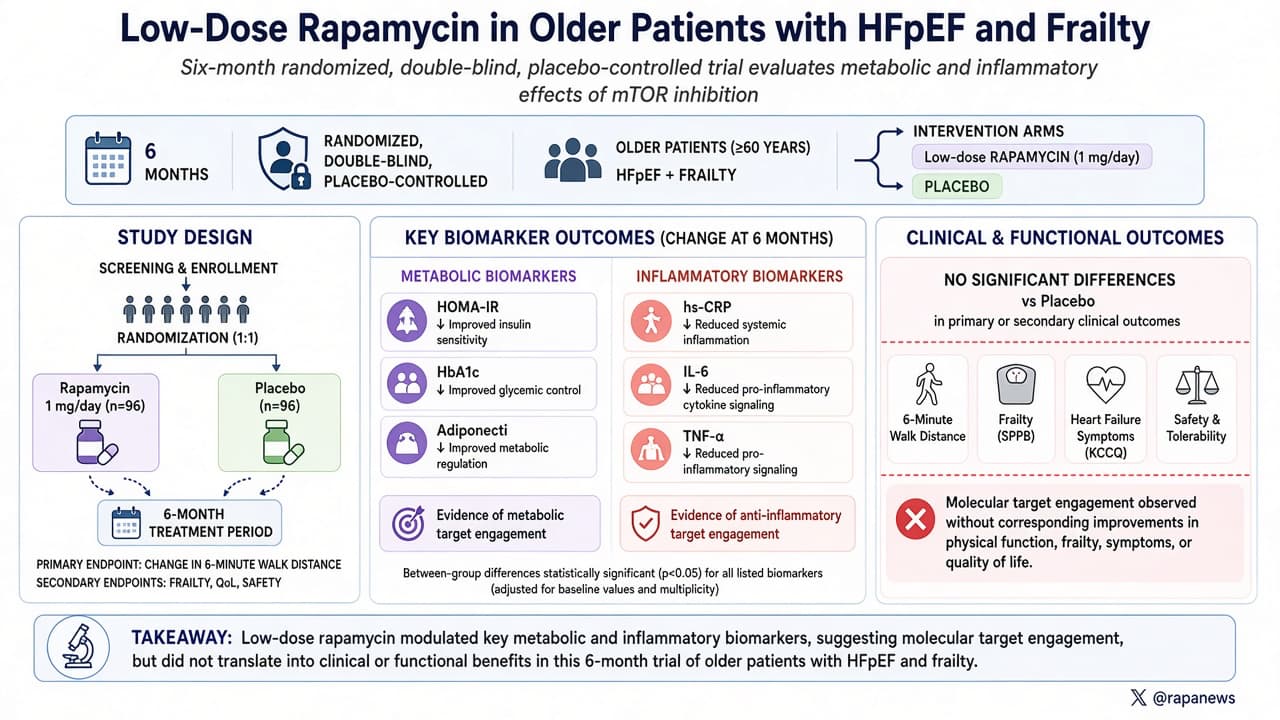
A six-month randomized, double-blind, placebo-controlled clinical trial evaluated low-dose rapamycin in older patients suffering from heart failure with preserved ejection fraction and frailty. The intervention successfully modulated key metabolic and inflammatory biomarkers, suggesting molecular target engagement. However, this low dose (0.5mg/day) of rapamycin failed to improve physical function or exercise capacity.
The inhibition of the mechanistic target of rapamycin (mTOR) has long been a cornerstone of longevity pharmacology. In animal models, rapamycin robustly reverses age-related cardiac hypertrophy and improves diastolic function while attenuating cellular senescence. Translating these molecular victories into functional improvements for highly morbid human populations is a persistent challenge in gerotherapeutics. This proof-of-concept trial tested whether these established cellular benefits could translate into improved physical performance for older, frail humans suffering from heart failure with preserved ejection fraction.
The trial enrolled participants with a median age of 71.3 years and a median body mass index of 34.0, representing an obese and severely deconditioned demographic. Over 79 percent of the cohort also suffered from atrial fibrillation. Subjects received either a placebo or an extremely low dose of rapamycin, capped at 0.5 mg, for six months.
The clinical results were completely neutral regarding physical function. Patients taking rapamycin saw no significant improvement in cardiopulmonary exercise test parameters, peak oxygen consumption, six-minute walk distance, or generalized frailty scores compared to the control group. The physical performance metrics remained functionally identical between the two groups. This failure to improve exercise capacity strongly suggests that correcting cellular senescence and metabolic signaling is insufficient to overcome the immense biomechanical limitations imposed by severe obesity and advanced heart failure.
Despite the lack of macro-level physical benefits, the trial provided clear evidence of systemic biological activity. Rapamycin-treated patients exhibited significant non-temporal reductions in key inflammatory cytokines associated with the senescence-associated secretory phenotype, including CXCL1, CXCL2, IL-8, and IL-1beta. Furthermore, the intervention positively altered arginine and proline metabolism. Markers of generalized metabolic decline and renal stress, specifically N-acetylputrescine and creatinine, increased steadily in the placebo group but remained stable or decreased in the rapamycin cohort. This indicates that while 0.5 mg of rapamycin cannot act as an exercise mimetic in severely frail patients, it successfully engages metabolic targets and provides measurable organ protection.
Actionable Insights
For longevity practitioners and clinicians, this paper provides a strict boundary condition on the efficacy of low-dose rapamycin as a rescue therapy for advanced physical decline. If an individual already presents with severe cardiovascular frailty and obesity, introducing a low dose of rapamycin will not magically restore functional exercise capacity over a six-month period.
The magnitude of physical improvement in this trial was virtually non-existent. The median difference in peak oxygen consumption between groups was -0.05 mL/kg/min, and the median difference in exercise time was just 0.18 minutes. The six-minute walk distance actually favored the placebo group by 22.5 meters. Standardized effect sizes for these physical performance markers approach absolute zero.
However, the biomarker data provides a highly practical insight for healthspan extension. The stabilization of creatinine and reductions in senescence-associated inflammatory cytokines demonstrate that systemic biochemical environments can be improved independently of physical fitness. The practical takeaway is that mTOR inhibition should be viewed primarily as a preventative intervention to maintain organ health and metabolic homeostasis, rather than a late-stage performance enhancer for functionally impaired populations.
Context/Source
Paywalled Paper: Rapamycin in Frail Older Subjects with Heart Failure with Preserved Ejection Fraction, Published September 18, 2026.
Institution: Mayo Clinic and University of Wisconsin-Madison.
Country: United States.
Journal: Mayo Clinic Proceedings.
Impact Evaluation: The impact score of this journal is 8.9, evaluated against a typical high-end range of 0–60+ for top general science, therefore this is a High impact journal.