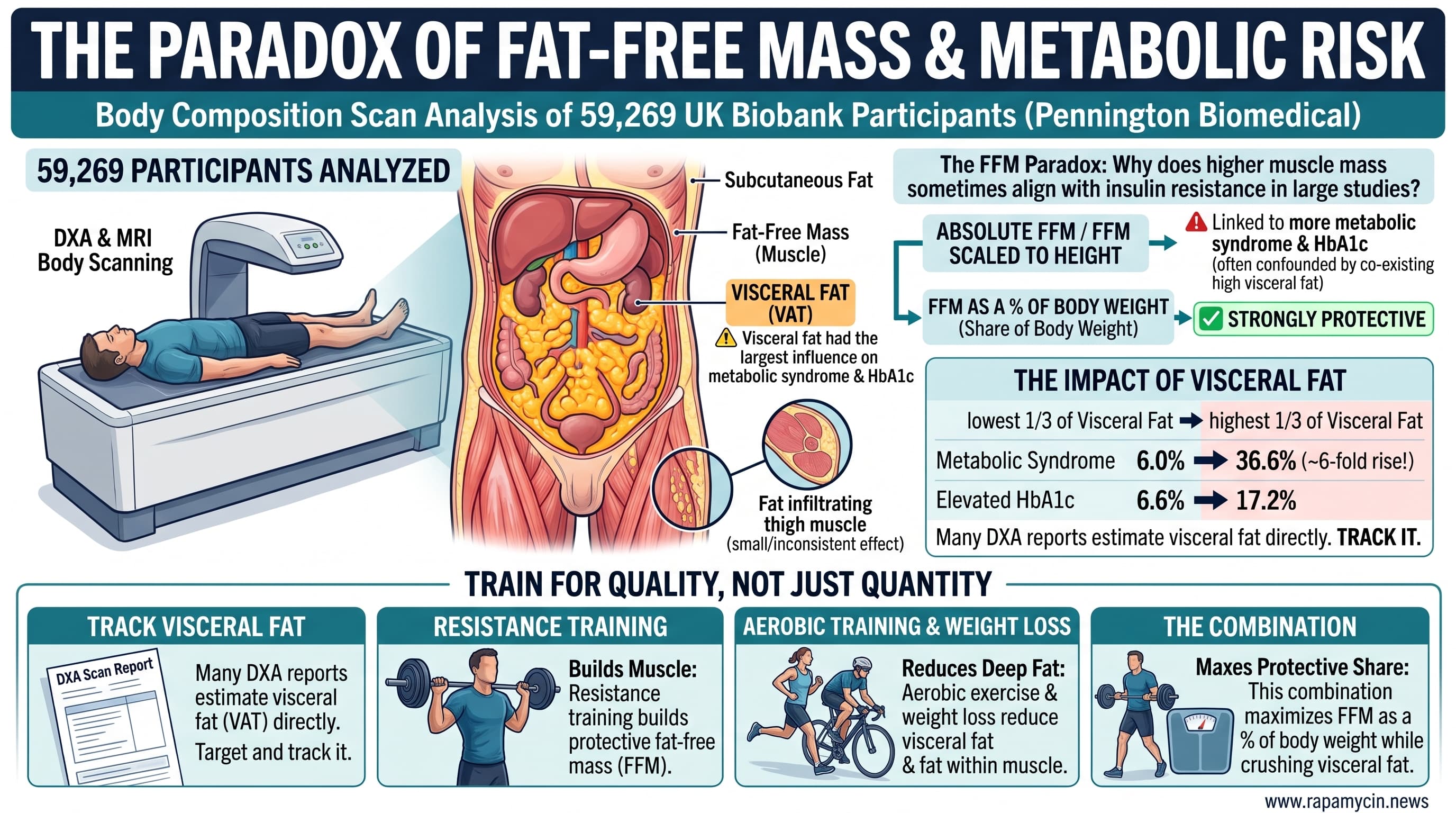
Researchers at Pennington Biomedical Research Center analyzed 59,269 UK Biobank participants with both DXA and MRI body composition scans. They asked why higher fat-free mass, usually considered metabolically protective, keeps turning up in large studies as a risk factor for insulin resistance. Absolute fat-free mass and fat-free mass scaled to height were linked to more metabolic syndrome and elevated HbA1c. Fat-free mass as a share of body weight was strongly protective. Interaction models suggested visceral fat had the largest influence on these relationships, while fat infiltrating thigh muscle and sex hormones had smaller, inconsistent effects. The core finding, that the lean-mass paradox mostly reflects overall body size and fat, is plausible.
Ask most fitness coaches and doctors, and they will tell you that more muscle is good for your metabolism. Muscle is the body’s largest consumer of blood sugar, and building it is a standard prescription for preventing diabetes. Yet several large population studies have found the opposite pattern: people with more fat-free mass are more likely to be insulin resistant.
A team led by Candida Rebello at Pennington Biomedical Research Center in Louisiana set out to explain this paradox using one of the richest body composition datasets in the world. They drew on nearly 60,000 UK Biobank volunteers who had both a DXA scan, which estimates lean and fat mass, and an MRI scan, which can measure fat deep in the abdomen and fat marbled through the thigh muscles.
The paradox showed up clearly. People in the top third for total fat-free mass were about twice as likely to have metabolic syndrome as those in the bottom third. But when fat-free mass was expressed as a share of body weight, the picture reversed. Those with the leanest body composition had about one-fifth the rate of metabolic syndrome of those with the least.
The explanation is mostly arithmetic. Larger people carry more of everything: more muscle, more bone, more organ mass and more fat. Fat-free mass is not the same as muscle; only about half of it is skeletal muscle. A high absolute lean mass often simply marks a big body that also carries a lot of fat.
The researchers then tested whether visceral fat, fat infiltrating muscle, or sex hormones changed these relationships. Visceral fat had the clearest influence. Fat infiltrating muscle had effects that were statistically significant but tiny, and sometimes pointed in opposite directions depending on how lean mass was measured. Sex hormones had modest effects that mostly disappeared when men and women were analyzed separately.
The study has notable weaknesses:
- In UK Biobank, blood tests were taken at enrollment in 2006 to 2010, while body scans began in 2014. The paper does not say which visit its blood data came from. The average age it reports matches the earlier visit, suggesting body composition was measured years after the metabolic outcomes.
- The authors claim their estimates are precise enough to show real differences across levels of muscle fat. For muscle fat, the confidence intervals overlap.
- Even MRI-measured thigh muscle volume, the purest muscle measure in the study, showed the same paradoxical pattern. That points to body size rather than poor muscle quality.
For readers, the practical lesson is sound even if the study cannot fully prove it. The absolute amount of lean mass on a body composition scan says little about metabolic health on its own. What matters more is how much fat surrounds it, especially in the abdomen.
Actionable Insights
- Read your DXA scan for ratios, not totals. In this cohort, people in the top third for lean-mass share of body weight had metabolic syndrome at 7.5 percent, versus 35.9 percent in the bottom third, roughly 79 percent lower. Each 4-percentage-point higher lean share (equivalent to 4 points lower body fat) went with about 55 percent lower odds. [Confidence: Medium, observational]
- Prioritize visceral fat. Metabolic syndrome rose from 6 percent in the lowest third of visceral fat to 36.6 percent in the highest, about six-fold. Elevated HbA1c rose from 6.6 to 17.2 percent. Many DXA reports estimate visceral fat directly; track it. [Confidence: High for direction]
- Train for quality, not just quantity:
- Resistance training builds muscle.
- Aerobic training and weight loss reduce visceral fat and fat within muscle.
- The combination addresses both.
- Do not assume adding lean mass alone protects you. A 3 kg gain in absolute lean mass corresponded to about 45 percent higher odds of metabolic syndrome in this cohort. That almost certainly reflects larger bodies carrying more fat, not harm from muscle, but it means lean mass gained alongside fat gain buys little.
Context and Source
- Open Acccess Paper: Relationship between fat-free mass and metabolic syndrome is shaped by ectopic fat in a UK Biobank cohort, Published 08 October 2026.
- Institution: Pennington Biomedical Research Center, Louisiana State University System
- Country: USA (UK Biobank data)
- Journal: The Journal of Clinical Endocrinology & Metabolism (Endocrine Society / Oxford University Press).
- Impact evaluation: The impact score of this journal is 5.1, evaluated against a typical high-end range of 0-45 for endocrinology and metabolism journals (Lancet Diabetes & Endocrinology and Nature Reviews Endocrinology near the top), therefore this is a Medium impact journal. It is the flagship clinical journal of the Endocrine Society.