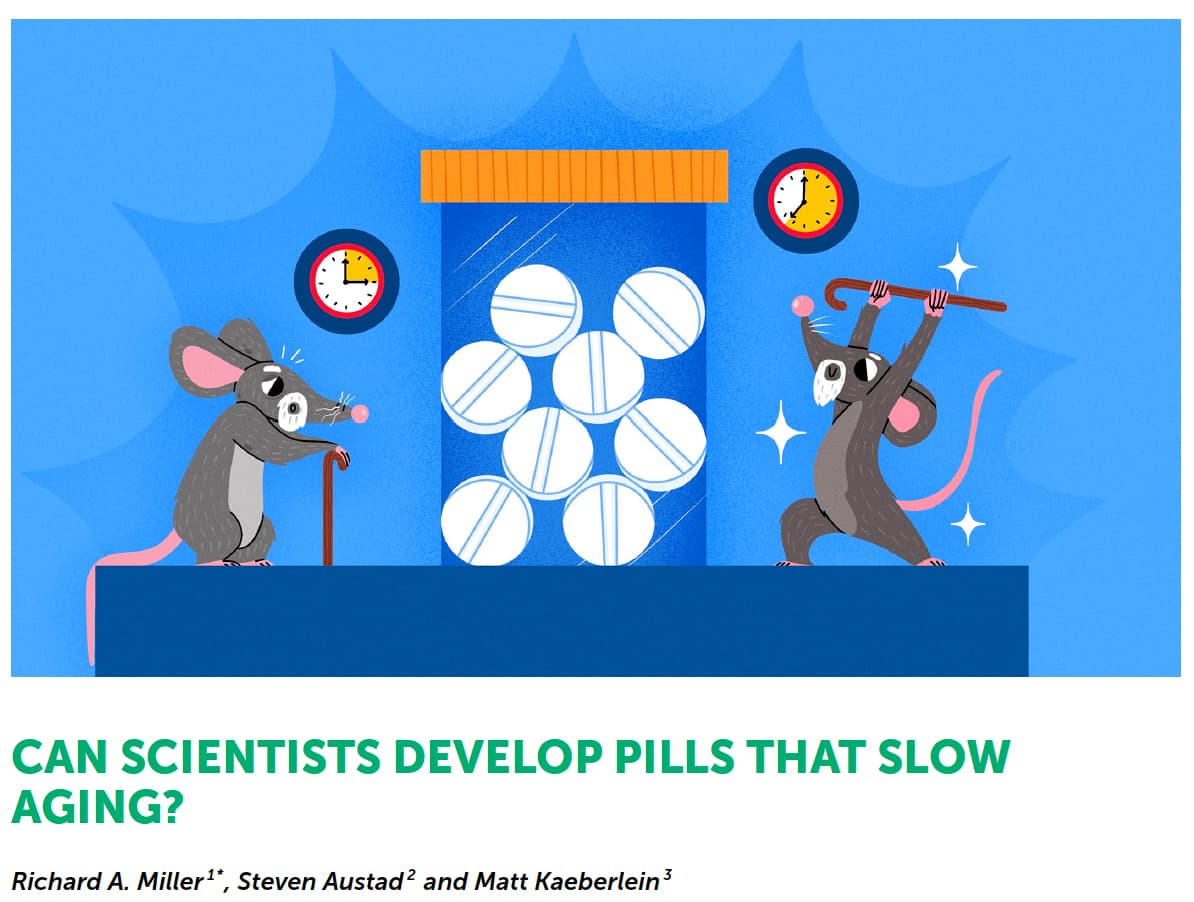
A great longevity paper for kids age 8 to 18, from Matt Kaeberlein, Steve Austad, and Richard Miller. Print it out and give it to your kids, or teachers you know.
Three well-known aging biologists, Richard Miller, Steven Austad and Matt Kaeberlein, have written a children’s version of their new Frontiers in Science lead article. It first recaps the evidence that aging can be slowed in mice. That evidence includes calorie restriction, dwarfing mutations, and 14 drugs or drug combinations validated by the National Institute on Aging’s Interventions Testing Program (ITP). The best of these is rapamycin plus acarbose. The article then argues that the field’s real bottleneck is measurement. The authors propose “aging rate indicators” (ARIs): molecular changes shared by many kinds of slow-aging mice that show up within about eight months of treatment. ARIs could screen candidate drugs far faster than lifespan studies, and perhaps one day allow short human trials. The article contains no new data. The concept is plausible but has not yet been validated.
Every adult carries a mortality clock that doubles the risk of death roughly every eight years. For most of the last century, scientists assumed nothing could change how fast that clock ticks. A short article written for schoolchildren by three prominent aging researchers argues that this assumption is dead, at least in mice. The next problem, they say, is learning to read the clock’s speed.
Richard Miller of the University of Michigan, Steven Austad of the University of Alabama at Birmingham, and Matt Kaeberlein, adapted the piece from a longer lead article in Frontiers in Science. A panel of reviewers aged 10 to 15 vetted the children’s version. It contains no new experiments. Its value lies in how clearly it states the field’s central bottleneck.
The case that aging can be changed rests on three legs. Cutting calories by 30 to 40 percent extends rodent lifespan by a similar margin. Single-gene mutations, starting with the Ames dwarf mouse in 1996, can add 20 to 40 percent. Since 2003, the ITP has tested drugs at three sites in genetically mixed mice, and it has found 14 agents or combinations that extend lifespan. The standout is rapamycin plus the diabetes drug acarbose, which the authors report extended median male lifespan by 29 percent.
The trouble is time and money. A single mouse lifespan study costs several hundred thousand dollars and takes about four years, and roughly 85 percent of candidate drugs fail. In humans the problem is far worse: a trial long enough to detect slower aging would run 5 to 20 years.
The proposed fix is what the authors call aging rate indicators. The idea is a speedometer rather than an odometer. Epigenetic clocks and similar biomarkers try to estimate how old a body is, which means measuring at least twice, years apart. An aging rate indicator would reveal from a single sample whether a body has entered a slow-aging state.
The Miller lab found its candidates by looking for changes shared across very different slow-aging mice. These include dwarf mutants, calorie-restricted mice, and mice given rapamycin, acarbose, 17-alpha-estradiol or canagliflozin. The overlap is surprisingly broad:
- Fat tissue makes more of UCP1, a heat-generating mitochondrial protein.
- In fat, inflammatory immune cells give way to anti-inflammatory ones.
- Muscle produces more of the exercise-linked protein FNDC5 and its fragment irisin.
- The liver secretes more GPLD1, an enzyme tied to exercise benefits in the brain.
- The hippocampus carries more BDNF and doublecortin, markers of nerve cell support and new neuron production.
These shifts appear after about eight months of treatment in groups of 10 to 20 mice. That is roughly four times faster than a lifespan study, at about one-twentieth of the cost.
The long game is human. If a handful of blood-borne indicators track slow aging in both mice and people, researchers could screen 20 candidate drugs in year-long trials of a few dozen volunteers. Only the one or two drugs that shift the markers would move on to full outcome trials.
Context/Source
- Full title: Can Scientists Develop Pills That Slow Aging? (PDF version here)
- Authors: Richard A. Miller, Steven Austad, Matt Kaeberlein
- Institutions: University of Michigan (Department of Pathology and Geriatrics Center, Ann Arbor); University of Alabama at Birmingham (Department of Biology); Optispan, Inc. (Seattle)
- Country: United States
- Journal: Frontiers for Young Minds, published 17 September 2026.
- Article type: A children’s adaptation of the lead article “Aging rate indicators and the search for anti-aging drugs”