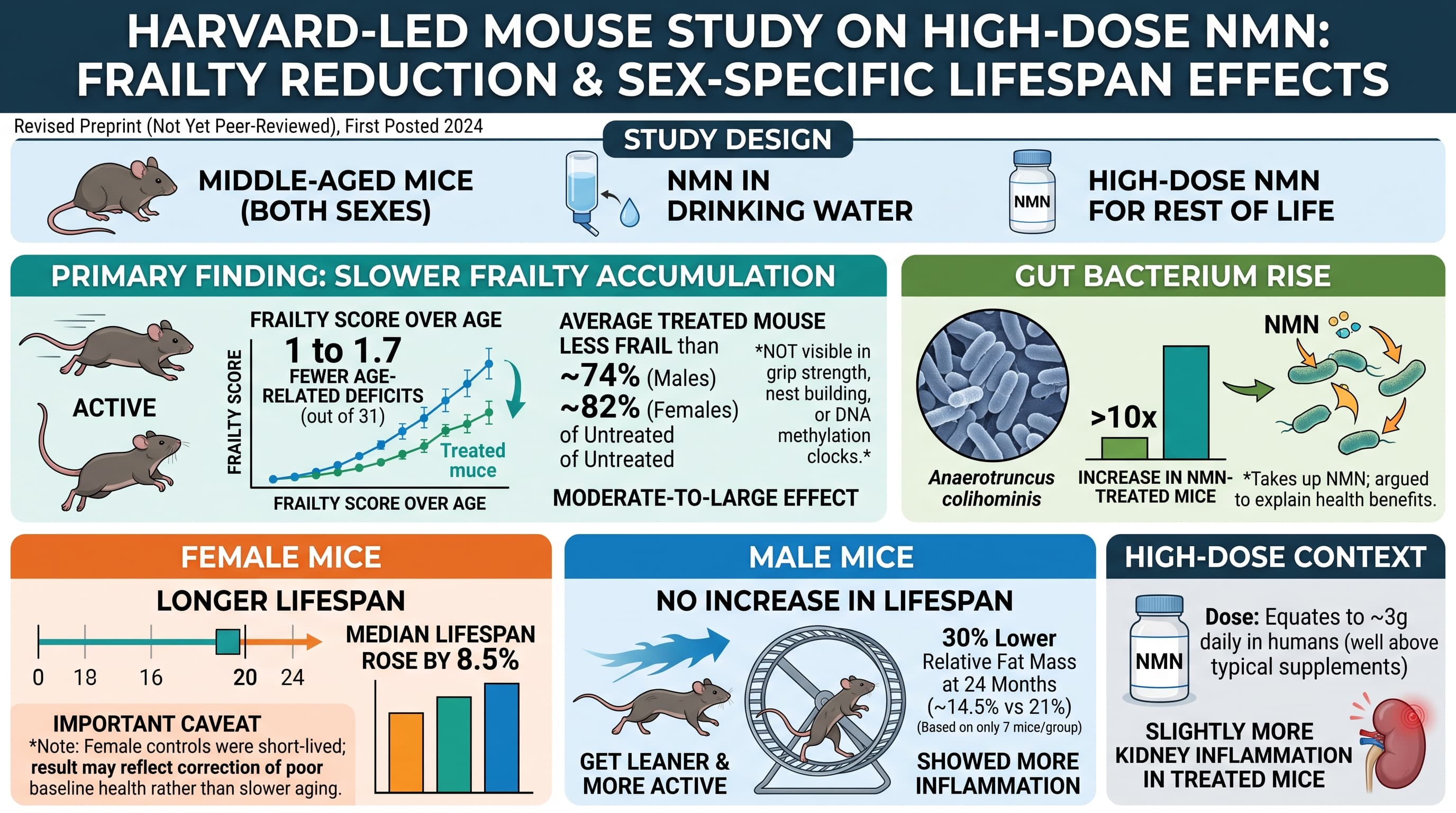
A large, long-running Harvard-led mouse study gave middle-aged mice a high dose of the NAD+ precursor NMN in their drinking water for the rest of their lives. Both sexes accumulated frailty more slowly. Only females lived longer: median lifespan rose by 8.5%. Males got leaner and more active but did not live longer, and their tissues showed more inflammation. The authors also report that NMN caused a more than tenfold rise in a gut bacterium, Anaerotruncus colihominis, which can itself take up NMN, and they argue it helps explain the health benefits. This is a revised, not-yet-peer-reviewed preprint of work first posted in 2024. The female control mice were short-lived, so the lifespan result may reflect a correction of poor baseline health rather than slower aging.
For a decade, NMN has been sold as an anti-aging molecule on the strength of mouse and cell studies that never answered the one question that matters most: does it make a mammal live longer? This study, led by Alice Kane and David Sinclair, is the first serious attempt to answer it, and the answer is a qualified “sometimes.”
The team started C57BL/6 mice on NMN at 13 months of age, roughly the human equivalent of the early 40s. The dose was about 550 mg per kilogram per day, which scales to roughly 3 grams a day for a 70 kg adult, two to three times what human trials usually use. Several hundred mice were followed until natural death, with subsets pulled for health testing and tissue analysis.
The clearest finding is on frailty. Using a 31-item checklist of age-related decline (fur loss, hunched posture, hearing and vision loss, breathing changes), treated mice of both sexes scored better at 18.5 and 21 months. The gain amounts to roughly two and a half months of delayed frailty accumulation.
Lifespan is where the sexes split. Treated females lived about 8.5% longer at the median and 7.9% longer at the 90th percentile. Males showed early separation of survival curves that faded to nothing. Autopsies found no change in tumor burden, which addresses a long-running worry that NAD+ boosters might feed cancer. They did find slightly more kidney inflammation in treated mice.
Males, meanwhile, got the metabolic benefits. They gained less fat in late middle age, burned relatively more fat, and ran around more at night. Yet their liver, muscle and fat tissue showed a gene expression pattern that looked older, not younger: more inflammatory and interferon signaling, less mitochondrial activity. Levels of CD38 and several PARP enzymes, which consume NAD+, went up in males but not females. The authors propose that males burn through the extra NAD+ on DNA repair and inflammation, while females route it into mitochondria. That is a plausible story, but it remains a hypothesis.
The gut microbiome adds a new layer. Isotope tracing suggests that much oral NMN is broken down and reprocessed by gut bacteria before the body uses it. A. colihominis, a butyrate producer previously linked to lower neuroinflammation and enriched in human centenarians, jumped more than tenfold with treatment, and the bacterium took up labelled NMN in culture. The authors float an A. colihominis probiotic as a partner to NAD+ precursors.
The big caveat is the controls. The untreated females died at a median of roughly 26 months, around 790 days. A widely used benchmark holds that healthy lab mice should reach about 900 days before a lifespan gain can be credited to slower aging. Even the NMN-treated females fell short of that line. The more cautious reading is that NMN helped unhealthy female mice catch up toward a normal lifespan. That still matters, since many humans age in less-than-ideal conditions, but it is not the same thing as slowing aging.
Actionable Insights
- NMN is not a proven lifespan drug. In this study it extended life only in female mice whose untreated lifespan was below normal, and not in males whose controls lived about as long as healthy mice should. The earlier NIH test of a closely related molecule, nicotinamide riboside, found no lifespan benefit in either sex.
- The most consistent benefit was slower frailty. Treated mice of both sexes carried roughly 1 to 1.7 fewer age-related deficits out of 31. The average treated mouse was less frail than about 74% (males) to 82% (females) of untreated mice. That is a moderate-to-large effect in mice, but it did not show up in grip strength, nest building, or DNA methylation clocks.
- In males, fat mass at 24 months was about 30% lower in relative terms (roughly 14.5% vs 21% body fat), based on only 7 mice per group.
- The mouse dose equates to about 3 g per day in humans, well above typical supplement doses. At that dose, treated mice had slightly more kidney inflammation. [Confidence: Medium]
- Sex may matter. Men and women could respond differently, and no human data yet tests this.
- Your gut bacteria may help determine how much NMN you actually use.
Context and Source
- Open Access Paper (Preprint): Long-term NMN treatment increases lifespan and healthspan in mice in a sex dependent manner
- Institutions: Blavatnik Institute, Harvard Medical School (lead) and the Institute for Systems Biology, Seattle, with contributors from the University of Pennsylvania, Brown University, the University of Rhode Island, NIA/NIH, UNSW Sydney, UT Health San Antonio, ETH Zurich and others
- Country: United States (lead), with Australian, Swiss and Austrian collaborators
- Journal: None (preprint server)