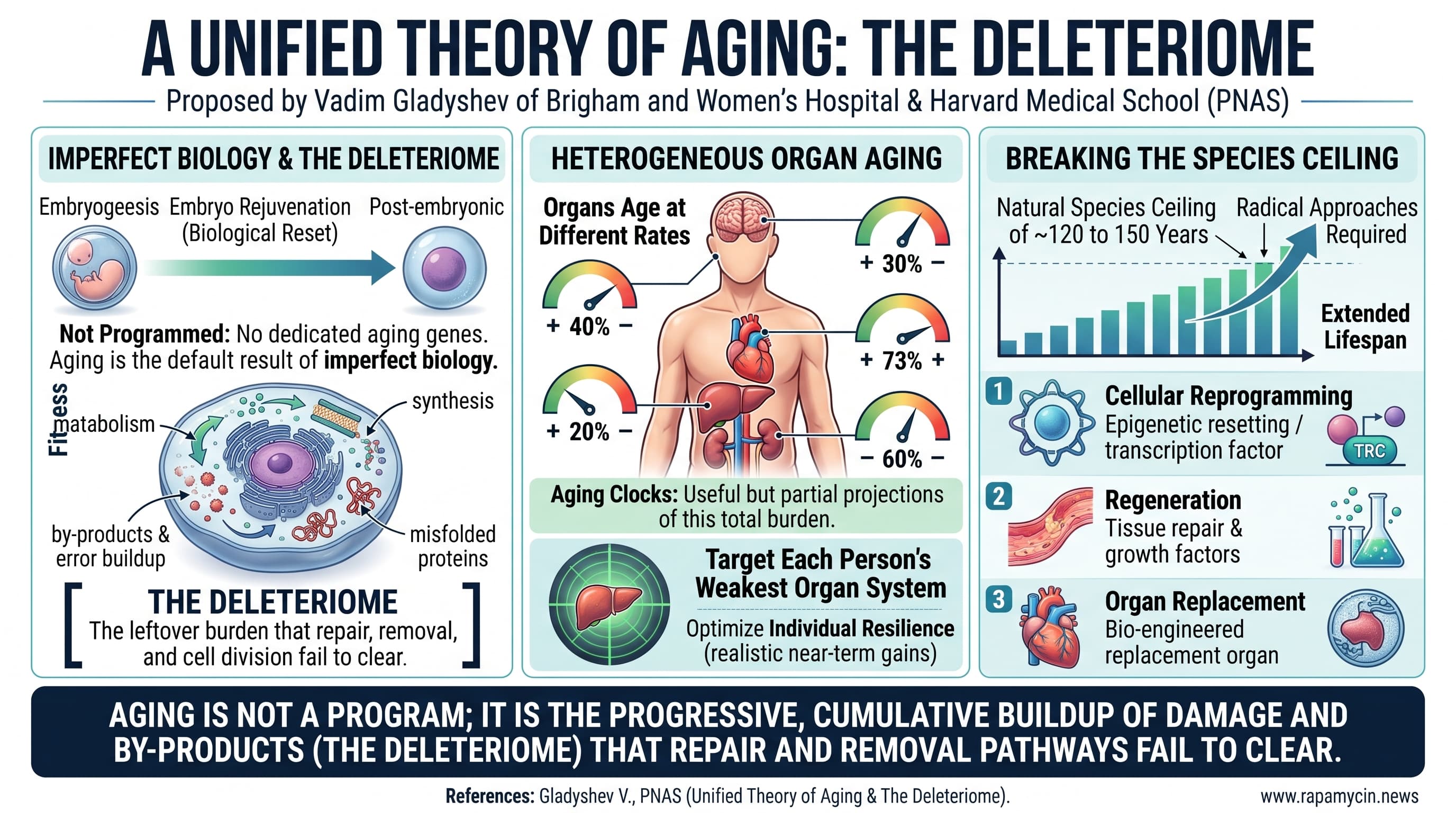
In his National Academy of Sciences inaugural article, Vadim Gladyshev of Brigham and Women’s Hospital and Harvard Medical School sets out a unified theory of aging. He argues that aging is the default result of imperfect biology. Every process in a living cell produces errors and by-products, and the leftover burden that repair, removal, and cell division fail to clear is what he calls the “deleteriome.” Aging is not programmed, there are no dedicated aging genes, and it starts after a natural rejuvenation in the early embryo. Aging clocks are useful but partial projections of this burden. Organs age at different rates. The most realistic near-term gains come from targeting each person’s weakest organ system and improving resilience. Breaking the species ceiling of roughly 120 to 150 years would need radical approaches such as reprogramming, regeneration, and organ replacement.
Biological aging resists a single mechanistic narrative. Researchers have long debated whether it is a programmed process, a loss of homeostasis, or the accumulation of molecular damage. A new unifying framework proposes that aging is simply the default outcome of living. Living systems operate under strict physical constraints and perform biological work imperfectly. These ongoing biological functions continuously generate errors, metabolic byproducts, and regulatory drift. Over time, this composite burden of deleterious changes accumulates into what is termed the deleteriome.
The deleteriome provides a cohesive way to view aging without reducing it to individual genes or isolated pathologies.Evolution does not program an organism to age. Instead, it selects for maintenance and renewal capacities that oppose deterioration, constrained by unavoidable energetic trade offs. Organisms naturally accumulate this residual burden because perfect damage clearance is biologically impossible for differentiated tissues. Aging officially begins early in development. Mammals experience a brief embryonic phase of rejuvenation that establishes a biological ground zero, the state of minimal damage. After this point, the deleteriome steadily rises, running in parallel with organismal development and maturation.
This perspective drastically shifts how clinical longevity interventions must be evaluated. Current biological aging clocks measure statistical projections of molecular states rather than the underlying deleteriome itself. While epigenetic and proteomic clocks provide useful proxies, they often conflate true age related damage with adaptive biological responses to that damage. Consequently, slowing aging requires more than superficially shifting an omic biomarker. It requires durably flattening the trajectory of functional decline across multiple distinct organ systems.
Organisms do not age uniformly. Different tissues accumulate deleteriome burden at different rates, creating localized states of accelerated aging that eventually manifest as distinct chronic diseases. Identifying and treating these distinct biological age patterns offers a highly effective route to increasing mean human lifespan. If interventions are applied universally, they fail to address the specific vulnerabilities of individual patients. A personalized diagnostic approach can identify an individual’s fastest aging organ system, their weakest physiological link, and target it with precise therapies before it triggers whole organism failure.
Maximal human lifespan features a soft limit dictated by our evolved systems level maintenance. Overcoming this ceiling demands more than lifestyle modifications or single drug regimens. Model organisms demonstrate that stabilizing system robustness decouples aging from mortality acceleration. For example, naked mole rats accumulate biological damage yet exhibit negligible Gompertzian mortality acceleration. Achieving similar outcomes in humans requires new classes of interventions. Long term strategies must explore partial cellular reprogramming, regeneration driven rejuvenation,heterochronic systemic modulation, and the targeted replacement of failing multiorgan systems. Until those radical technologies mature, the immediate medical imperative is to stabilize human physiological resilience and minimize the environmental fluctuations that transform accumulated biological burden into lethal clinical events.
Practical longevity depends on slowing the accumulation of the deleteriome and mitigating the failure of your fastest aging organ systems. Generic longevity protocols are suboptimal. Individuals must utilize multi system biomarkers to identify their specific physiological weak links, such as a rapidly aging kidney or cardiovascular system, and target therapies directly to that bottleneck before pathology develops.
The real world magnitude of optimizing this system level maintenance is substantial. The global mean lifespan is currently 73 years, yet populations with optimized environmental and lifestyle factors approach a mean lifespan of 90 years. This demonstrates a 17 year absolute effect size available through the reduction of lifelong deleterious exposures and the strengthening of baseline resilience. Furthermore, intrinsic human lifespan is up to 50 percent heritable. The remaining 50 percent variance is highly modifiable through actions that reduce damage flux, such as avoiding chronic overnutrition, minimizing avoidable toxins, and preserving robust repair systems through consistent aerobic and resistance exercise. Future interventions that effectively target individual organ ageotypes possess the potential to square the survival curve, moving the average biological failure point closer to the 120 year species ceiling.
Source and Context
- Open Access Paper: Simply aging , (Published November 6, 2026).
- Institution: Brigham and Women’s Hospital, Harvard Medical School Country: United States * Journal Name: PNAS
- Impact Evaluation: The impact score of this journal is 11.1, evaluated against a typical high-end range of 0 to 60+ for top general science, therefore this is a High impact journal.