After some study I think it is the mtDNA germline. A point I have made to the US government and the Uk government. I will press this more firmly in the UK because I have the contacts, but it is a global issue.
Problem is, ChatGPT will tell you a bunch of bullshit to keep you happy depending on the prompt you give it. It is sycophantic and wants to please you, instead of pushing back if you raised a bad theory or proposition. You need to take a much more adverserial approach if it gives you an answer like this.
So my question is: is it actually a base truth that we are getting dumber, or is that simply based on your observation? I ask because every single generation has said the younger ones are worse. (https://www.washingtonpost.com/politics/2024/04/29/history-generations-disagreements/) If you’ve been teaching high school since 1989, then you’re officially an old fart now (sorry) and you’ve reached the “get off my lawn” stage when you can start complaining about younger generations!! ![]()
So I asked ChatGPT Pro ($200/month version) to draw up an unbiased assessment. After some research, there are some conclusions:
- 20th century: IQ test performance rose dramatically across much of the world (the “Flynn effect”). Meta‑analyses put the typical gain around +2–3 IQ points per decade.
That’s pretty amazing. As a species globally we’ve benefited from good nutrition, global peace and prosperity, eradication of a ton of childhood disorders, and an education system which has generally been improving. That has lead to decades of steady increases, which is an incredible achievement. By reducing child poverty, malnutrition etc, we allow people to reach their full potential.
- Globally: IQ gains still appear in many lower‑ and middle‑income countries; the worldwide picture is mixed”
However, there is indeed some truth to declines in wealthy countries:
- Since the 1990s–2010s: Several high‑income countries show plateaus or decline in cognitive test scores and in large-scale school achievement tests (e.g., PISA, NAEP). These reversals are **not well explained by genetics; the best causal evidence points to **environmental factors.
- OECD PISA 2022 reported an unprecedented drop across OECD countries vs. 2018: ~−15 points in math and −10 in reading on average (roughly three‑quarters of a school year).
Massively disrupting school during the pandemic caused a lot of damage, but some of the changes did pre-date the pandemic.
When looking at chemicals specifically, it seems that the evidence is not very strong for most of them. While some those chemicals have definitely been linked to low IQs - particularly if exposed in utero, the exposures don’t really correlate with changes in test performance.
- The most solid evidence is for lead, methylmercury, certain organophosphate (OP) pesticides, and legacy flame retardants (PBDEs). Effect sizes in prospective cohorts are on the order of a few IQ points per typical exposure contrast.
However:
The sharpest drops in lead, PBDEs, and Mercury came before the test-score declines seen in the late 2010s–2020s. If anything, those exposure trends would tend to raise average performance, not lower it.
I would ask: why take the leap to assume it’s chemicals? It’s a convenient simple answer, but “environmental factors” can mean a lot of things. We have electronic devices distracting people to a greater extent, and distraction is massively detrimental to learning. Teenagers spend 5-8 hours per day on screens and they are sleeping worse than ever before. It also means they are less physically active, and spend less time reading. Childhood obesity is higher than ever before. All of those are going to negatively affect educational outcomes.
I would also venture that parents are busier and probably spend less time with their children, (and the parents are probably also addicted to electronic devices!) I’ve read anecdotes of elementary school teachers saying more kids lacking basic life skills, can’t put on their own shoes, some still wearing nappies/diapers. Those are failures of parenting.
I asked my ChatGPT to rank the most likely causes of drops in test performance, based on which have the strongest evidence. I’ve summarised the findings it came up with:
- Lost instructional time. Chronic absence from school
- Heat exposure, including lack of AC in schools. Massive negative influence on learning apparently
- Air pollution. Indoor air quality affects cognition and learning outcomes
- Digital distractions and attempted multitasking
- Poor sleep schedules in children, particularly adolescents
- Parental engagement
- Noise pollution (this one surprised me)
- Reading for pleasure has almost disappeared in children
- Poorer early-childhood education (pre-schools etc). Economic/time issues
- Economic stress, housing insecurity, food insecurity
- Lower physical activity
- Teacher quality, teacher shortages, teacher passion
Plenty of reasons other than chemicals IMO
Re: Flynn Effect
Honestly, I feel bad for the younger generations. AI is replacing entry-level jobs at a terrifying pace. How is a college graduate supposed to make a living?
I was talking to a recent college grad about their job prospects. He’s been looking for a job for over a year and has complained that all the entry-level jobs in the USA required 5 years of experience. How does that work?
I have to admit that I am struggling more than usual with school this year. I hope to retire and move on to an adjunct position in the Physics department at the nearby university. So, I’m sort of in reflection mode right now. I’m constantly looking back at the years in public ed. Although through the years, I’ve always critically examined what I’m doing in the classroom to adapt and remain successful. I could easily continue in my current position because of that trait and the fact that my students consistently score above the average on the state science test. This is what makes teaching an incredibly difficult job. Constantly having to examine and compensate for the abrupt changes in culture that we feel first here in the classroom For me it’s been drug epidemics, wars, financial crisis, pandemics, and now phones. My curriculum has gone from paper and pencil to complete digitalization with the ability to go completely remote, and lab activities have gone from stopwatches and meter sticks to motion sensors, accelerometers, interfaces, laptops, and graphing software.
I’m also a parent and both of my kids have passed through my classroom. My son is in law school and my daughter went to work for a survey company immediately after graduating with her bachelors in a GIS environmental field. However, both struggle with issues related to phones and social media. It was a real crisis for our family and nothing like I ever encountered with previous generations.
I’m usually quick to blame phones for the lack of attention in the classroom. But, after backpacking the Haute route from Chamonix to Zermatt this summer I began to feel like our physical environment in the USA might also be to blame for attention problems. Compared to the north american backpacking adventures that I have had there were so many more teenagers out on the extremely tough trails of the alps. Whole gangs of school aged boys and girls hiking at incredible paces up down the trails of France and Switzerland. The food and water we encountered was amazing. Everyday we were powered by wholesome dinners, breakfasts, and glacial water.
We got home days before school started (my wife teaches math) in total culture shock. I’ve never felt less ready for school to start with my perspective on health and society turned upside down. I’ve been trying to make sense of it in my classroom and as a parent of kids here in the USA. Hence, my consultations with Chatgpt.
Politics in the USA can’t be ignored as a major factor affecting children and school. Politics have played a huge role in the state of affairs in science education and education in general. Funding and autonomy have reached a new low. Now, as a result the profession isn’t very attractive and very few students are entering teacher training . We have at least 3 uncertified teachers in positions in math and science in my small school. We also were unable to adopt nation wide science standards because of politics. Climate change, evolution, vaccines, etc. are now all controversial to teach. I still cover these topics carefully, so I don’t get parental complaints.
Climate change is especially personal for me. I’m an avid cross country skier. I moved to the lake Superior region for the abundant snow and long winters. I ski everyday after school and have been dreaming of all day outings when I retire. Alas, climate change has different ideas. We now have marginal snow throughout the winter with much later start dates and earlier melt offs. Many races are cancelled every season.
If I’m having a “get off my lawn” moment it is because my lawn is poking through the snow in December when it should be a foot deep. ![]()
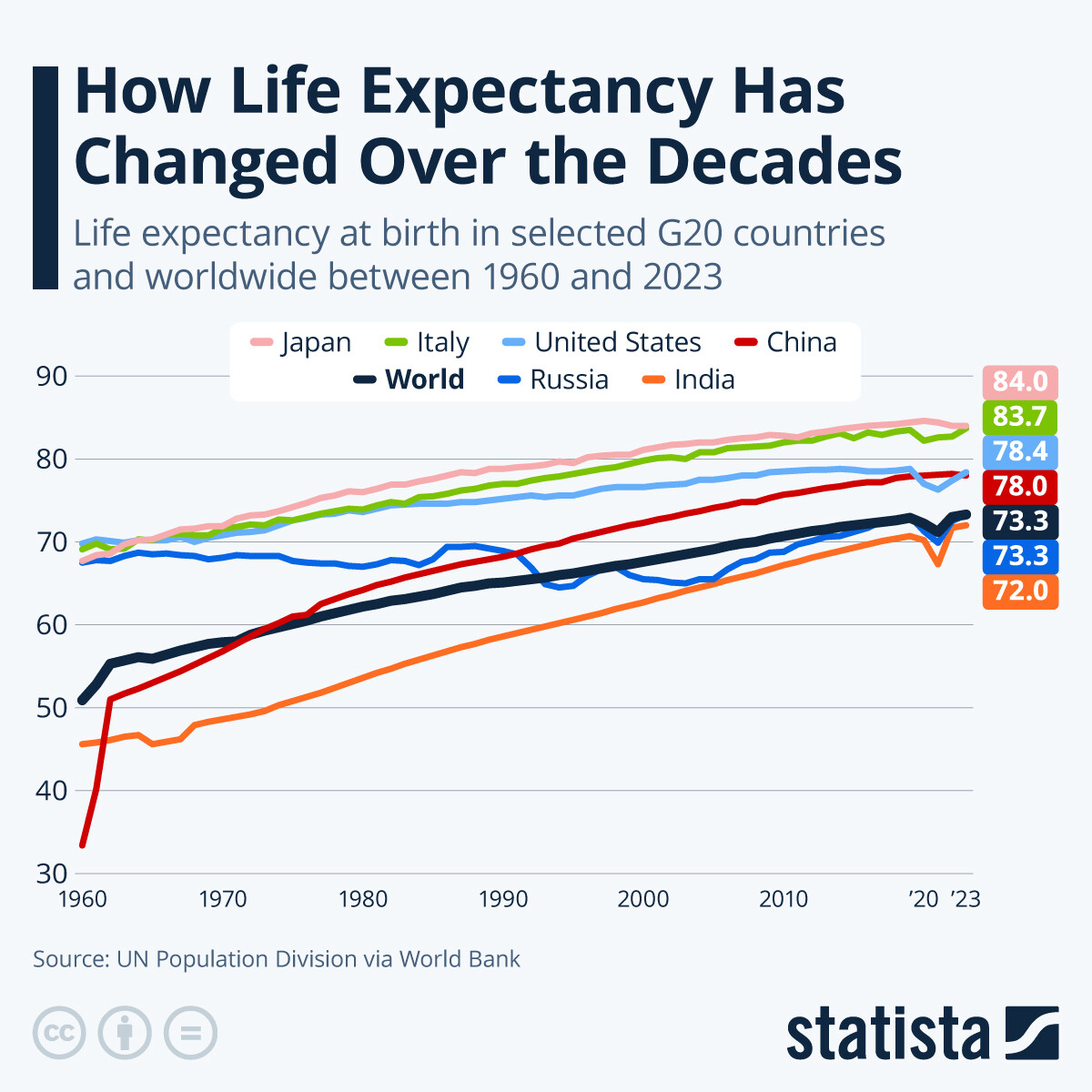
I think we may be turning a corner here… With future growth in life expectancy to follow…
After decades of trying it appears telling fat people to move more and eat less finally worked!
Seems like something every country should measure their success by… improving healthy lifespan.
China targets increasing average life expectancy to 80 years
By Wang Xiaoyu | chinadaily.com.cn | Updated: 2025-10-24 11:32
China aims to increase the average life expectancy to 80 years over the next five years, up from 79 at the end of 2024, Health Minister Lei Haichao said at a news conference on Friday.
Lei said the target is based on an analysis of international development trends, current progress in healthcare, and the country’s overall national strength.
This video says it all. Americans under 50 are dying earlier for one major reason.
No. It’s the GLP-1RAs! People are eating just as much and moving just as little as ever ![]()
Why are people taking those drugs, if the danger of ODing is so great? There must be a reason(s). If you want to prevent those deaths, what do you do? What is the approach in formulating a policy to decrease those deaths? Does that policy address the reason(s) for taking those drugs or does the policy not address those reasons and instead tries to solve the problem somehow differently? Substance abuse and dependence has been with us since the dawn of time and not been solved. Wonder why that is. Why is the problem bigger in some countries than others?
But the first and most fundamental question is: why do people take those drugs if the danger of ODing is so great?
My guess is that a rather small percentage of the ODs can be chalked up to experimentation, but mostly it’s because for a huge percentage of the population life sucks in the USA, and drug use is a escape from malaise and sorrow engendered in and by the difficulty of life in this society. I see it daily in the major US city I live in.
The same reason people still drink and drive. It won’t happen to me.
![]()
Because Purdue Pharma marketed their opioids as non addictive pain killers so a lot of people got it from their doctors for pain treatment and got hooked.
From BBC: Why opioids are such an American problem
Honestly, I am assuming a large proportion of the ODs could be due to fentanyl. It’s amazingly addictive, deadly and drug dealers usually lace normal drugs with it to increase sales. Fentanyl is horrible.
It seems to be a fairly “US centric” problem. Hong Kong, where DeStrider is from, and much of East Asian, seemingly doesn’t have many overdoses. I would guess that’s from a policy of extremely strict drug laws which are very strongly enforced at every level. Japan, Singapore, Taiwan, South Korea - all have extremely harsh penalties for drug offences and very tight border controls.
And culturally, I reckon the population is much less open minded to using drugs in the first place. There is strong stigmatism against drug users. The societies in general are less “me me me”. You don’t have rappers and celebrities etc on TV boasting and glamourising drug use. And I have to wonder whether population education levels have something to do with it, but that’s pure speculation.
I do agree, but I don’t think that’s US-specific. Millions of people across Asian countries are packed into tiny apartments, with crushing working hours, low salaries and almost no time off. Plus a shitload of cultural and societal pressures.
Yes, drug offences are very serious in Hong Kong. It may be even worse in places like Singapore.
Any person who has in his possession; or smokes, inhales, ingest or injects a dangerous drug, shall be liable upon conviction to a fine USD$ 125,000 and imprisonment for 7 years.
That’s enough to deter me, not that I’d ever want to touch the stuff. The prisons here are full of unwitting mules and drug traffickers.
In 2023, there were 105,007 drug overdose deaths in the United States, a nearly 3% decline from 2022.
In 2021, there were 36 drug overdose and poisonings in Hong Kong
Since the USA is 50X larger, adjuster per capita, that would be about 1,800 ODs in Hong Kong. However, that figure also includes all other poisonings including suicides (drinking floor cleaner is a popular suicide method and would be counted). Either way, it’s a big difference!
CDC: Life Expectancy Increased in Most States in 2022
Their latest report. However, as their 2019 visualization shows, life expectancy still hadn’t caught up to pre-pandemic levels:
https://www.cdc.gov/nchs/data-visualization/state-life-expectancy/index_2019.htm
Yes there is.