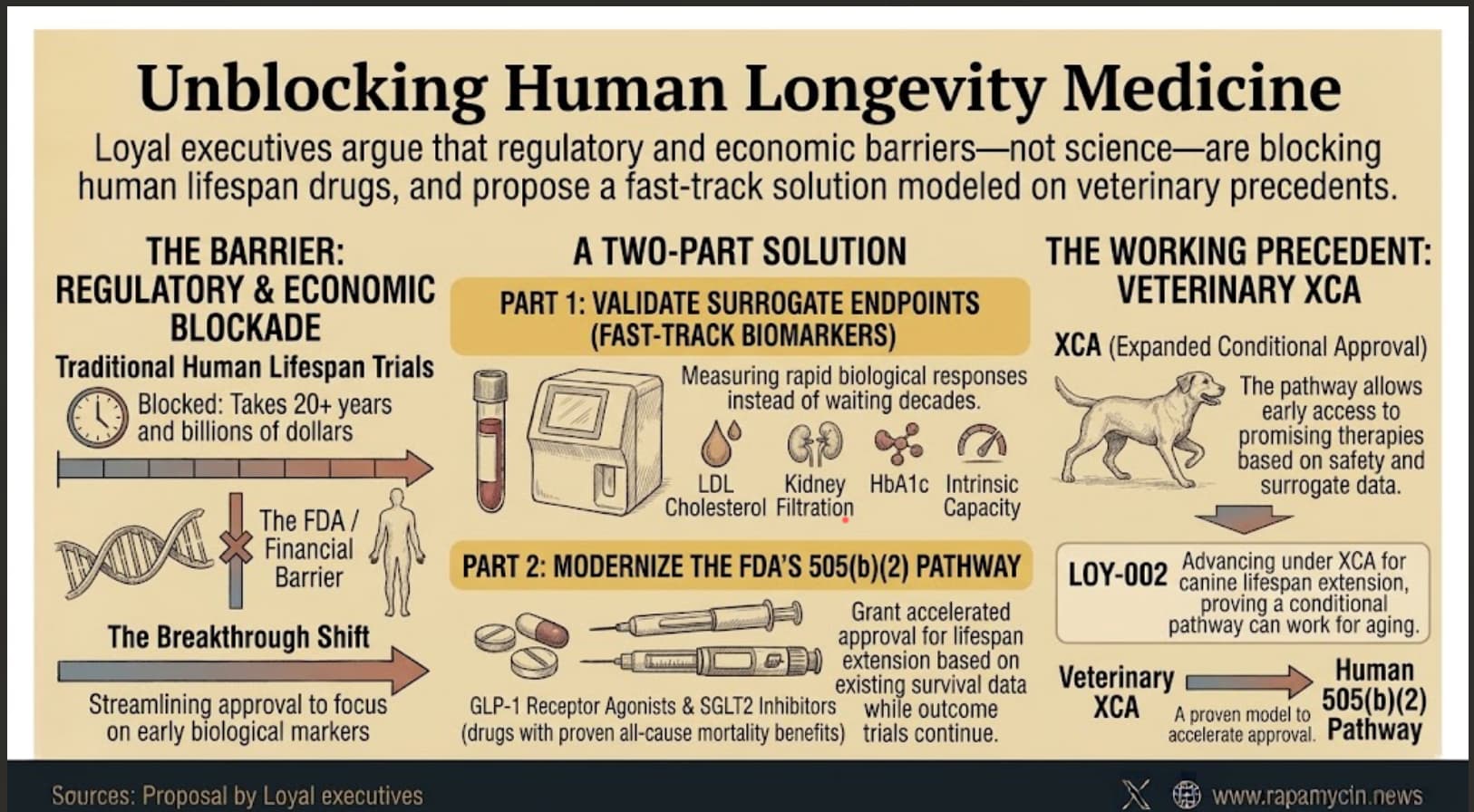
Three executives from Loyal, a San Francisco company developing lifespan drugs for dogs, argue that human longevity medicine is blocked less by science than by regulation and economics. Their proposal has two parts. The first is to validate surrogate endpoints that respond quickly enough to measure, such as “intrinsic capacity” or established biomarkers like LDL cholesterol, kidney filtration and HbA1c. The second is to change the FDA’s 505(b)(2) pathway so that already-approved drugs with proven all-cause mortality benefits, chiefly GLP-1 receptor agonists and SGLT2 inhibitors, can get accelerated approval for lifespan extension while outcomes trials continue. They point to the veterinary expanded conditional approval (XCA) pathway, under which Loyal’s LOY-002 is advancing, as working precedent. The piece is an opinion commentary with no new data.
There is no approved drug for aging. The authors argue the main obstacles are not biological. They are the clock and the money.
A human trial with lifespan as its endpoint would need thousands of older participants followed for decades and would cost billions. Even if it succeeded, the sponsor would get only a short window of market exclusivity. Under those terms almost no company will run such a trial, and those with the resources to do it have little reason to try.
The authors work at Loyal, which is trying to get the first drug approved specifically to extend lifespan in any species. In dogs, a regulatory route already exists. Under 2018 legislation, the FDA’s Center for Veterinary Medicine can grant conditional approval to an animal drug when demonstrating efficacy requires long and expensive studies. A sponsor that shows safety, consistent manufacturing and a “reasonable expectation” of benefit from shorter studies (improved metabolic function, for instance) can sell the drug while the definitive trial runs. Conditional approval lasts one year and can be renewed annually for up to five years if the company shows progress.
Loyal’s lead candidate, LOY-002, is a daily pill for dogs aged 10 or older and weighing at least 14 pounds. It aims to correct age-related metabolic dysfunction. Its pivotal STAY trial has enrolled 1,346 dogs at 73 US clinics and will run at least five years, with lifespan as the primary endpoint. The FDA has accepted LOY-002’s efficacy and safety sections. Manufacturing review remains, and the company expects that in 2027.
The commentary proposes a parallel route for humans. Drugs already approved and already shown to reduce deaths from all causes in several diseases could be granted accelerated approval for lifespan or mortality reduction. Eligibility would require a good post-marketing safety record, action against common age-related changes such as insulin resistance or early atherosclerosis, and measurable biomarkers that track the drug’s effects. GLP-1 drugs such as semaglutide and SGLT2 inhibitors such as dapagliflozin are the obvious first candidates. Full approval would still depend on outcomes trials.
The proposal also depends on better ways to measure aging in people. The authors highlight ARPA-H’s PROSPR program, which funds VITAL-H. That $38 million trial will test rapamycin, dapagliflozin and semaglutide against placebo in 726 adults in their early 60s, using intrinsic capacity, a composite of physical and mental function, as the outcome.
There is a reasonable argument here. Dogs share our homes, our diets and many of our diseases, so a positive lifespan result in a diverse population of pet dogs would mean more than another mouse study. The proposal’s weaknesses are equally clear. No lifespan drug has yet received conditional approval in dogs, so the “precedent” is a process, not a result. The mortality benefits of GLP-1 and SGLT2 drugs have been shown in sick people, not healthy ones. Human medicine also has a long record of drugs that improved a biomarker while failing to improve, or even worsening, survival. The authors acknowledge some of these limits.
Actionable insights
The commentary contains no new data, so its practical value comes from the evidence it cites.
- In the SELECT trial, semaglutide given to people with overweight or obesity, established heart disease and no diabetes cut deaths from any cause from 5.2 percent to 4.3 percent over about three years. That is a 19 percent relative reduction, roughly 1 death prevented for every 111 people treated. Across SGLT2 inhibitor trials in diabetes, heart failure and kidney disease, the risk of death fell by about 11 to 16 percent.
- VITAL-H is the trial to watch. It is the first rigorous test of whether these drugs preserve function in healthy people in their 60s.
- Dog owners should know that LOY-002 is not yet available for commercial sale, and its effect on lifespan is still unknown.
Context and source
- Open Access Paper: Lessons from dog lifespan therapeutics for their human companions
- Institution: Loyal Animal Health, San Francisco, California
- Country: United States
- Journal: GeroScience (Springer; official journal of the American Aging Association)
-
Funding and conflicts: Funded entirely by Loyal. All three authors are Loyal employees and/or shareholders.
Impact evaluation: The impact score of this journal is 5.4, evaluated against a typical high-end range of 0-60+ for top general science, therefore this is a Medium impact journal.