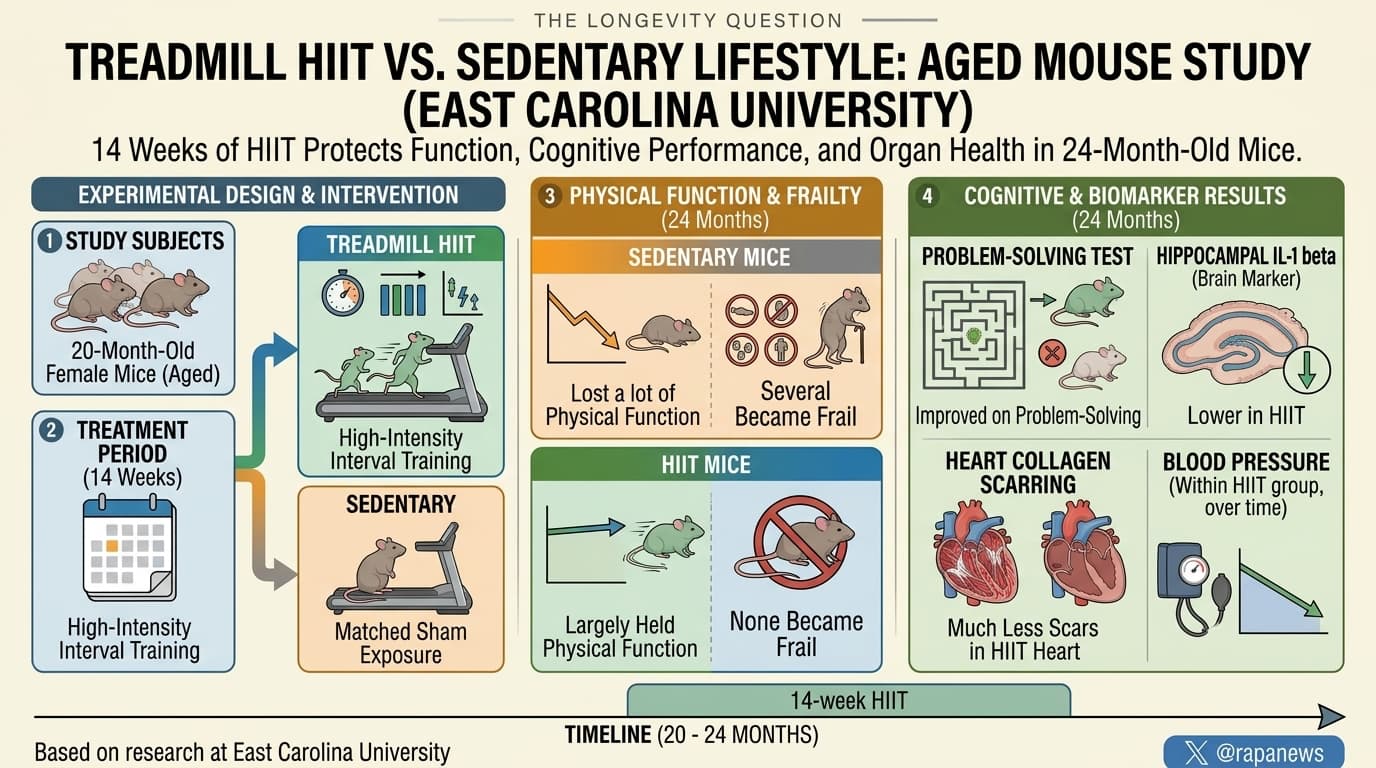
Researchers at East Carolina University gave 20-month-old female mice 14 weeks of treadmill high-intensity interval training (HIIT) and compared them with sedentary mice that received a matched sham treadmill exposure. By 24 months of age, the sedentary mice had lost a lot of physical function and several had become frail. The HIIT mice largely held on to their physical function, none became frail, and they improved on a problem-solving test. They also had lower hippocampal IL-1 beta, lower blood pressure within their own group, and much less collagen scarring in the heart. The study is small.
Mice are not people, and a treadmill is not a spin class. Even so, a new study from East Carolina University gives one of the fullest pictures yet of what hard interval exercise does to an old female body, and most of it is good news.
The team started with 18 female laboratory mice aged 20 months, roughly comparable to people in their early 60s, and split them into two groups of nine. One group ran high-intensity intervals three times a week for 14 weeks. Each interval was a one-minute burst at 70 to 80 percent of that mouse’s personal top speed, followed by a minute of walking, and sessions built up to seven bursts. The other group spent the same time on a treadmill that barely moved. By the end, all the mice were 24 months old, the rough equivalent of a person approaching 70.
The sedentary mice declined the way old mice do. Their forelimb grip weakened, and their ability to hang from an inverted wire grid dropped by two thirds. Six of the nine slid into pre-frailty or frailty. The trained mice mostly held their ground. Their top running speed rose by 71 percent, their combined physical-function score barely changed, and none became frail.
The brain and heart results were more surprising. In a puzzle-box test, a mouse has to find its way into a dark hiding place through routes that get harder to use. Trained mice cut their solving time by nearly three quarters, about twice the improvement seen in controls, who also got better with practice. The trained mice’s hippocampus, a region central to learning, carried less IL-1 beta, an inflammatory signal linked to memory problems in ageing. In the heart, sedentary mice had built up large amounts of scar-like collagen in the main pumping chamber. The trained mice had far less, closer to the levels seen in three-month-old animals.
Blood pressure fell too. Systolic pressure in the trained group dropped by about 17 mmHg, which on paper is larger than the typical effect of a single blood pressure drug in people.
The big idea is that exercise does not work on one organ at a time. Muscle, blood vessels, heart and brain seem to respond together, possibly through signalling molecules released during exercise. This appears to hold even when training starts late in life, and in females, who are underrepresented in exercise research.
There are real caveats. The groups were tiny, and the brain analyses used only four mice per group. Many of the headline numbers compare each group with its own starting point rather than with the other group. Compared head to head, several effects, including the blood pressure drop, fall short of statistical significance because the sedentary mice also improved somewhat. The paper also reports different numbers for the same outcomes in its text, tables and figures.
Still, the direction matches decades of human data. It is rarely too late to start training hard, and the payoff may reach well beyond the muscles.
Actionable Insights
- Starting late still works. Training began at roughly the human equivalent of age 60. Translated into human terms, the protocol is modest: about 25 minutes, three times a week, with one-minute hard efforts at 70 to 80 percent of maximum and one to two minutes of easy movement between them, building from 3 to 7 efforts over several weeks.
- The biggest gain is in fitness itself. Top treadmill capacity rose 71 percent with HIIT and did not change without it. The between-group effect size (Hedges’ g of about 1.2) means the typical trained mouse outperformed roughly 88 percent of sedentary mice.
- Expect preservation, not rejuvenation. Whole-body strength endurance still fell 29 to 36 percent with HIIT, compared with 67 percent without it. Intervals slow the decline but don’t stop it, so pair them with resistance training.
- Blood pressure benefit is real but smaller than it looks. Systolic pressure fell about 17 mmHg within the HIIT group. The net advantage over controls was only about 9 mmHg and was not statistically certain.
- Don’t count on fat loss. The trained mice actually gained body fat.
Context and Source
- Open Access Paper: High-intensity interval training in aged female mice preserves physical, cognitive, and cardiovascular function
- Institution: East Carolina University (Departments of Pharmacology and Toxicology, Physical Therapy, Physiology, Kinesiology, and Psychology), Greenville, North Carolina
- Country: USA
- Journal: GeroScience (Springer), published online 10 September 2026
- Impact evaluation: The impact score of this journal is 5.4 (2025 JIF), evaluated against a typical high-end range of 0 to 60+ for top general science, therefore this is a Medium impact journal.