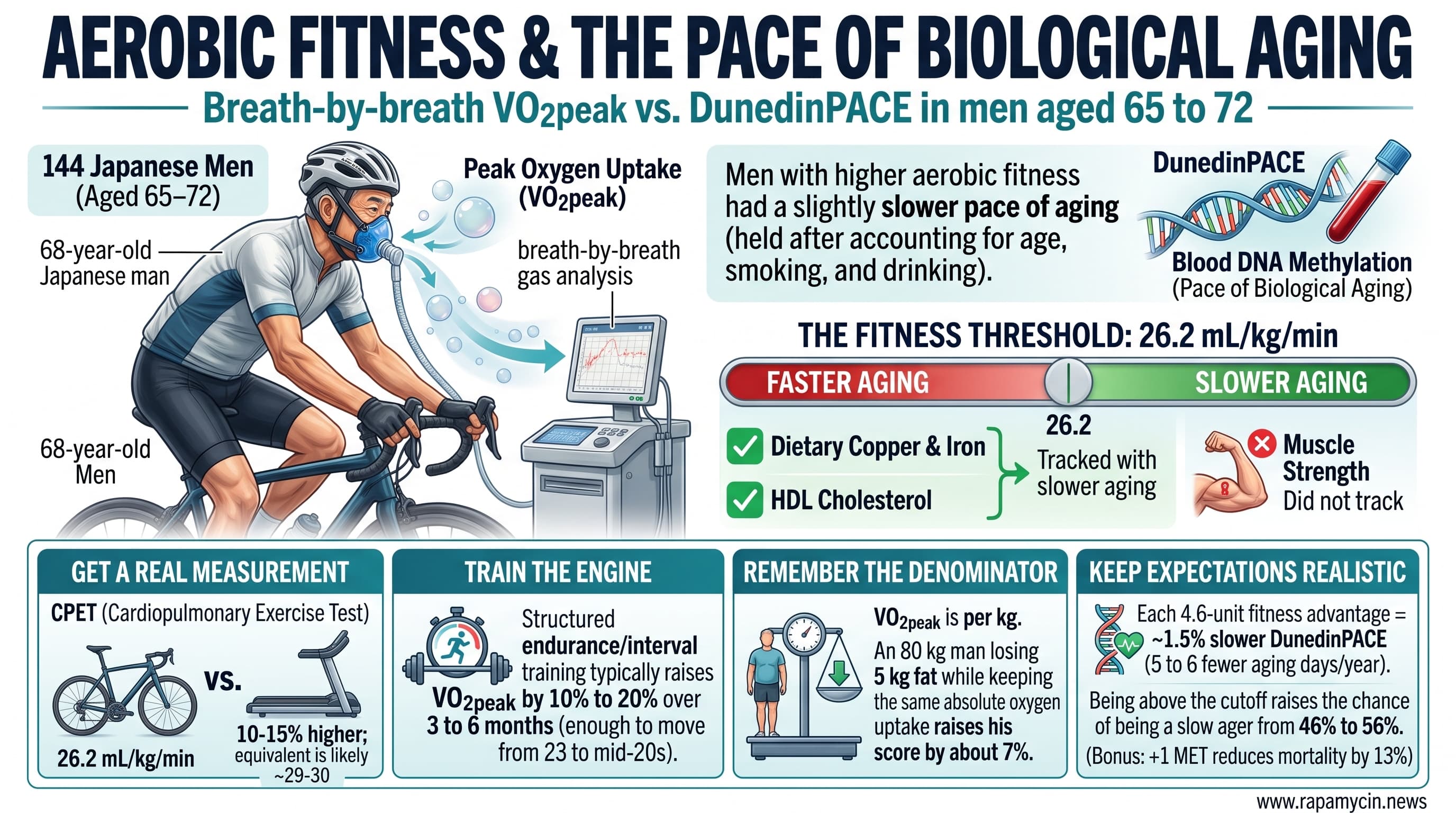
Japanese researchers measured peak oxygen uptake with breath-by-breath gas analysis in 144 men aged 65 to 72 and compared it with DunedinPACE, a blood DNA methylation measure of how fast a person is biologically aging. Men with higher aerobic fitness tended to have a slightly slower pace of aging, and the link held after accounting for age, smoking, and drinking. Using a resampling-based classification analysis, the team proposed 26.2 mL/kg/min as a fitness threshold separating slower from faster agers. Dietary copper and iron intake and HDL cholesterol also tracked with slower aging, while muscle strength did not. The associations were weak, explaining about 3 percent of the variation in aging pace, and the single-timepoint design cannot show that fitness causes slower aging.
Aerobic fitness has one of the strongest track records in longevity research. People who can take up more oxygen during hard exercise live longer and have fewer heart attacks, a pattern that has held across decades of follow-up studies. What has been less clear is whether that fitness shows up in the molecular signals used to track biological aging.
A team led by Takuji Kawamura at Tohoku University and Waseda University tested this in 144 Japanese men aged 65 to 72, all alumni enrolled in a long-running health study. Each man completed a graded cycling test while breathing through a mask that captured every breath, giving a direct measure of peak oxygen uptake, the gold standard for cardiorespiratory fitness. The researchers then analyzed DNA methylation in blood using DunedinPACE, which estimates how many years of biological aging a person accumulates per calendar year. A score of 1.00 means aging at the expected rate; 0.90 would mean about 10 percent slower.
The fitter men did tend to age more slowly by this measure, and the relationship survived adjustment for age, smoking, and drinking. Muscle strength, by contrast, showed no link at all. That points to the heart, lungs, and oxygen-burning capacity of muscle, rather than raw force, as what tracks with the methylation signal.
The team then asked whether a specific fitness level separates slower agers from faster ones. Resampling the data 2,000 times, they settled on 26.2 milliliters of oxygen per kilogram of body weight per minute. That sits above the typical value of about 22.7 for men this age on a cycle test, which the authors read as a sign that above-average fitness is what counts.
Diet appeared in the results too. Men who reported eating more copper and iron per calorie, and men with higher HDL cholesterol, had slower aging scores. Men carrying more visceral belly fat aged slightly faster.
The size of the effect needs to stay in view. Fitness explained roughly 3 percent of the differences in aging pace. In practical terms, a man about one standard step fitter than his peers (4.6 units of oxygen uptake) would be expected to accumulate five or six fewer days of biological aging per year. The cutoff sorted men only modestly better than chance, and the authors concede it has limited value for judging any one person.
There is also a chicken-and-egg problem. Each man was measured once, so the study cannot tell whether fitness slows aging or whether men aging slowly for other reasons find it easier to stay fit. DunedinPACE was also originally built partly from declines in aerobic fitness, so some overlap is baked into the measure.
Still, the work links a trainable trait to a blood-based aging rate in older adults and gives researchers a concrete number to test. The obvious next step is a trial: train older adults past the 26.2 line and see whether their DunedinPACE scores actually fall.
Actionable Insights
- Get a real measurement. A cardiopulmonary exercise test gives true VO2peak. The study’s 26.2 mL/kg/min line was set on a stationary bike; treadmill tests usually read about 10 to 15 percent higher, so the treadmill equivalent is likely near 29 to 30. [Confidence: Medium]
- Train the engine. Structured endurance or interval training typically raises VO2peak in older adults by roughly 10 to 20 percent over three to six months, enough to move a man from 23 to the mid 20s.
- Remember the denominator. The target is per kilogram. An 80 kg man who loses 5 kg of fat while keeping the same absolute oxygen uptake raises his score by about 7 percent.
- Keep expectations realistic. Each 4.6-unit fitness advantage lined up with about 1.5 percent slower DunedinPACE, or 5 to 6 fewer days of biological aging per year. Being above the cutoff raised the estimated chance of being a slow ager from about 46 percent to about 56 percent. The stronger reason to train comes from outcome studies: each extra 1 MET (3.5 units) of fitness is linked to about 13 percent lower all-cause mortality.
- If you take metformin, note that one trial in older adults found it blunted mitochondrial and insulin-sensitivity gains from aerobic training. [Confidence: Medium]
- Copper and iron here were diet estimates, not blood levels. This is not a case for supplements.
Context and Source
- Open Access Paper: Revisiting the relationship between cardiorespiratory fitness and biological aging: insights from DunedinPACE analysis, published 30 October 2025
- Institutions: Smart Aging Research Center, Tohoku University (corresponding author); Faculty of Sport Sciences, Waseda University; with co-authors at Juntendo University, Sophia University, Meiji Yasuda Life Foundation, and the Hungarian University of Sports Science
- Country: Japan (one co-author in Hungary)
- Journal: GeroScience (2026)
- Impact evaluation: The impact score of this journal is 4.9, evaluated against a typical high-end range of 0-20 for aging and geroscience journals (Nature Aging sits near the top of that range), therefore this is a Medium impact journal.