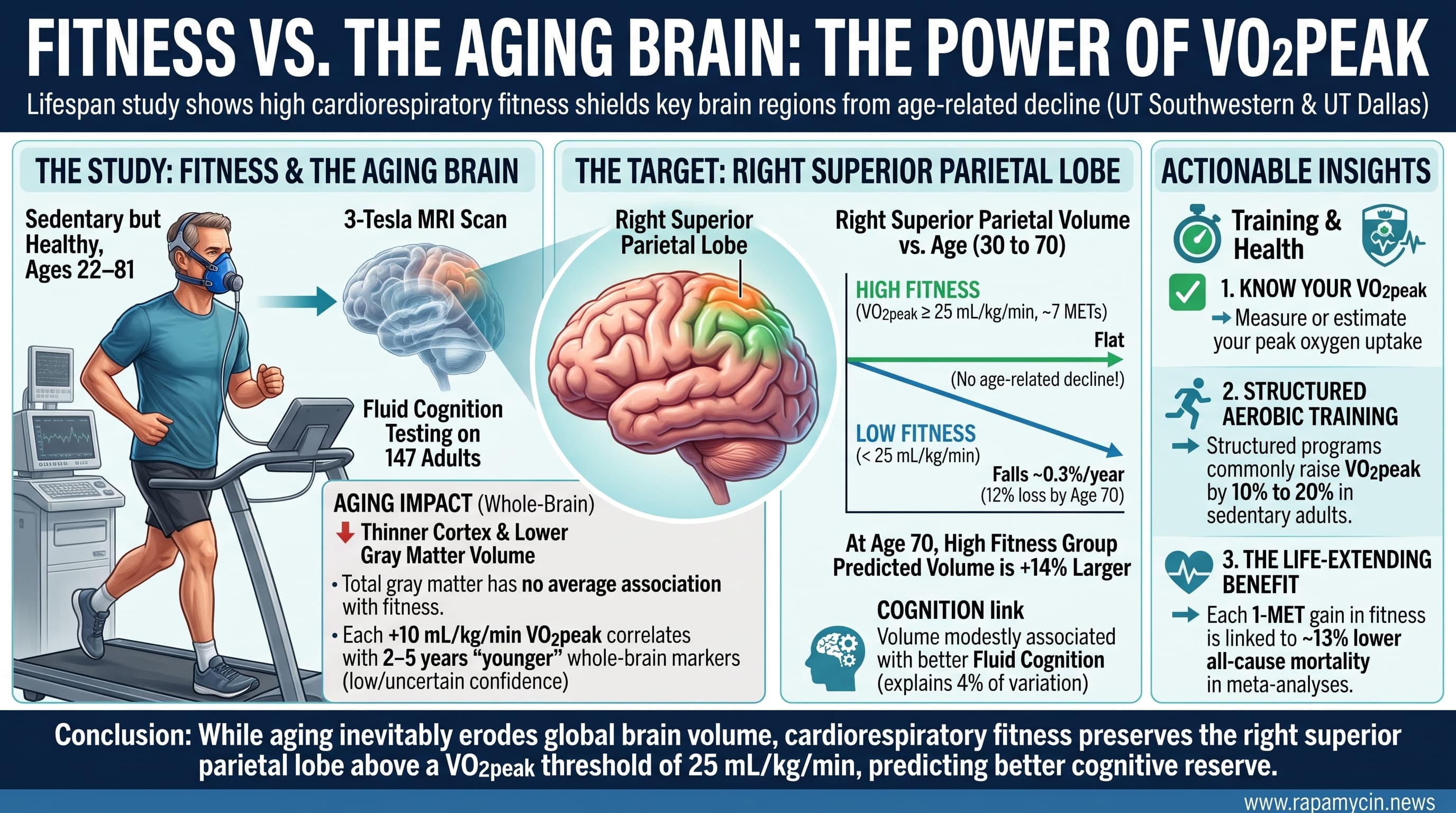
A cross-sectional study from UT Southwestern Medical Center and the University of Texas at Dallas looked at whether cardiorespiratory fitness is linked to brain structure across the adult lifespan. Fitness was measured directly as peak oxygen uptake (VO2peak) on a treadmill. The researchers scanned 172 sedentary but healthy adults aged 22 to 81 with 3-Tesla MRI and tested fluid cognition in 147 of them. Age was strongly associated with thinner cortex and lower gray matter volume throughout the brain. Fitness showed no association with total gray matter or average cortical thickness. One region stood out. In the right superior parietal lobe, volume fell with age among the less fit participants but stayed flat among those above the median fitness of 25 mL/kg/min. Larger volume in this region was modestly associated with better fluid cognition. The findings hint that fitness benefits the brain in specific regions, but they cannot establish cause and effect.
Your brain shrinks as you age. That much is well established, and this study confirms it in detail. Across 172 healthy adults aged 22 to 81, each extra decade of age came with roughly 3 percent less total gray matter and a measurably thinner cortex. The open question is whether anything you control changes that trajectory, and aerobic fitness has long been a leading candidate.
The researchers tested this with unusually rigorous measurements. Instead of relying on questionnaires or step tests, they put every participant on a treadmill and measured peak oxygen uptake directly, collecting expired air until exhaustion. Each person also had a high-resolution brain scan and a cognitive battery covering reasoning, long-term memory, working memory, processing speed and executive function.
The main result is less tidy than most exercise headlines. Once age, sex, education and head size were accounted for, fitness did not predict total gray matter volume or average cortical thickness. A trend toward thicker cortex in fitter people narrowly missed statistical significance. Across most of the cortex, age dominated and fitness seemed not to matter.
One region broke the pattern. The right superior parietal lobe sits near the top and back of the head and supports spatial attention, reasoning and working memory. Here the link between age and volume depended on fitness. Among participants below the median VO2peak of 25 mL/kg/min, volume fell by about 39 cubic millimeters per year, roughly 12 percent between ages 30 and 70. Among those above the median there was no detectable decline. People with more volume in this region also scored somewhat better on fluid cognition, even after accounting for age and fitness.
It makes sense that fitness would matter here. The parietal cortex is among the regions that thin early in mild cognitive impairment and Alzheimer’s disease, and earlier studies have linked fitness to parietal structure and blood flow. The region also sits in a vascular border zone where blood flow drops with age, so better cardiovascular function could plausibly protect it.
This is a single snapshot in time, so it cannot show that fitness slows brain aging within any one person. Fitter older adults may differ from less fit peers in body weight, blood pressure and medication use, and none of these were adjusted for. The sample was mostly white, highly educated and deliberately sedentary, which limits both who the results apply to and the range of fitness studied. The effect appeared in only one region of the cortex, and only for volume, not thickness.
What the study adds is gold-standard fitness measurement applied across the whole adult lifespan rather than only in older adults, plus a specific anatomical target for future trials. The real test will be randomized studies that raise VO2peak and track the right superior parietal lobe over years. Until then, the result is a promising signal rather than proof.
Actionable Insights
- The fitness line that mattered was a VO2peak of about 25 mL/kg/min, roughly 7 METs. Above it, right superior parietal volume showed no age-related decline. Below it, volume fell about 0.3 percent per year, around 12 percent from age 30 to 70. At age 70, the fitter group’s predicted volume was about 14 percent larger. [Confidence: Low to Medium]
- At the whole-brain level, the fitness effect was small and statistically uncertain. Each extra 10 mL/kg/min of VO2peak corresponded to total gray matter about 2 years “younger”. The data are consistent with anything from 4 years older to 8 years younger. Average cortical thickness looked somewhat better, about 5 years “younger” per 10 mL/kg/min, but this narrowly missed significance. [Confidence: Low]
- The link between parietal volume and cognition is modest. After adjustment, parietal volume explained roughly 4 percent of the person-to-person variation in fluid cognition. [Confidence: Medium]
- The practical move is to know your VO2peak, either measured or estimated, and train to raise it. Structured aerobic programs in sedentary adults commonly raise VO2peak by 10 to 20 percent. In meta-analysis, each 1-MET gain in fitness is associated with about 13 percent lower all-cause mortality. Treat the brain-structure benefit as a plausible bonus on top of well-proven cardiometabolic benefits, not a proven effect in its own right. [Confidence: Medium]
Context and Source
- Open Access Paper: Associations of cardiorespiratory fitness with cerebral cortical thickness and gray matter volume across the adult lifespan, 2025.
- Institutions: University of Texas Southwestern Medical Center (Department of Neurology); Institute for Exercise and Environmental Medicine, Texas Health Presbyterian Hospital Dallas; Center for Vital Longevity, University of Texas at Dallas; National Institute of Advanced Industrial Science and Technology, Japan (co-affiliation)
- Country: United States
- Journal: Journal of Applied Physiology (American Physiological Society), 2025.
- Impact evaluation: The impact score of this journal is approximately 3.0 (Clarivate JIF; Scopus CiteScore approximately 5.9), evaluated against a typical high-end range of 0 to 60+ for top general science, therefore this is a Medium impact journal.