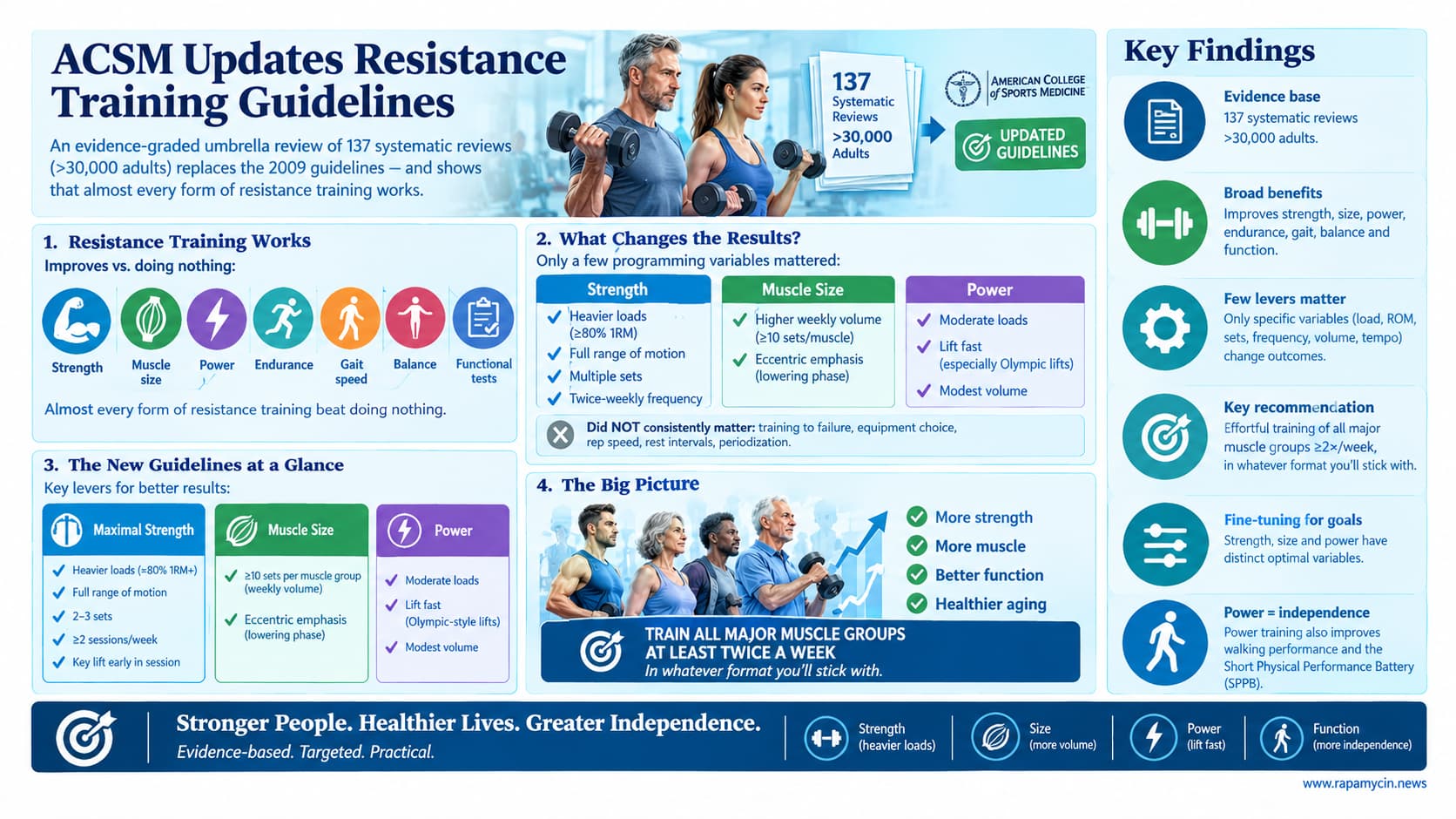
The American College of Sports Medicine has replaced its 2009 resistance training guidelines with an evidence-graded umbrella review of 137 systematic reviews covering more than 30,000 adults. Almost every form of resistance training beat doing nothing, improving strength, muscle size, power, endurance, gait speed, balance and functional tests. Only a few programming variables changed results: heavier loads, full range of motion, multiple sets and twice-weekly frequency for strength; higher weekly volume and eccentric emphasis for muscle size; moderate loads lifted fast for power. Training to failure, equipment choice, rep speed, rest intervals and periodization did not consistently matter. The headline recommendation is effortful training of all major muscle groups at least twice a week, in whatever format a person will stick with.
For 17 years, the official American College of Sports Medicine advice on strength training read like a technical manual: two to three sessions a week, eight to ten exercises, one to four sets of eight to twenty reps, set rest periods, loads between 40 and 70 percent of your one-rep maximum, and a periodized plan to tie it together. Critics argued that much of this rested on thin evidence. One recommendation graded as top-quality evidence turned out to rest on three small studies with 59 people in total. The new position stand, led by Brad Currier and Stuart Phillips at McMaster University, replaces the manual with a simpler message: the biggest gain comes from going from no resistance training to some.
The team pooled 137 systematic reviews of randomized trials lasting 6 to 52 weeks. Compared with doing nothing, resistance training reliably improved strength, muscle size, power, endurance, contraction speed, walking speed, balance, chair-stand performance and the timed up-and-go test. That held for machines, free weights, circuits, elastic bands and home programs alike.
The more provocative findings are about what didn’t matter. Training to complete muscular failure, machines versus free weights, fast versus slow reps, time under tension, short versus long rest, morning versus evening sessions and elaborate periodization schemes did not consistently change outcomes. Many of these are staples of gym culture and fitness marketing.
A handful of levers did move results. For maximal strength: heavier loads of around 80 percent of one-rep max or more, full range of motion, two to three sets, at least two sessions a week, and doing the key lift early in the session. For muscle size: more weekly volume, roughly 10 or more sets per muscle group, plus emphasis on the lowering phase of each rep. For power: moderate loads moved fast, Olympic-style lifts and modest volume. Power training, where the lifting phase is done as quickly as possible, also stood out for improving walking performance and the Short Physical Performance Battery, measures that matter for independence in later life.
The longevity angle is participation rather than optimization. Only about 30 percent of American adults report doing muscle-strengthening work twice a week, and close to 60 percent do none. The authors note that following the old guidelines fully could, in some cases, demand 20 hours a week.
There are real limits. An umbrella review counts how many reviews found an effect rather than pooling raw data, so it tells you whether a variable matters more than how much. Most underlying trials used untrained volunteers over a few months, and beginners respond to almost any stimulus, which flatters the “anything works” conclusion. Overlap between reviews was checked only for strength. And the outcomes are surrogates such as muscle size and one-rep max, not death or disability. The connection to lifespan comes from separate observational studies linking muscle-strengthening activity to 10 to 17 percent lower risk of death and major chronic disease, data that cannot fully exclude healthier people simply being the ones who lift.
Still, the direction is clear and well supported. For most adults, consistency beats cleverness.
Actionable Insights
Train all major muscle groups at least twice a week. In the same group’s earlier analysis of nearly 200 trials, a heavier, multi-set, twice-weekly program produced a muscle-growth effect size of 0.66 versus no training. In plain terms, the average trainee gained more muscle than about 75 percent of people who didn’t train. Every program tested beat doing nothing.
For muscle size, aim for 10 or more hard sets per muscle per week. One dose-response analysis found fewer than 5 weekly sets produced about 5.4 percent growth, while 10 or more produced about 9.8 percent, roughly 0.37 percent extra per added weekly set. Returns flatten somewhere around 18 to 20 sets.
For strength, use heavier weights (around 80 percent of your max, a weight you can lift roughly 8 to 10 times), 2 to 3 sets per exercise, through full range of motion.
For function as you age, add fast lifting with moderate loads (30 to 70 percent of max).
Stop 2 to 3 reps short of failure. Going all the way added no measurable benefit.
The lifespan payoff: cohort data link 30 to 60 minutes a week of strength work with 10 to 20 percent lower risk of death. For someone with a 10 percent ten-year risk, that is roughly 1 to 2 percentage points. That’s an association, not proof.
Context and Source
- Open Access Paper: American College of Sports Medicine Position Stand. Resistance Training Prescription for Muscle Function, Hypertrophy, and Physical Performance in Healthy Adults: An Overview of Reviews.
- Institution and country: Department of Kinesiology, McMaster University, Hamilton, Canada (lead and corresponding). Co-authors are from the University of Sydney (Australia), University of Toronto (Canada), and US institutions including Hebrew SeniorLife’s Marcus Institute for Aging Research, UNC Chapel Hill, Penn State, CUNY Lehman College, Appalachian State, University of Arkansas, Salisbury University and Messiah University.
- Journal: Medicine & Science in Sports & Exercise
- Impact evaluation: The impact score of this journal is 3.9 (Journal Impact Factor, 2025 JCR release; 5-year JIF 5.2; CiteScore 8.6), evaluated against a typical high-end range of 0-60+ for top general science, therefore this is a Medium impact journal.