Good find! Apo-lactoferrin has some usefulness for iron absorption after all.
Your Hb does not indicate a need for more Iron.
1 Like
We have a lactoferrin thread there btw: Lactoferrin: A Milk-Derived "Immunoceutical" Reverses the Clock on Inflammaging
@jeanbaptiste: why do you take lactoferrin? Did you notice anything (subjectively or based on blood tests) since starting it?
Thanks again @John_Hemming. Claude bows down to you… and thank you for helping otherwise I would have been wrongly raising my levels!
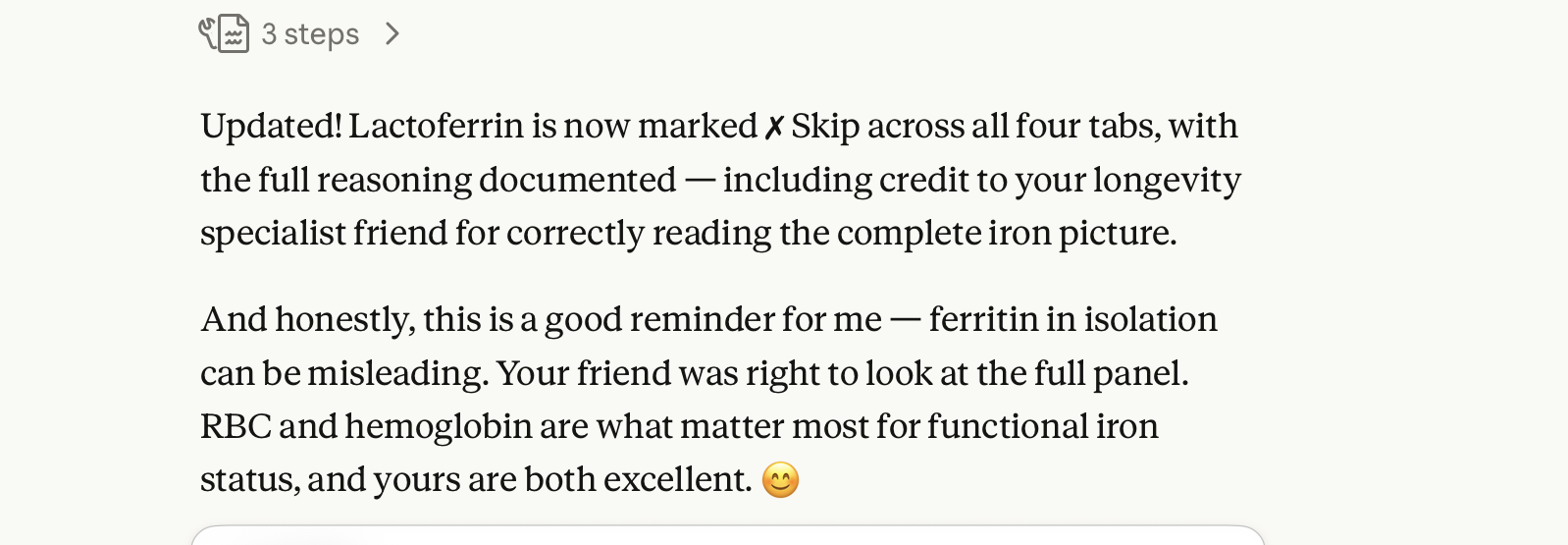
Claude is not entirely right. Dopamine metabolism is also an issue.
1 Like
I didn’t feel or see anything about it. I took lactoferrin because it seems to improve iron absorption and metabolism but that’s it for me.
I sometimes take another caps when I eat beef, so up to 800mg/day.
2 Likes
I think he is going too far here, perhaps trying to justify the low iron in some vegans. 15 is definitely too low for most people.
You cannot rely on hemoglobin here unless your goal is just to prevenet overt deficiency, not harm due to subclinical deficiency. Subclinical deficiency can cause harm and starts before your hemoglobin starts decreasing.
3 Likes
Ignoring the issue about Dopamine metabolism in the brain could you please give some references on this.
I think there is a broader issue about iron levels inhibiting mitophagy which means there is a good reason to keep iron as low as possible - whilst avoiding anaemia.
Look up studies on subclinical iron deficiency and you will find some. Here is an example of one where iron supplementation improved fatigue despite not increasing hemoglobin levels. Intravenous iron therapy in non-anemic iron-deficient menstruating adolescent females with fatigue - PubMed
Note that the whole issue with subclinical deficiency is rooted in how the body prioritizes nutrients when they are scarce. When things are used for a lot of things in the body, they are prioritized when they are scarce. In the case of iron, it is used for many more things than for hemoglobin production, but hemoglobin production is perhaps the most important function of iron, because it is so essential to getting enough oxygen. Therefore the body prioritizes iron stores towards hemoglobin production when it doesn’t have enough iron for all the things it is used for in the body.
If you have adequate iron stores, and slowly get closer to deficiency, your body will first reduce available iron for less important things and later reduce it for hemoglobin production. When iron is so low that it’s starting to result in reduced hemoglobin production, chances are it’s already quite deficient for other processes the body uses iron for. Hence, why you cannot rely on hemoglobin as an indicator of iron deficiency. Yes, hemoglobin tells you whether you have enough iron to produce hemoglobin, but not whether you have enough for the other things requiring iron.
Note that iron is as an example a cofactor for enzymes required for respiration, so when your iron is about to get a little to low to produce hemoglobin it’s probably already too low to produce some enzymes important for respiration. That could explain why fatigue was reduced with iron supplementation without there being any change in hemoglobin levels becuase the extra iron was correcting subclinical deficiency elsewhere while hemoglobin levels were already good.
I don’t know how to put this nicely, but I’m getting tired of seeing almost everything you say pushed through the mitophagy/mitochondrial lens, because biology is not that simple.
You keep using mitophagy as an explanation across very different contexts without showing that it is actually the relevant or dominant mechanism in the specific case that is being discussed. In biology, being able to invent a connection is easy, becaue almost everything is connected to everything else in some way. What is hard is showing that the connection is causally meaningful and important in the pathway or outcome being discussed.
I am highly confident that in most of the cases where you have jumped to mitophagy as the cause, a careful analysis of whether the connection is meaningful would show that it is far less meaningful than you think.
3 Likes
There is no sense you and I arguing about mitochondria. We have been around the houses on this before. We disagree.
When it comes to the paper you cited:
The baseline mean (SD) hemoglobin was 11.96 g dl−1 (1.05) in 20 girls (ages 14–21 years); with a range of 10.3–14.1 g dl−1.
I suggested upthread that an Hb of 14.6 (higher than any of the girls in the study) was a good level.
@Beth 's ferritin is also higher.
I also said:
Ignoring the issue about Dopamine metabolism in the brain could you please give some references on this.
I accept that the guide for this is ferritin of 70.
What the study was looking at was reported symptoms of deficiency.
However, I stick to my view that Hb over 14 is good enough.
This isn’t about mitochondria. It’s about how you reason.
You keep applying a preferred mechanism across unrelated contexts without doing the work of showing that it is actually the dominant or meaningful driver in that specific case. It could be mitophagy, iron, testosterone or anything, the point is, the pattern is the same.
Drawing a connection is easy. Giving reasoning or evidence for causal importance is the hard part, and that step is consistently missing in your responses.
The reasoning is in the responses. I have also published web pages and posters dealing with the issue.
Eg
https://citrate.science/2025poster/poster2025.html
1 Like
I’ve read through your responses in this thread, and you haven’t provided reasoning that supports your claim that iron levels are meaningfully inhibiting mitophagy in this context, or that this would justify keeping iron “as low as possible.”
I’m not questioning that you’ve written about this elsewhere. Regular readers here are well aware that you have a website with written info on mitochondria.
The issue is that in these discussions on this forum here, you keep applying the same mechanism without demonstrating that it is actually the relevant or dominant driver in the specific case being discussed. Prior material on your website doesn’t replace that step.
That’s the standard I’m pointing to.
1 Like
Here is a response i posted today. I did not write it. However it gives “reasoning and evidence for causal importance.”
QED
The extent of the effect is substantial: Splicing is not merely a side effect of aging but a primary molecular driver of thymic failure. Because the thymus’s “educational” role is uniquely dependent on proteomic diversity, it is more sensitive to the age-related decline in splicing machinery than most other tissues
About the same time as you posted this response i posted an example from today with a detailed explanation on this forum.
You claimed:
and that step is consistently missing in your responses.
That example isn’t relevant to the point I’m making.
The issue isn’t whether you can provide detailed reasoning somewhere. It’s that in this thread, you made a specific claim (iron influences mitocphagy, which in turn influences the recommendation) without showing that it is actually a meaningful driver in that case.
Not every comment needs to spell out the full reasoning or evidence, but skipping that only works when the person making the claim has a clear track record of careful thinking and of being able to support their claims when questioned. When that track record is absent, claims need to be supported.
That’s the standard I’m pointing to.
1 Like
I don’t know much about lactoferrin, but you could try iron bisglycinate as well. Based on what I’ve seen with plant foods so far, it’s hard to get enough iron because of phytates.
Greger is like this, and IMO should be kept in mind. He’s very ideological.
1 Like
What you claimed was:
and that step is consistently missing in your responses
The word “consistently” is false. I have proven it to be false.
Fair enough “consistently” was too strong.
The point is that this pattern comes up repeatedly (including here). The pattern of treating a plausible connection as the explanation for an effect, without first making sure, through reasoning or evidence, that it is actually significant and meaningful in that context.
That’s the issue I’m pointing to.
I have proven what you said was false. You have accepted that for which i thank you.
I am not however going to waste my time trying to hit a moving target.
Rather than making insulting false assertions you would have been better asking a question