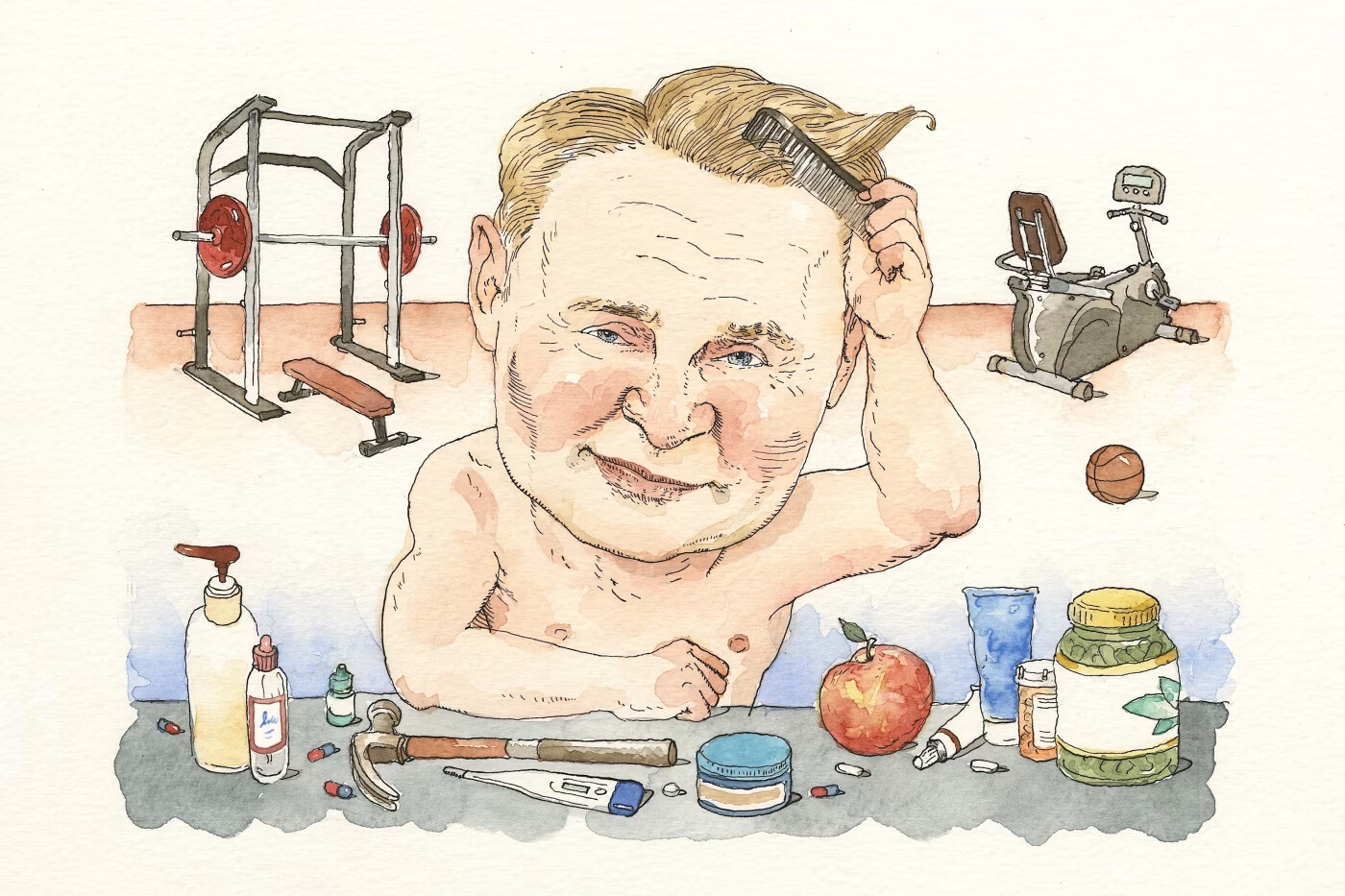
From mini-pigs and organ printing to cryotherapy and genetics, Russia’s president has turned antiaging research into a Kremlin priority
When Vladimir Putin was captured by a hot mic telling Xi Jinping that humans could achieve immortality by replacing their organs, some dismissed the exchange as eccentric small talk between aging autocrats.
In fact, during the conversation at a Beijing military parade last September, Putin appeared to be describing a Kremlin-backed longevity initiative that has become one of Russia’s flagship scientific projects.
Like Silicon Valley billionaires including Jeff Bezos, Sam Altman and Peter Thiel, Putin has long been fascinated with antiaging research. But in Russia, Putin’s quest to stave off decline is now a state priority relying on methods as wide-ranging as organ printing, harvesting mini-pigs and exposure to ultralow temperatures.
Last month, Russia’s government announced that scientists are developing a gene-therapy treatment aimed at slowing cellular aging as part of “New Health Preservation Technologies,” Putin’s $26 billion longevity initiative.
The drug “represents one of the most promising avenues in the fight against aging,” Deputy Science Minister Denis Sekirinsky said on April 23.
Another auspicious avenue? Creating human organs in a lab for transplantation, one of the lifespan-extending innovations Putin likewise spoke about in Beijing. All these efforts are part of the national longevity initiative he unveiled in 2024, which promises to save 175,000 lives by the end of the decade (the figure had an awkward wartime echo, roughly matching independent estimates of Russian troop losses in the invasion of Ukraine, as critics noted at the time).
Russian state scientists appointed by Putin have focused on two key technologies: bioprinting, or 3D-printing living tissue, and xenotransplantation, or growing human organs inside mini-pigs, a porcine breed deemed genetically compatible to humans. Russian scientists working with government agencies claim to have bioprinted human cartilage tissue and a mouse thyroid gland, with the aim of achieving human organ replacement by 2030. A similar timeline has been discussed for growing organs inside pigs.
“In the Russian Federation, work is under way on a whole range of scientific programs in this field,” the Kremlin press service said in an email. “These projects are supported by the state, and many scientific and research institutions are taking part in them.”
Russia’s longevity initiative is spearheaded by two figures close to Putin: his daughter Maria Vorontsova, an endocrinologist overseeing state-backed genetics programs, and physicist Mikhail Kovalchuk, head of the Kurchatov Institute, the Soviet-era nuclear research center.
Full story: Inside Putin’s $26 Billion Quest for Longevity (WSJ)