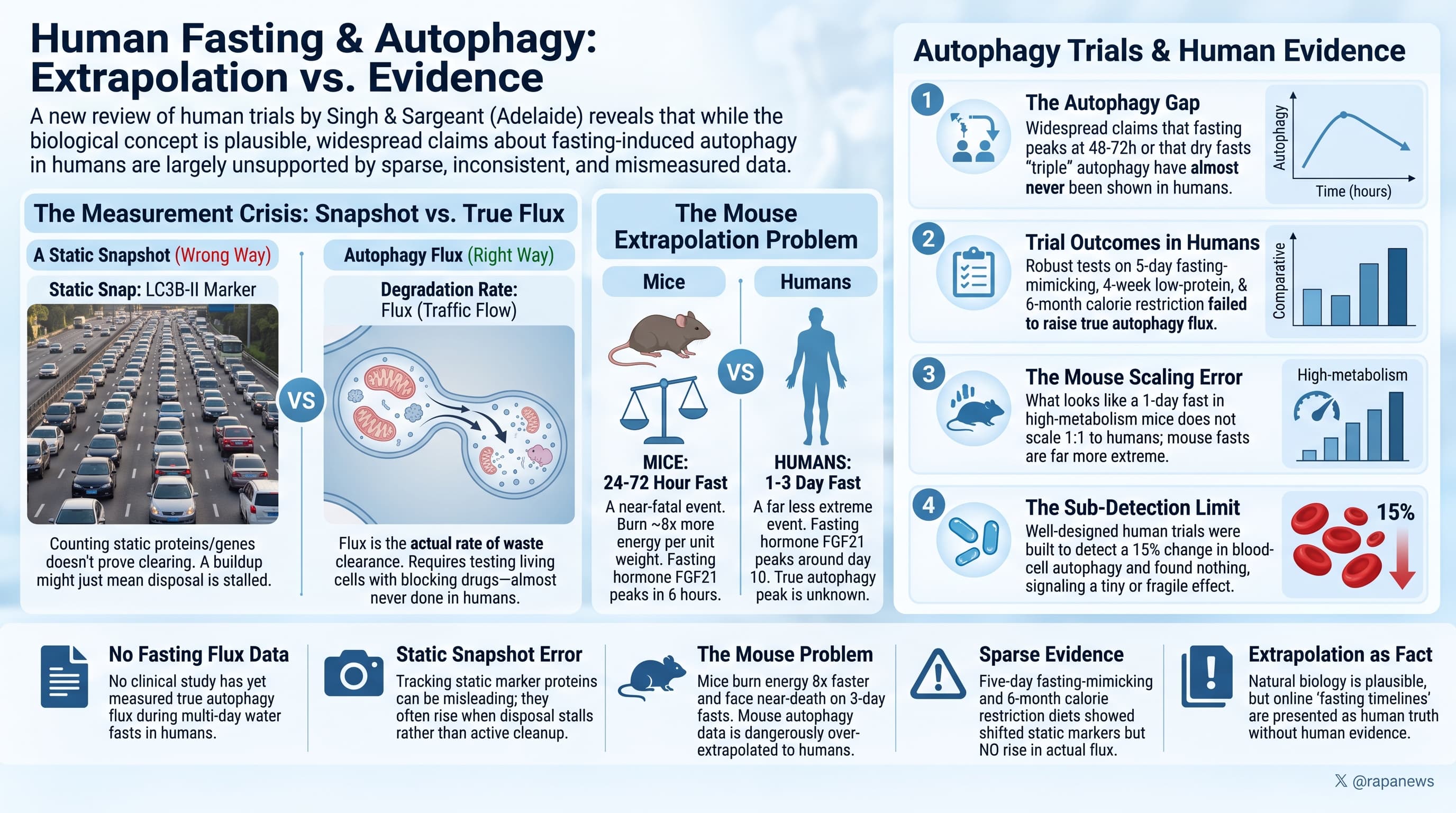
This review from Adelaide University and the South Australian Health and Medical Research Institute looks at every human study it could find that tested whether fasting, intermittent fasting, calorie restriction, or changing protein and fat intake changes autophagy, the process cells use to break down and recycle their own damaged parts. Animal evidence is strong. Human evidence is thin. Most human studies measured snapshots of autophagy-related genes or proteins, which cannot show whether the pathway is actually running faster. The few studies that measured real throughput (“flux”) mostly found no change. The popular idea that autophagy switches on or peaks at 24 to 72 hours of fasting comes from mouse work, and mice are poor stand-ins for human fasting physiology. The authors conclude that diet-driven autophagy in humans is plausible but unproven.
Ask a fasting enthusiast why they stretch a fast to three days, and the answer is often one word: autophagy. Starve the body, the story goes, and cells start eating their worn-out parts, clearing damaged proteins and tired mitochondria. Online, the claims come with numbers attached: autophagy peaks at 48 to 72 hours, or a dry fast triples the effect of a water fast.
A new review from Sanjna Singh and Timothy Sargeant in Adelaide argues that almost none of this has been shown in people. They went through the human studies on prolonged fasting, intermittent fasting, calorie restriction and altered protein and fat intake. Their verdict: the biology is plausible, the animal data are strong, and the human data are sparse, inconsistent and mostly measured the wrong way.
Measurement is the core problem. Most human studies count levels of autophagy genes or proteins at one moment. That is like judging highway traffic from a single photo: a crowded road could mean lots of cars getting on, or a blockage at the exit. The most popular marker, a protein called LC3B-II, rises both when autophagy speeds up and when the final disposal step stalls. What matters is flux, the rate at which cellular waste actually reaches the lysosome and gets broken down. Measuring that in people means taking living cells, usually blood, and comparing samples with and without a drug that blocks the last step.
Only a handful of human studies have done this. A five-day fasting-mimicking diet shifted static markers but did not raise flux. Four weeks of lower protein intake did not change flux in blood cells. Six months of calorie restriction did not change it either. One intermittent fasting protocol showed higher flux than usual care at six months, yet flux in that group did not rise significantly from its own starting point. Nobody has yet measured flux during a true multi-day water fast in humans, although a trial is registered.
Then there is the mouse problem. The belief that a 24 to 72 hour fast switches on autophagy traces largely to landmark mouse studies. But mice start dying after about three days without food, burn roughly eight times more energy per unit of body weight, and lean heavily on making new glucose within hours. Their fasting hormone FGF21 rises within six hours; in humans it peaks around day ten. A day without food is a far more extreme event for a mouse than for a person.
Even in animals, the details are unforgiving. Fruit flies fasted for 20 hours every other day lived longer; stretch the fast to 24 hours and they lived shorter lives.
The authors are not saying fasting is useless. Their point is narrower: specific claims about when and how much human autophagy turns on are extrapolation presented as fact. Readers should know the senior author holds a patent on a flux-measurement method and the group produced several of the key flux studies reviewed.
Actionable Insights
There is no human evidence for a fasting duration that “triggers” autophagy. If 24, 48 or 72 hour fasts appeal to you, do them for reasons with better support, such as weight or blood sugar control, and accept that autophagy benefits are unverified.
On real-world magnitude: the best-designed human flux trial (61 adults, low versus standard protein for 4 weeks each) was built to detect a 15% change in blood-cell autophagy and found nothing. In plain terms, if cutting protein boosts autophagy in blood cells, the boost is probably smaller than 15%, which is near the limit the test can reliably see. The intermittent fasting study’s positive result was a between-group difference only; the fasting group did not improve against its own baseline, which signals a small or fragile effect. Standard effect sizes such as Cohen’s d cannot be calculated from the data reported, and no human study links any measured autophagy change to a health outcome.
The animal effect sizes are real but narrow: flies gained 13 to 18% lifespan on one specific schedule and lost lifespan on a slightly longer fast. Protocol details matter.
Ignore commercial or influencer claims built on single gene or protein readings. Autophagy is also not universally good; tumors can exploit it.
Context and Source
- Open Access Paper: Increasing autophagy with fasting and diet: separating fact from fiction
- Article type: Narrative review (not a systematic review or meta-analysis)
- Authors: Sanjna Singh and Timothy J. Sargeant
- Institutions: School of Pharmacy and Biomedical Science, College of Health, Adelaide University; Lysosomal Health in Ageing, Lifelong Health Theme, South Australian Health and Medical Research Institute (SAHMRI)
- Country: Australia
- Journal: Biochemical Society Transactions (Portland Press, on behalf of the Biochemical Society), published 13 October 2026
- Impact evaluation: The impact score of this journal is 4.4 (JIF), evaluated against a typical high-end range of 0 to 60+ for top general science journals (roughly 15 to 30 for the leading cell and molecular biology titles), therefore this is a Medium impact journal.