Imeglimin: An Approved Diabetes Pill Just Made Old Mice Stronger

Good question. I asked Claude to check on other possible drugs in the pipeline:

The short answer is that there is no list to give you. The glimin class is a class of one. I found no glimin-class compound in Phase 1, 2, or 3 at any company anywhere. Imeglimin is the only glimin ever to enter human trials, and no second-generation glimin has been disclosed as a clinical candidate by anyone.

That absence is itself the finding. Novel mechanisms that validate in Phase 3 normally attract fast followers within a few years; gliflozins went from one compound to a crowded field. Fourteen years after imeglimin’s first positive Phase 2 data and five years after Japanese approval, nobody has put a second glimin into the clinic.

Note: One finding changes how the mouse paper reads. Human muscle data already exist. Oyanagi et al. (Diabetes Therapy 2024, reference 21 in the paper you sent) followed 23 imeglimin patients against 27 controls for 24 weeks. Quadriceps extension strength improved 13 percent versus 2.1 percent, p=0.022. But grip strength was not significant (p=0.16), and there was no change in lean body mass. Grip strength was the headline functional result in the mouse study, and it is the one endpoint that did not replicate in the only human dataset available.

The nearest non-glimin neighbours are Poxel’s own PXL770, a direct AMPK activator now Phase 2 ready, which is interesting because AMPK is exactly the pathway the mouse paper failed to measure, and Hua Medicine’s dorzagliatin, a glucokinase activator approved in China.

There are roughly 54 registered trials involving imeglimin, but the great majority are Japanese investigator-initiated phase 4 studies in already-approved populations, exploring mitochondrial effects, kidney endpoints, erythrocyte lifespan, heart failure, and muscle. These are academic exploration of a marketed drug, not a company development programme, and they do not lead to new approvals on their own.

Imeglimin in China (most likely to actually happen)

Sumitomo holds the rights and Poxel has named China commercialization as a strategic priority for 2026. If a bridging study or local phase 3 begins in 2026 to 2027, Chinese approval would plausibly land in 2029 to 2031. The NMPA has accelerated considerably and the compound has a full Japanese phase 3 package plus five years of post-marketing data to lean on. This is the only near-term glimin expansion with a realistic path.

2 Likes

This is an interesting result, especially because the study looked beyond muscle size and reported a measurable improvement in grip strength in aged mice. I agree with the caution raised in the replies, though the small sample size and company funding make independent replication important. The existing human data also seem worth watching closely, particularly since the functional results aren’t completely consistent yet.

Reading up on it, the ability to resist Reverse Electron Transfer in Complex I is a positive. I suspect mk7 may have some link to RET as well.

I tried to get the best chatGPT report that is possible 5.6 paid and upload it. I need to convert it from md to pdf. I will do this later.

Interestingly MS Word does not open markdown files, but chatGPT can create PDFs.

imeglimin_evidence_report_2026-08-27.pdf (138.7 KB)

3 Likes

Seems like this is the study result we should be talking about instead of the mouse one.

2 Likes

Thanks for that summary/analysis and convenient link, John.

Taking imeglimin at this point represents a gamble of sorts, depending on your purpose. I am prediabetic, so I feel slightly more justified in trying this - even though there are no studies of its efficacy in preventing or slowing the transition from prediabetes to diabetes.

My main interest is in it possibly ameliorating the cytotoxic effect of rapamycin on pancreatic beta cells. Obviously, this is highly speculative, but I am willing to roll the dice on this. Being prediabetic, rapa impact on the pancreas concerns me greatly - I don’t have much of a margin for error.

The drug has had some five years of clinical use, which is approaching a timeframe where if there were some disastrous side effects in the general diabetic population, we would see a signal by now. It goes without saying that we need much more time and greater numbers of patients to get more clarity here - it’s a far cry from the depth of data we have for SGLT2i or even GLP-1RA. Just look at metformin, decades and decades of millions of users and we’re still not anywhere with firm conclusions about key issues.

Anyhow, I’m still looking into this drug - taking it is only for the risk tolerant. At the moment it’s still right at the border of what I’m willing to take a chance on - partially driven by my age (68 yo); in plain terms I have less to lose as I’m running out of time anyway and so mathematically less of significant life/healthspan total shortening. Smaller downside risk for a modest/unknown upside potential - I’m placing my chips and spinning the roulette wheel :sweat_smile: … pending a bit more research. We’ll see. Also I’m waiting for an update from @cl-user , heh. YMMV.

2 Likes

One advantage I have of weekly blood tests is that I can try things and see what happens. I would need to drop back some of the interventions I am using at the moment, but there is at least possibly an argument for taking it together with rapamycin. It may have a broader benefit as well. I should be noted, however, that it is generally not metabolised only really excreted.

2 Likes

I looked through the papers on imeglimin, and the only phrase that comes to mind is that it feels like a chicken rib: too tasteless to enjoy, yet a pity to throw away. Maybe my perspective will change years down the line.

1 Like

Here is the Human study mentioned earlier in this thread:

Strength Without Size: A Mitochondrial Diabetes Drug Made Legs Stronger Without Adding a Gram of Muscle

A Japanese observational cohort followed 50 people with type 2 diabetes for 24 weeks and compared 23 who were newly started on imeglimin, a first-in-class oral drug that targets mitochondria, against 27 who were not. Quadriceps knee extension strength rose 13 percent in the imeglimin group versus 2.1 percent in controls, a difference that held up after adjusting for age, sex, BMI, and muscle mass index. Grip strength did not differ. Critically, lean body mass, fat mass, and skeletal muscle index were unchanged in both groups. The strength gain therefore came from something other than muscle growth, which the authors attribute to improved mitochondrial function inside existing muscle fibres. The study was small, non-randomised, unblinded, and the effect was statistically fragile.

Muscle strength and muscle size usually travel together. Get stronger, and you generally have more muscle to show for it. A small Japanese study has just reported a case where they came apart.

Researchers at St. Marianna University School of Medicine in Kawasaki followed 50 outpatients with type 2 diabetes over six months. Twenty-three had just been started on imeglimin, sold in Japan as Twymeeg and the first drug in a new class that works by acting directly on mitochondria, the structures that convert food and oxygen into usable cellular energy. The other 27 stayed on whatever they were already taking. Everyone had their thigh strength, grip strength, and body composition measured at the start and again at 24 weeks.

The thigh result is the headline. Knee extension strength in the imeglimin group rose by 13 percent on average. In the comparison group it rose 2.1 percent, which is roughly measurement noise. In absolute terms the drug group gained 3.6 newton-metres of torque against 0.5 in controls. Grip strength, by contrast, barely moved in either group.

The part that makes this interesting to anyone thinking about ageing is what did not happen. Lean body mass did not increase. Neither did fat mass, nor the skeletal muscle index derived from DEXA scanning. The muscles did not get bigger. They apparently got better at generating force with the tissue already there.

That points at muscle quality rather than muscle quantity, and quality is largely a mitochondrial story. Ageing muscle accumulates mitochondria that leak reactive oxygen species and generate less energy per unit of tissue, a decline that tracks closely with slower walking and greater fatigue in older adults. Imeglimin has been shown in animal and cell work to partially inhibit one part of the mitochondrial respiratory chain while restoring another, increasing mitochondrial DNA content and lowering reactive oxygen output. If that also happens in human leg muscle, stronger legs without bigger legs is the expected signature.

The idea matters because most modern diabetes drugs push in the opposite direction. GLP-1 receptor agonists and SGLT2 inhibitors reliably reduce body weight, and a meaningful fraction of what they remove is lean tissue. A glucose-lowering agent that leaves muscle mass alone while improving what that muscle can do would be a genuinely different proposition for older patients.

The caveats are large. Nobody was randomised, nobody was blinded, and doctors chose who got the drug. The statistical margin was thin. The authors themselves call for randomised trials, and they are right to.

Insights

On magnitude: the standardised effect size for the thigh strength difference is Cohen’s d of about 0.66. In plain terms, that means if you picked one imeglimin patient and one control at random, there is roughly a 68 percent chance the imeglimin patient improved more, versus 50 percent if the drug did nothing. That is a moderate, not dramatic, effect, and the confidence interval runs from 0.09 to 1.23, meaning the true effect could be trivially small or quite large. The study cannot tell you which.

The transferable insight is the dissociation itself. Strength and size are separable, and strength is the outcome that actually predicts falls, disability, and mortality. Anyone tracking sarcopenia should be measuring force output, not just DEXA lean mass. A stable lean mass reading does not mean function is stable.

Context and Source

  • Open Access Paper: The Effects of Imeglimin on Muscle Strength in Patients with Type 2 Diabetes: A Prospective Cohort Study
  • Institution: Department of Metabolism and Endocrinology, St. Marianna University School of Medicine, Kawasaki, Kanagawa, Japan
  • Journal: Diabetes Therapy (Adis / Springer Healthcare), 2024.
  • Impact evaluation: The impact score of this journal is 4.2 (2025 Journal Impact Factor as listed by the publisher; 5-year JIF 3.7; SJR 1.137, Q1 in Endocrinology, Diabetes and Metabolism), evaluated against a typical high-end range of 0 to 60+ for top general science journals, therefore this is a Medium impact journal.
2 Likes

I started taking it about 3 weeks ago and feel incredible. My blood work was normal before but I suspect there was some glucose disruption at night that would keep me awake at 4am. I can now sleep like I used to, not hungry in am. I would rank my improvement up there with rapamycin and I think it pretty much saved my life. My partner who is clearly prediabetic been taking it for about 2 weeks. He wore CGM and effects are very clear- lower average glucose, tighter peaks, glucose actually drops after dinner and thru the night

3 Likes

The rough pricing I’ve seen from Indian pharmacies for Imeglimin products are:

Imeglyn by Zydus Pvt Ltd. - 1000mg- 20$ / 100 tablets ($0.20 per tablet).

2 Likes

I am scheduled for my next blood labs next Wednesday and will provide an update when I receive the results.

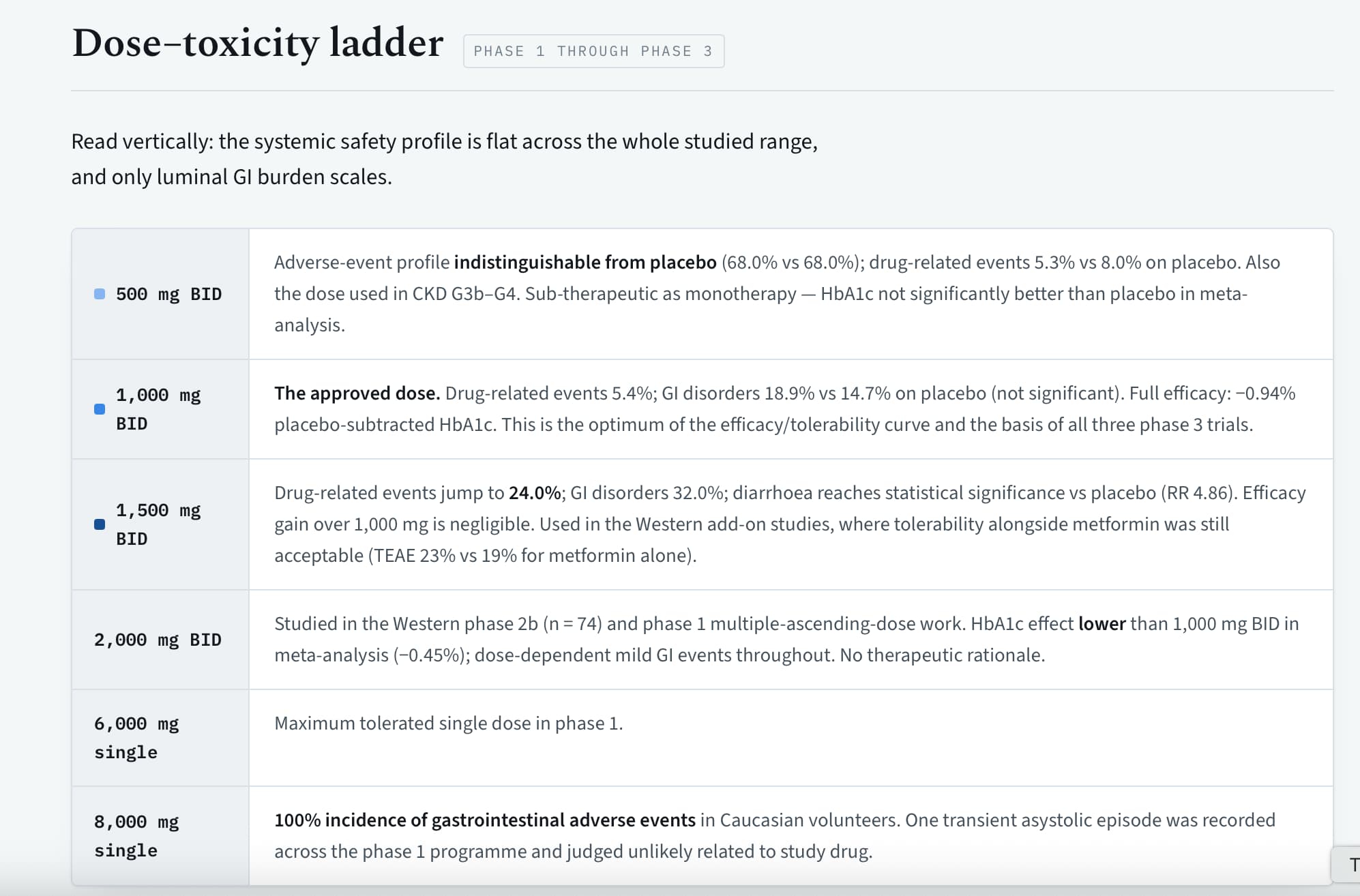
Additionally, I found that a 1500mg BID dosage was more effective in the European population than the 1000mg BID dosage used in Japan. In fact the 1000mg BID dose might not be enough for a western population.

That is why I am currently taking 1000mg three times per day. I am splitting the dosage rather than taking 1500mg at once to avoid GI issues.

Here is Claude 5’s perspective on this dosage:

Two parallel Phase 2b dose-ranging programs, two different answers

Poxel ran essentially the same design (500 / 1000 / 1500 mg BID vs placebo, 24 weeks) in Western and Japanese populations, and they diverged:

  • Western trial (n=382, topline Dec 2014, presented as a poster at ADA 2015 by Fouqueray): the primary HbA1c endpoint was met versus placebo (p<0.001) with a significant FPG decrease at the 1500 mg dose, which was designated as the dose to carry into Phase 3. HbA1c fell dose-dependently with 1500 mg BID most effective (placebo-adjusted −0.63%, p<0.001), 33.3% of patients on 1500 mg BID reached HbA1c ≤7% vs 12.5% on placebo (p=0.005), and maximum efficacy at all doses was reached by 18 weeks. Poxel’s framing at the time was that 1500 mg BID was both the most active and well-tolerated, and therefore the optimal Phase 3 dose.
  • Japanese trial (Dubourg et al., Diabetes Obes Metab 2021, n=299): placebo-adjusted HbA1c was −0.52% at 500 mg, −0.94% at 1000 mg and −1.00% at 1500 mg BID. Because the 1500 mg increment over 1000 mg was marginal and carried a GI tolerability penalty, 1000 mg BID was selected for the Phase 3 TIMES program — and that is what got approved.

Why the difference

Population PK modelling attributes it mostly to exposure, not to ethnicity per se. Japanese patients showed somewhat higher imeglimin exposures than Western patients at the same dose, and simulations indicated the Japanese/Western AUC gap at identical doses was driven mainly by eGFR differences — about +15 mL/min/1.73 m² in the Western cohorts. Imeglimin is not metabolized and eliminated unchanged in urine, so renal function dominates. Same reasoning drives the renal dose reduction: 500 mg BID for eGFR 15–45.

One caveat on the “better results” framing

Within-trial, yes — 1500 mg was the top of the dose-response curve in Westerners. Across trials, no: the Western 1500 mg effect (−0.63%) was smaller in absolute terms than Japanese 1000 mg (−0.94%). A meta-analysis group also flagged that the Fouqueray Western study found non-significant HbA1c lowering at both 500 and 1000 mg BID versus placebo, which is part of why the dose-response there pushed higher — the lower doses simply underperformed in that cohort. That trial was also never published in full peer-reviewed form, only as the ADA poster.

Supporting Western data at 1500 mg BID

The one properly published Western study using that dose is Theurey et al., Endocrinol Diabetes Metab 2022 (EudraCT 2013-001539-35): 18 weeks, 1500 mg BID vs placebo in 59 metformin-washed-out patients across Hungary, Latvia and Romania, with glucose AUC −429.6 mmol/L·min (p=0.001) and HbA1c −0.62% (p=0.013) — the authors themselves noted this was modest relative to the Japanese data at 1000 and 1500 mg.

Tolerability ceiling: GI events increase dose-dependently from 1500 mg upward to the maximal tolerated 6000 mg, mostly mild nausea, vomiting and diarrhea.

The Western Phase 3 program at 1500 mg BID was never completed, so that dose has never been validated in a registrational trial — the evidence for it is one unpublished Phase 2b poster and one small mechanistic study. Worth discussing with whoever manages your glycemic control before extrapolating, particularly since renal function is the variable that actually determines your exposure at any given dose.

4 Likes

tnx alot!!! I had no idea dosing could go so high to achieve best glucose control plus the systemic beneficial side effects. I’ll not be shy with my afternoon prior to dinner dose!!

tnx curt

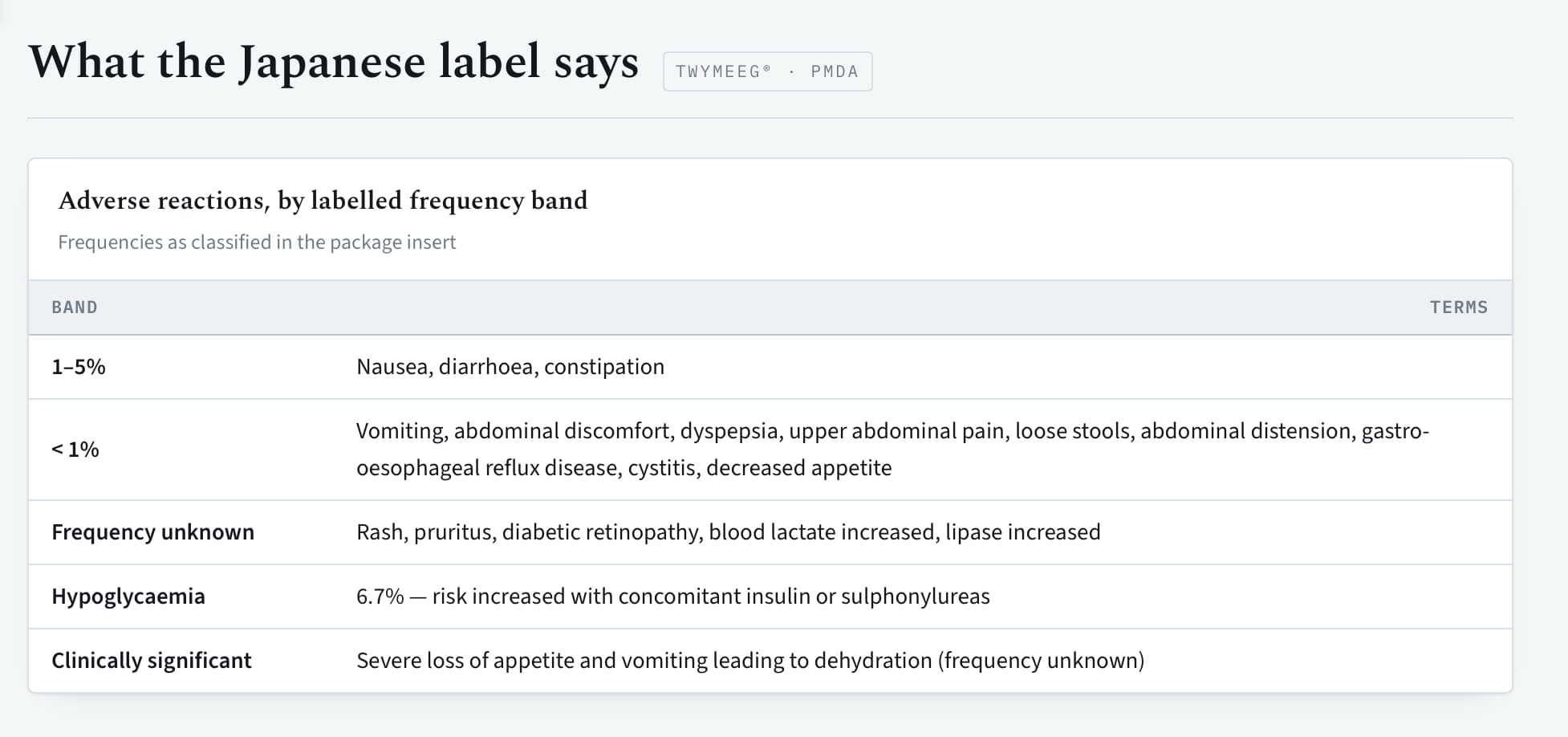
I was curious about the exact side effect profile for imeglimin (I’ve never had any side effects, but have only taken it once per day (1,000mg).

Its amazingly benign… basically a side effect profile that is almost identical to placebo, up to 2, or 3 grams per day.

Here is the full report:

1 Like

The question I have is, should it be used in combination with Metformin or as a replacement for it? My mother is on 2 g of Metformin daily, and 1.5 g of Imeglimin would probably have a lesser effect on her HBA1C. However, I worry about mixing these two medications.

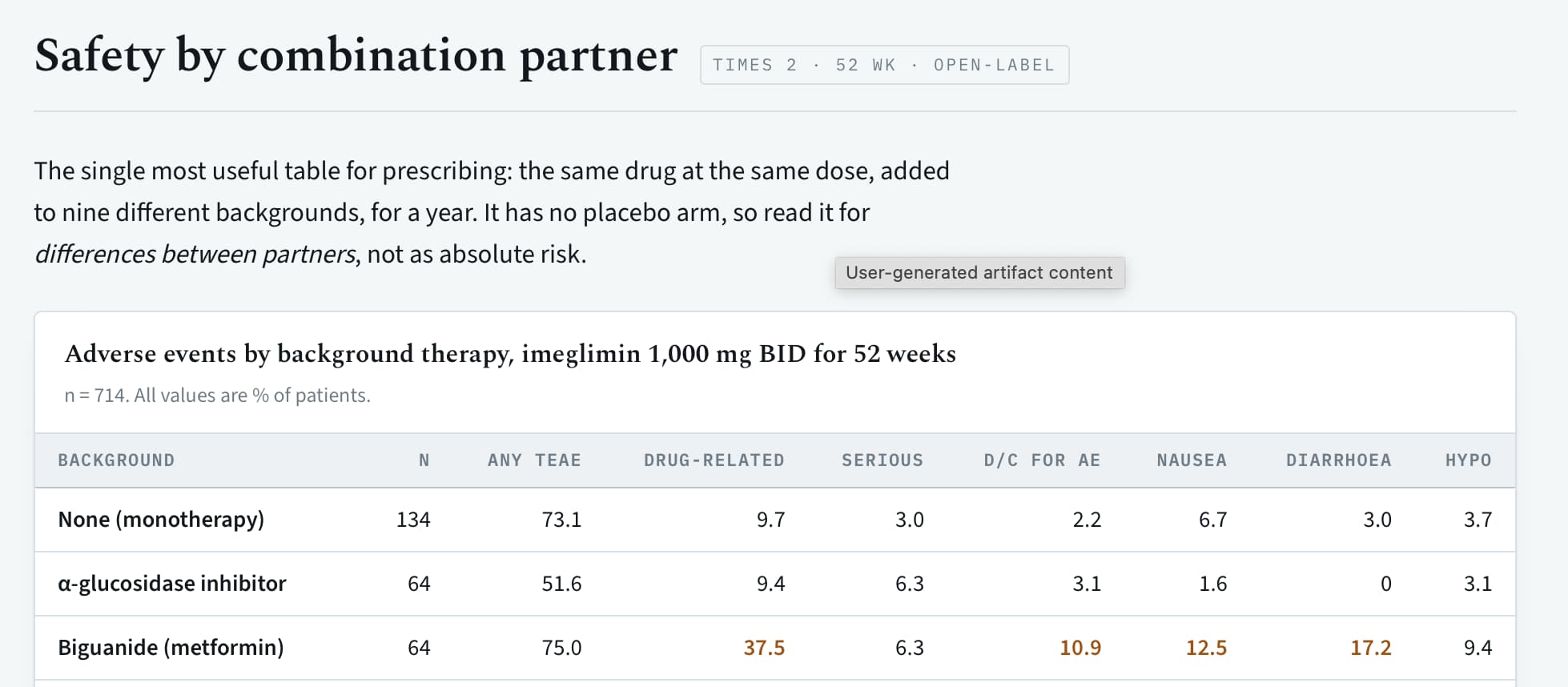
That info is in the report. I included info on possible combinations like metformin (a biguanide class drug). See below the side effects when added:

2 Likes

DDI pretty benign combined with acarbose. Still some serious events, but overall OKish as these things go.

I’m also curious if there’s any effect with various SGLT2i, though it seems pretty different MOA, so not direct interaction, rather ultimate outcome as the body strives for homeostasis. I have a kind of suspicion - can’t even call it a hypothesis - that when we gradually develop tolerances to meds, or meds seem not as effective as they should be on paper, it’s because the body is working hard to get back to its previous balance through various compensatory mechanisms. Sort of how the body fights to maintain weight even as you cut calories. And that’s how I can take BA, EZ and pita all at max doses and my LDL levels are not that much affected; empa and A1c stays put, all impervious to diet and exercise. YMMV.

1 Like

I think it all depends. My parents and I take Pitavastatin, Bempedoic Acid and Ezetemibe and get our Apob in the 25-55 range. I’m the highest at 53! Everyone has a unique biology. Just like I and my mother are statin intolerant.

When imeglimin is combined with metformin, the incidence rates of diarrhea and nausea reach as high as 15.6% and 10.9% respectively, which is significantly higher than with monotherapy or other combination regimens.

1 Like

From my perspective (an obsession with mitochondria and acetylation) it arguably would reduce ROS which reduces the creation of deletions in mtDNA, it also would improve ⟨ΔΨm⟩ which would improve gene expression. However, it would act as a prop rather than encouraging mitophagy (and particularly fission-mitophagy-fusion). Hence it looks like something worth taking with Rapamycin, but not something that would replace Rapamycin.

2 Likes

Imeglimin, especially in combination with non-Metformin OHAs, improves glycemic control and reduces mitochondrial and inflammatory stress in T2DM patients. These findings support its use as an adjunctive therapy with broader metabolic benefits.

3 Likes