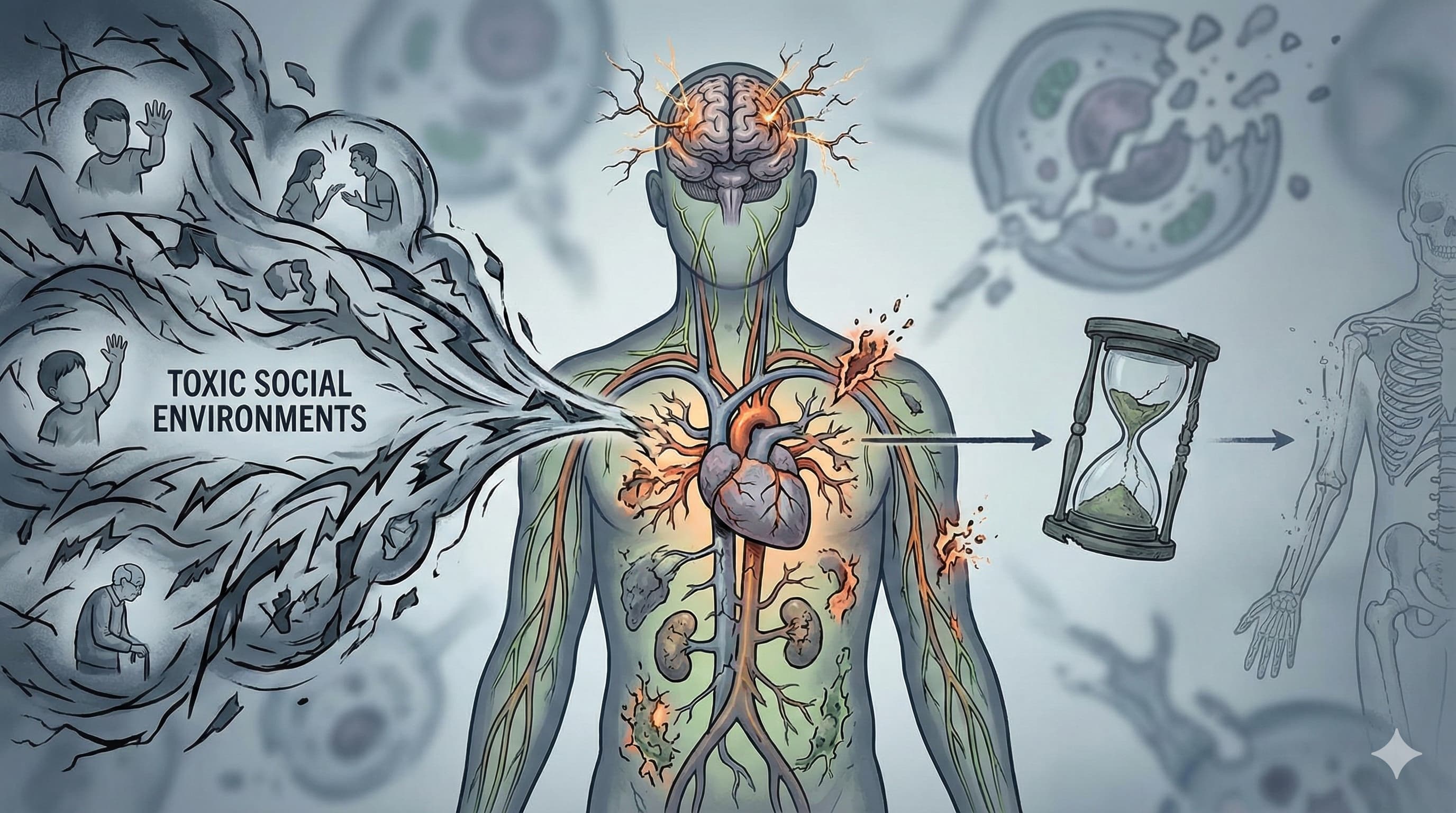
A new review out of the VA Mid-Atlantic Mental Illness Research, Education and Clinical Center and Georgetown University (USA), published in Current Opinion in Psychology, outlines the grim reality of how toxic social environments actively decay human health. The core premise is that interpersonal adversity—spanning from childhood abuse and intimate partner violence (IPV) to elder abuse—is not merely a psychological burden, but a potent driver of chronic physiological dysfunction and premature mortality. The paper argues that emotional trauma mechanically accelerates biological aging, acting as a direct vector for chronic diseases such as diabetes and cardiovascular conditions. Rather than viewing these events as isolated incidents, the authors frame them as a life-course cascade. Adverse childhood experiences (ACEs) wire the developing brain for threat, altering attachment styles and dampening emotion regulation. This psychosocial dysregulation feeds directly into high-risk adult environments, increasing the statistical probability of revictimization and IPV. Behaviorally, this drives maladaptive coping mechanisms, predictably cratering health behaviors like sleep, nutrition, and exercise.
Crucially for longevity protocols, the authors highlight hard physiological mechanisms. The review points to distinct neuroanatomical shrinkage, notably reduced amygdala, medial prefrontal cortex, and hippocampal volumes. Systemically, chronic interpersonal stress acts as a continuous inflammatory trigger, manifesting in elevated biomarkers like soluble urokinase plasminogen activator receptor (suPAR). This sustained inflammatory cascade accelerates epigenetic aging, quantifiably shortening healthspan.
Source:
- Paywalled Paper: Interpersonal adversity and health across the life course
- Journal: Current Opinion in Psychology Volume 68, April 2026, 102259
- The impact score of this journal is 6.9, evaluated against a typical high-end range of 0–60+ for top general science, therefore this is a Medium impact journal.
Mechanistic Deep Dive
The physiological mechanisms bridging interpersonal trauma to accelerated aging center on chronic stress signaling and immune dysregulation.
-
Inflammaging and Epigenetic Clocks: The review explicitly links interpersonal adversity to accelerated biological aging via epigenetic clocks (e.g., DunedinPACNI) and inflammatory markers like suPAR. Constant psychological threat maintains hyperactive sympathetic and HPA-axis tone. Over decades, this chronic signaling drives systemic “inflammaging.” Although the paper does not specifically name cGAS-STING or mTOR, the elevation of broad inflammatory biomarkers strongly suggests the activation of innate immune pathways that ultimately inhibit autophagy and drive cellular senescence [Confidence: High].
-
Organ-Specific Aging (Brain): The brain is the primary target organ of interpersonal adversity. The authors note structural degradation, specifically reduced volume and cortical thickness in the hippocampus, medial prefrontal cortex, and amygdala. Additionally, traumatic brain injuries (TBI) secondary to physical violence compound this neurodegeneration. This directly limits cognitive longevity and accelerates the onset of dementia and functional disability.
-
Behavioral Epigenetics: A downstream consequence of ACEs and IPV is the collapse of longevity-promoting behaviors. Poor sleep, high stress, and poor nutrition inhibit AMPK signaling and impair mitochondrial dynamics, stripping the body of its endogenous repair mechanisms [Confidence: Medium].
Novelty
- While the link between stress and health is established, this review emphasizes the continuous, cumulative nature of interpersonal adversity across the entire life course—from childhood abuse to elder abuse.
- It strongly advocates for integrating neuroimaging with epigenetic clocks (like DunedinPACNI) to map out how psychological trauma leaves a permanent biological footprint on the aging brain.
Critical Limitations
- Causal Uncertainty: As the authors concede, the literature is plagued by nonrandom exposure, selection bias, and confounding variables.
- Methodological Weaknesses: Most studies in this field rely on retrospective self-reporting, which is notoriously unreliable over long time horizons.
- Lack of Dyadic Data: IPV is inherently a relationship-level issue, yet there is a critical lack of dyadic data assessing both partners simultaneously, skewing our understanding of the exact psychosocial dynamics at play.
- Missing Data: We need Mendelian randomization, twin studies, and polygenic risk scores to strip out shared genetic vulnerabilities that might predispose individuals to both high-conflict environments and accelerated aging. Without this, we cannot definitively separate the biological damage caused by the trauma from the baseline genetic risk.