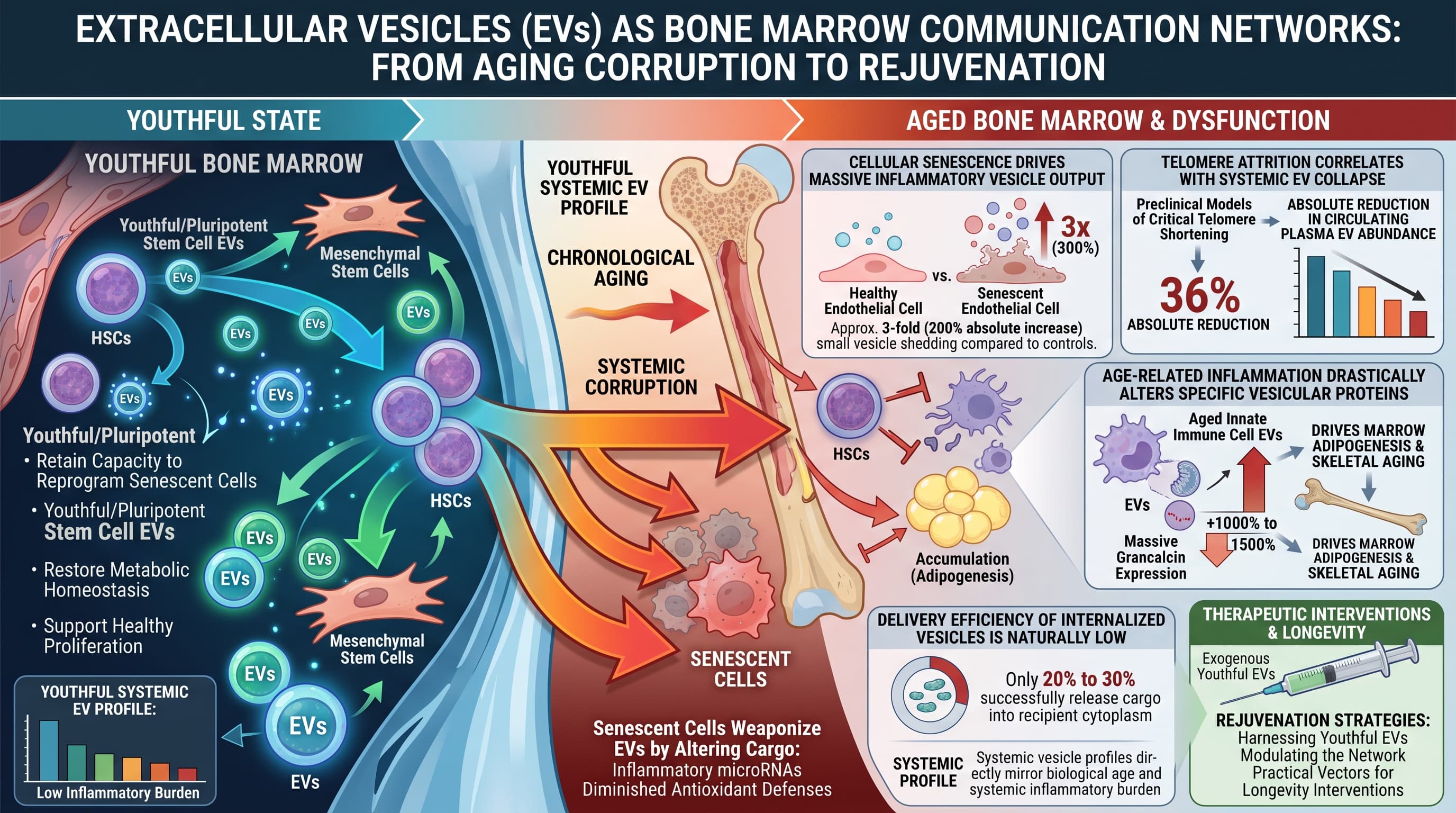
Extracellular vesicles function as critical intercellular communication networks within the bone marrow, but chronological aging fundamentally corrupts this system. Senescent cells weaponize these vesicles by altering their cargo to include inflammatory microRNAs and diminished antioxidant defenses, which suppresses healthy stem cell proliferation and drives age-related immune dysfunction. Conversely, vesicles derived from youthful or pluripotent stem cells retain the capacity to reprogram senescent cells and restore metabolic homeostasis, highlighting a novel mechanism for systemic rejuvenation interventions.
The biological aging of the hematopoietic system has historically been attributed to intrinsic cellular failures like telomere attrition and epigenetic drift. Recent data strongly suggests a non-cell-autonomous driver of tissue decline [Confidence: High]. Extracellular vesicles function as a dynamic communication grid within the bone marrow niche, transferring proteins, lipids, and nucleic acids between stromal cells and hematopoietic stem and progenitor cells. During youth, this vesicle exchange maintains homeostasis by delivering regenerative signals and structural support proteins like tropomyosin-1.
As chronological aging progresses, the accumulation of senescent cells severely corrupts this signaling network. Genotoxic stress and systemic inflammation activate specific transcriptional pathways that accelerate vesicle biogenesis and shedding. These aged vesicles are heavily modified. Senescent stromal and immune cells pack them with senescence-associated secretory phenotype factors, mitochondrial fragments, and specific microRNAs such as miR-183-5p, miR-34a, and miR-21. When healthy stem cells internalize these toxic packages, the delivered cargo actively suppresses proliferation, inhibits normal osteogenesis, and forces a secondary senescence state. This process fundamentally remodels the microenvironment to favor myeloid-biased hematopoiesis and establishes a supportive niche for mutated, malignant clones.
Reversing this pathological communication network offers a distinct therapeutic opportunity. Experimental models demonstrate that administering extracellular vesicles derived from young plasma or youthful stem cells successfully attenuates oxidative stress and partially rejuvenates aged stem cell populations. Youthful vesicles carry protective payloads, including peroxiredoxins and proliferating cell nuclear antigen, which restore telomere replication capacity and mitochondrial dynamics in aged recipients. While systemic administration in preclinical models rapidly reduces inflammatory cytokines and restores marrow homeostasis, the precise molecular targeting mechanics remain incompletely mapped. Addressing how specific vesicle surface signatures interact with distinct hematopoietic subsets will dictate the viability of engineered vesicle therapies for age-related functional decline.
Actionable Insights
Systemic vesicle profiles directly mirror biological age and systemic inflammatory burden. Modulating this network offers practical vectors for longevity interventions [Confidence: Medium].
-
Cellular senescence drives a massive output of inflammatory vesicles. Senescent endothelial cells demonstrate an approximate 3-fold (200%) absolute increase in small vesicle shedding compared to healthy controls. Interventions that reduce total senescent cell burden likely reduce this circulating toxic payload.
-
Telomere attrition correlates with a systemic collapse of healthy vesicle populations. Preclinical models of critical telomere shortening show a 36% absolute reduction in circulating plasma vesicle abundance.
-
Age-related inflammation drastically alters specific vesicular proteins. Grancalcin expression increases by 10 to 15-fold (1000% to 1500%) in aged innate immune cells, driving marrow adipogenesis and skeletal aging.
-
Only 20% to 30% of internalized vesicles successfully release their cargo into the recipient cytoplasm. This highlights that delivery efficiency is naturally low, requiring highly concentrated interventions if exogenous youthful vesicles are utilized therapeutically.
Context/Source
- Paper Title: The Role of EVs in the Aging Hematopoietic System
- Institutions: University of Glasgow, UK; University of Veterinary Medicine Vienna, Austria; Mayo Clinic, USA
- Journal: Aging Cell
- Impact Evaluation: The impact score of this journal is 7.8, evaluated against a typical high-end range of 0–60+ for top general science, therefore this is a Medium impact journal.