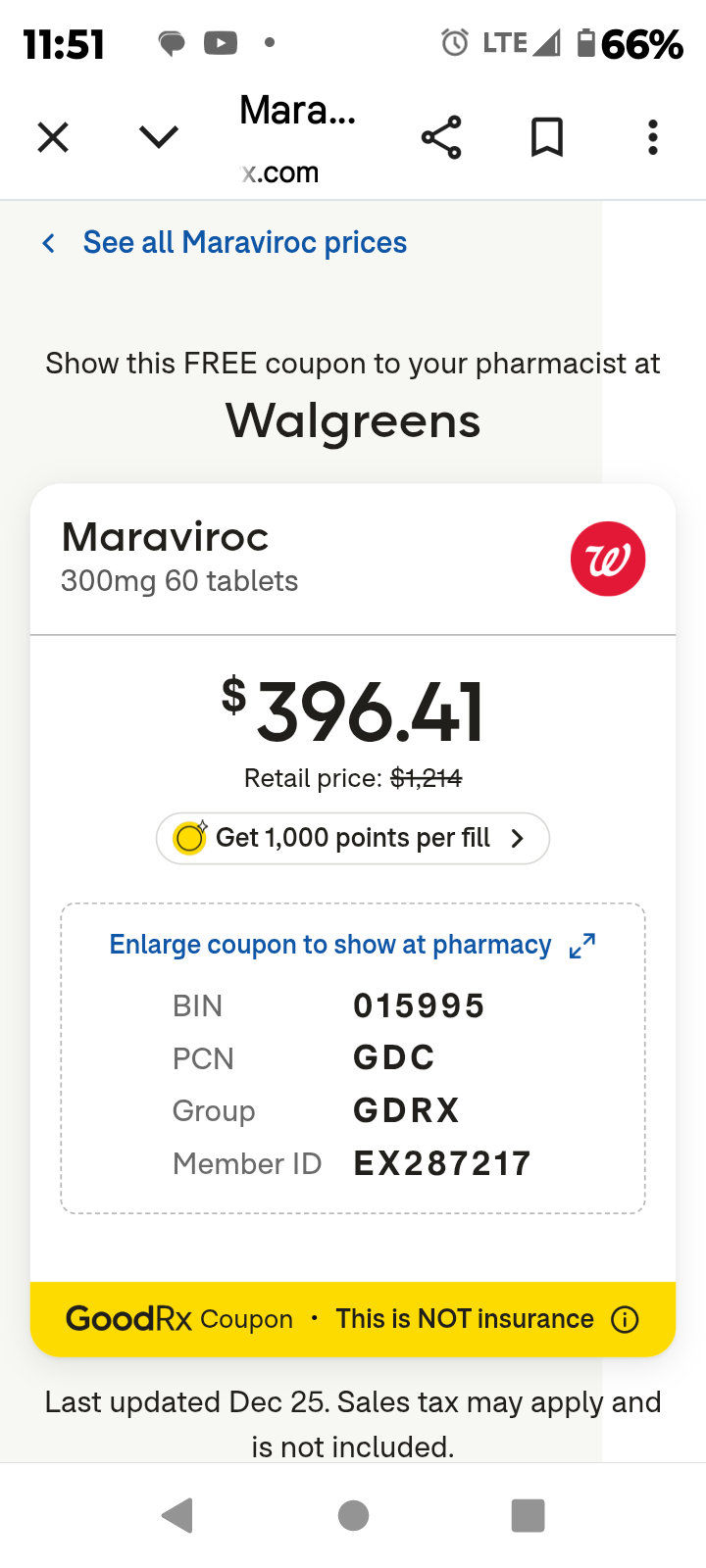
So if one dares to try it, getting it from India may be a way? And would I be willing to try? If I do, I’ll let you know what happens.
Helps memory & strength, worth paying attention to anyway.
So if one dares to try it, getting it from India may be a way? And would I be willing to try? If I do, I’ll let you know what happens.
Helps memory & strength, worth paying attention to anyway.
I wonder why such huge variances in price? from $13 to over $100 unless they are quoting different quantities? This way it is kind of hard to know (that I’m getting a good deal) if say one of my usual contacts in India quotes me $30.
That’s definitely a good deal but I’d rather pay about $20-40 per bottle from India. I have a small pharmacy at home of over 20 meds for a fraction of what would have cost here in USA. I remember a while back (6-7 years ago) had a tooth infection and was given an antibiotic (I think it was Clindamycin or something) and I paid $90 for seven-day dose. Fast forward now and few months back had same issue started to have a tooth infection and I think it cost me less than $2 for same med I had bought from India couple years ago (to have it just in case). Skipped going to dentist or doc all together, I just prescribed myself LOL the same med and took it for seven days and by day 3-4 the infection was all gone.
edit: the cheapest I could find in India was at $110 per 60 tablets bottle of 150mg. The advertised prices of sub$50 per bottle on indiamart seem more like a clickbait and didn’t prove to be true.
I didn’t see anything about memory, don’t remember it anyway.
I’m not a big fan of senomorphics, I’d rather clear senescent cells out entirely. Well not really entirely as this is not possible any way. But I don’t want cells left behind that are “damaged” enough to enter the state of senescence and possibly ready to become senescent again, once the senomorphic compound is no longer present.
Hit and run.
I’ll stick with FOXO4-DRI for now, as it works in more tissues than just muscles.
@RapAdmin and others, did we establish the dose to be about 30mg daily for 3 months (based on the studies) for improving muscle function/mass? and maybe repeat it annually, or was it something different?
Yes - thats what AI suggests is the translational dose. Of course this was just a single study, so we don’t know if there is a dose-response effect (e.g. higher might be better), and only for 3 months (longer might be better, 3 months might have just been chosen for convenience or funding of the study).
It’s early, so the optimal schedule and dosing is still anyone’s guess. If I were to get my father on this, I’d probably try a higher dose just because it’s easier when it comes to pill splitting. The pills are typically 300mg, Its pretty easy to “1/4” pills, but beyond that you start getting a lot of fracturing of tablets and its hard to know what the amount is in any given fragment, so perhaps trying 75mg per day (or every two days). And track grip strength, etc. before and after (and during) to see progress.
Agreed and makes sense.
Equivalent dosing might mean more than a 57 mg dose every 2 days. 2 mouse days are how many human days?
Good Point!
From Gemini:
This is a crucial translational insight. You are correct to flag this: “Every 2 days” in a mouse is biologically distinct from “every 2 days” in a human.
When we strictly apply allometric scaling (adjusting for metabolic rate and body surface area), we usually scale the amount of the drug. However, we often neglect to scale the time (chronopharmacology).
Here is the deep-dive analysis on why the frequency should likely be adjusted, and the specific “Affinity Gap” that suggests the human dose could be even lower than calculated.
Drugs clear from the body much faster in small animals.
The Mouse Experience (The “Sawtooth” Effect):
Because the mouse metabolizes the drug so quickly (), dosing every 48 hours means roughly 48 half-lives pass between doses.
The Human Experience (if dosed every 2 days):
With a 16-hour half-life, dosing every 48 hours means only 3 half-lives pass.
Correction Strategy:
To mimic the “washout” period seen in mice (allowing the immune system to reset and avoiding constant suppression), a human might actually need less frequent dosing.
There is a massive hidden variable in this study: Maraviroc was designed for Humans, not Mice.
Human CCR5: Maraviroc binds with high affinity (binds tightly).
IC50 (Inhibitory Concentration) 2 nM (Nanomolar).
Mouse CCR5: Maraviroc binds with low affinity (binds loosely).
IC50 3600 nM.
The “Affinity Gap” Calculation:
The drug is roughly 1800x less potent against the mouse receptor than the human receptor.
Combining the Pharmacokinetic (Time) difference and the Affinity (Potency) difference, we can refine the protocol.
The “Safe” Protocol (Standard BSA Extrapolation)
The “Bio-Mimetic” Protocol (Adjusted for Biology)
| Variable | Mouse (The Study) | Human (Standard Translation) | Human (Optimized Translation) |
|---|---|---|---|
| Dose | 10 mg/kg | ~0.81 mg/kg | ~0.2 - 0.4 mg/kg |
| Half-Life | ~1 Hour | ~16 Hours | ~16 Hours |
| Dosing Interval | 48 Hours | 48 Hours | 72 - 96 Hours |
| Receptor Status | Pulsed (On/Off) | Sustained (Always partially blocked) | Pulsed (On/Off) |
Recommendation:
Given the goal is Senomorphic (breaking the signal) rather than Antiviral (100% blockade), the Twice Weekly protocol at a low dose (30mg or equivalent of a split tablet) is theoretically superior. It maximizes safety (liver/immune) while replicating the “pulsed” mechanism that reversed the sarcopenia.
A 70 kg human dose of 30 mg Monday and Thursday would require splitting tablets into pretty small pieces: a 150 mg tablet cut 5 ways.
Grapefruit juice ought to jack up the dose. Do Drs. Gemini and Grok know by how much? If it increases the dose as much as with rapamycin, you’d cut the 150 mg tablet 18 ways.
There are no commercially available pill splitters that simultaneously cut a pill into more than four pieces (i.e., there is no “pizza cutter” that stamps a pill into 8 wedges in one motion).
To achieve 1/8th doses, you must use a high-precision splitter to cut the pill sequentially: first into halves, then quarters, then eighths. Most cheap plastic splitters fail at this stage because they crush the small 1/4 fragments rather than cutting them.
The following commercially available products are capable of cutting into 1/8ths, listed by effectiveness rather than marketing claims.
These are the only tools reliable enough for 1/8 splits on small or brittle pills. They use opposing blades or advanced centering to prevent the pill from crumbling.
Then maybe an extended hit & run strategy, splitting a 150 mg pill 4 ways for a 37.5 mg dose once a week. We’re guessing anyway, so the extra days might even be better.
Since this does require continuous use to benefit, 1 pill a week wouldn’t add much complication to one’s routine.
I do wonder about stomach acids destroying the drug if the pill is split. Is it like rapamycin in that regard?
Grind the pill into powder.
Separate into as small a dose as you like.
Kelman, I’ve checked the sources advertising low prices like $13.00. All of the sources I asked provided prices per bottle around $100.00 or more. The low prices being shown may be errors or an advertising gimmick.
Is there a grinder for this purpose that you know of?
Get a small, lab-grade porcelain mortar and pestle, such as the Cole-Parmer AO-63100-61 Mortar and Pestle Set, Porcelain, 50 mL, from Amazon (~ $18). I bought a larger stainless steel one, but I don’t like it as much, as the powder from crushing tends to cling to the sides and is harder to remove. Also get a small milligram scale (Digital Milligram Scale 50g x 0.001g, Mini Precision Scale) for ~$13.
Important to note that CCR5 is a critical but not sole driver of muscle aging via SASP. The authors reinforce this: The CCL3/4/5-CCR5 axis amplifies SASP (inflammation, niche disruption), but senescence involves a network (e.g., NF-κB, AP-1 TFs like JUNB/ATF3; other SASPs like CXCL8/IL6/TGFB1). Heterogeneity across cells and multiple pathways (e.g., ECM remodeling, growth factors) means no single driver dominates.
Also, no specific data exists yet on gut impacts in non-HIV contexts like sarcopenia or aging. (Virtually every ingested drug may impact the gut microbiome as we are learning that it has an “elephant memory.”)