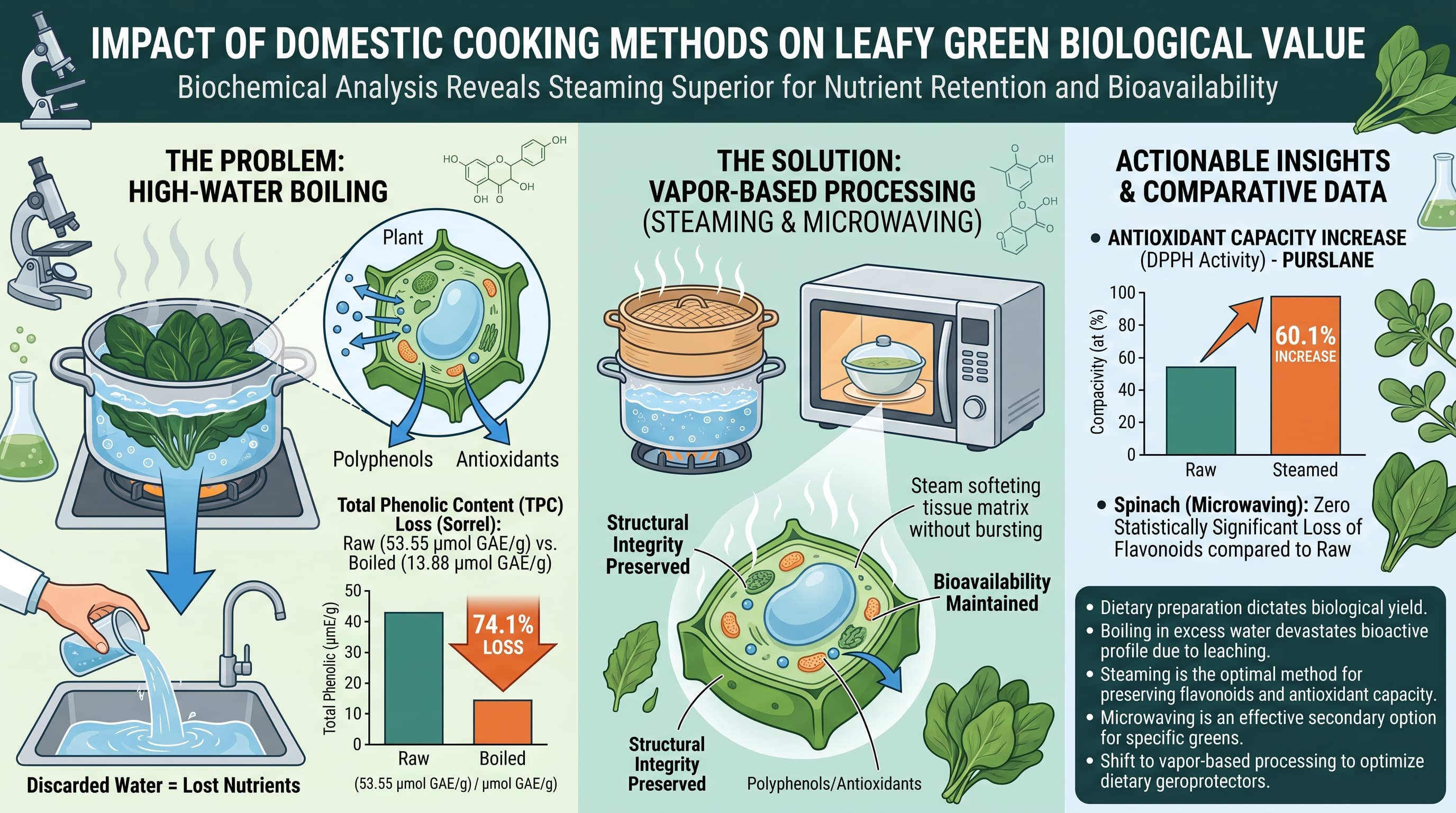
A recent biochemical analysis demonstrates that domestic cooking methods fundamentally alter the phenolic composition and antioxidant capacity of dark green leafy vegetables, with steaming emerging as the superior method for preserving structural integrity and bioavailability.
The longevity community heavily relies on dietary interventions to supply systemic antioxidant and epigenetic modifying compounds. Dark green leafy vegetables provide an abundant source of these phytochemicals, specifically phenolic acids and flavonoids. While raw consumption is often assumed to be optimal, the rigid cellulosic cell walls of many plant species trap these bioactive molecules, preventing absorption in the human gastrointestinal tract. Thermal processing breaks down these structural barriers, but simultaneously introduces the risk of molecular degradation and solvent leaching.
Researchers at Fenerbahçe University and Haliç University executed a controlled biochemical analysis to quantify this precise trade off. They measured the total phenolic content, flavonoid levels, and antioxidant capacities of sorrel, stinging nettle, spinach, Swiss chard, and purslane across four cooking modalities. The modalities included steaming, microwaving, low water boiling, and high water boiling. The team utilized a battery of spectrophotometric assays, including DPPH and CUPRAC, to measure distinct radical scavenging and electron transfer mechanisms, providing a multi dimensional view of post cooking antioxidant potential.
The results illustrate a profound species dependent response to thermal stress. Sorrel exhibited the highest baseline total phenolic content at 53.55 micromoles per gram. However, it proved highly unstable under heat, losing significant antioxidant capacity across all cooking methods. Conversely, purslane demonstrated remarkable matrix stability. Steaming actually increased the measurable antioxidant capacity of purslane by liberating bound phenolics from the plant tissue without destroying them. Heat alters the ester and glycosidic linkages of compounds like quercetin and caffeic acid, enhancing their extractability if the thermal stress is applied correctly.
The volume of water used during processing emerged as the primary variable dictating nutrient retention. High water boiling consistently devastated the bioactive profile of the vegetables. The excessive liquid acts as a solvent, creating a concentration gradient that draws water soluble polyphenols out of the plant tissue and into the cooking medium. Because most culinary applications involve discarding the boiling water, these compounds are entirely lost to the consumer. Steaming and microwaving circumvented this leaching effect, retaining the structural integrity of the compounds while still providing the thermal disruption necessary to soften the plant matrix.
These data indicate that the biological value of a dietary protocol is strictly bound to its execution in the kitchen. Practitioners calculating daily polyphenol intake from raw food databases are overestimating their actual consumption if they employ high water boiling methods. Optimizing dietary geroprotectors requires a shift toward vapor based thermal processing, ensuring that the theoretical benefits of green leafy vegetables translate into measurable biological inputs.
Actionable Insights
Dietary preparation dictates biological yield. To maximize the intake of plant derived geroprotectors, boiling vegetables in excess water must be abandoned. High water boiling caused a 74.1 percent reduction in the total phenolic content of sorrel, dropping the absolute yield from 53.55 to 13.88 micromoles of gallic acid equivalents per gram. If boiling is strictly necessary, minimal water should be used, as low water boiling actually increased the measured phenolic acids in purslane by 275 percent due to the liberation of bound compounds.
Steaming remains the optimal universal method for preserving flavonoids and antioxidant capacity across all tested species. Steaming purslane increased its DPPH radical scavenging activity by 60.1 percent compared to the raw plant. Microwaving serves as an effective secondary option, particularly for spinach, where it preserved total flavonoid content with zero statistically significant loss compared to the raw state. Practitioners should match the preparation method to the plant matrix. Robust cellular structures in purslane benefit from heat driven disruption to liberate bound polyphenols, whereas fragile matrices like sorrel suffer rapid degradation under thermal stress.
Context/Source
- Open Access Paper: Impact of traditional cooking methods on total phenolics, flavonoids, and antioxidant capacities of dark green leafy vegetables.
- Institution: Fenerbahçe University and Haliç University.
- Country: Türkiye.
- Journal: PLOS One.
- Impact Evaluation: The impact score of this journal is 3.7, evaluated against a typical high-end range of 0-60+ for top general science, therefore this is a Medium impact journal.