Hack Your Bones: How Mechanical Loading Reverses Systemic Aging

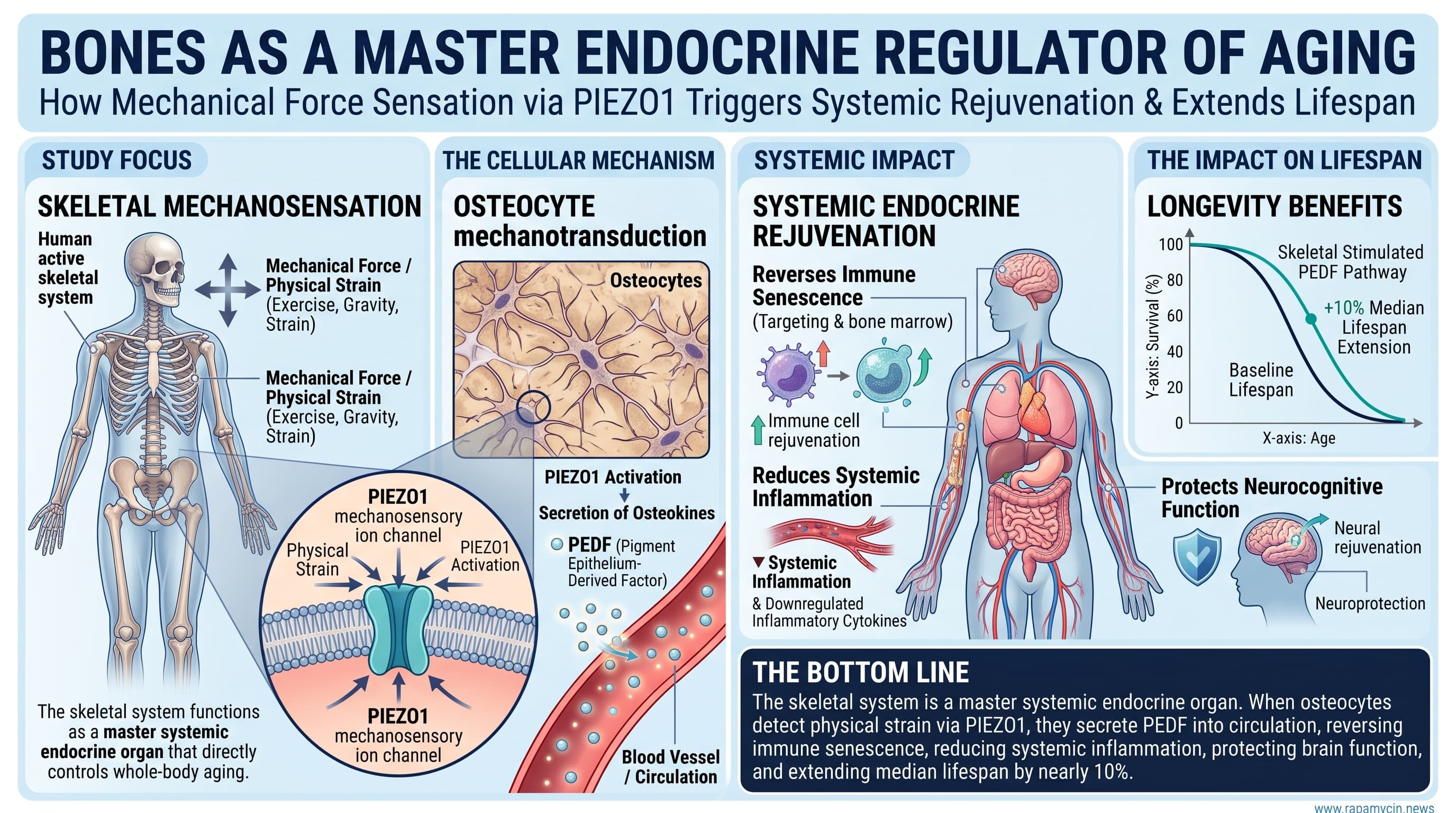
The skeletal system functions as a master systemic endocrine organ that directly controls whole-body aging through mechanical force sensation. When osteocytes detect physical strain via the mechanosensory ion channel PIEZO1, they secrete circulating osteokines, most notably pigment epithelium-derived factor (PEDF). This bone-derived signaling cascade reverses immune system senescence, reduces systemic inflammation, protects neurocognitive function, and extends median lifespan by nearly 10%.

Aging research traditionally positions skeletal muscle and metabolic networks at the center of systemic longevity. This study entirely shifts that paradigm by identifying bone as the primary mechanosensitive trigger for whole-body rejuvenation. The fundamental premise is that bone is not merely a structural scaffold but a highly active endocrine gland that dictates systemic aging based on the mechanical forces it experiences.

Researchers established this causality through a two-pronged approach. First, by knocking out the mechanosensory PIEZO1 channel specifically in the osteocytes of mice, they induced rapid, multi-systemic aging. Without the ability to sense physical load, the mice suffered severe cognitive decline, motor impairment, multi-organ senescence, and a 13.2% reduction in median lifespan. Second, applying controlled Dynamic Tibial Axial Loading (DTAL) to aged mice completely reversed these aging phenotypes. The targeted mechanical strain on the tibia reduced the epigenetic age of the brain, liver, and muscle by an average of 5.5 to 11.4 months, effectively wiping out a massive percentage of the animals’ biological age.

The mechanism bridging bone stimulation to whole-body rejuvenation is humoral. Bone loading triggers osteocytes to release a specific suite of anti-aging proteins, known as osteokines, into the bloodstream. Through isochronic parabiosis and plasma transfer experiments, the researchers proved that plasma from bone-loaded aged mice could transfer youthful benefits to non-exercised mice. The most potent molecule identified in this process is PEDF. While PEDF is known for various protective roles, this study confirms that mechanical loading drives a massive 583% upregulation of PEDF specifically in bone tissue, which then circulates to protect the brain against excitotoxicity, clear hepatic lipids, and reverse bone marrow immunosenescence. This establishes bone mechano-sensing as a definitive, manipulable target for preventing systemic aging and extending healthspan in mammalian biology.

Actionable Insights

To leverage this bone-derived longevity pathway, the skeletal system must experience distinct, dynamic mechanical strain. Relying solely on low-impact cardiovascular work like swimming or cycling is insufficient to trigger osteocytic PIEZO1 channels. To trigger PIEZO1, athletic practices must involve high-impact loading, rapid changes in direction, or heavy resistance that places bending and compressive loads on the skeleton. Sports that do this include high-impact racquet and court sports, high-torque and contact sports like ice hockey or basketball, and exercises that place compressive loads on the axial skeleton and lower limbs, such as heavy barbell squats, deadlifts, and weighted hip thrusts, are highly effective.

The real-world magnitude of these interventions is highly significant. The 9.4% median lifespan extension observed in the treatment group equates to an absolute increase of 79.5 days in mice. If mathematically extrapolated to an average 80-year human lifespan, this represents a potential 7.5-year extension in median survival. Furthermore, the reversal of epigenetic clocks by 5.5 to 11.4 months in 24-month-old mice represents a biological age reduction of 23% to 47% relative to their chronological age. Activating this pathway provides a massive, systemic return on investment for high-load physical training.

Source / Context:

  • Open Access Paper: Dynamic force sensing by bone delays aging and extends lifespan
  • Institution: Southern Medical University (Guangzhou, China) and Kunming Medical University (Kunming, China)
  • Journal Name: Cell Metabolism
  • Impact Evaluation: The impact score of this journal is 27.7, evaluated against a typical high-end range of 0–60+ for top general science, therefore this is a Elite impact journal.
3 Likes

Novelty

Prior longevity models attributed the systemic benefits of exercise almost exclusively to myokines (muscle-derived factors) and metabolic flux. This paper establishes that bone is an independent, primary driver of whole-body aging. It introduces the concept that manipulating the skeleton’s physical state can remotely re-energize the immune system and clear aggregates in the brain via targeted osteokines.

Biomarker Data (Effect Size Calculation)

  • Median Lifespan Extension: Increased by 9.4% in the DTAL group, representing an absolute extension of 79.5 days (845.5 days control vs. 925.0 days DTAL).

  • Maximum Lifespan Extension: Increased by 15.4% in males and 7.6% in females.

  • Biomarker Standardized Effect Sizes:

    • PEDF Upregulation: DTAL induced a 583% absolute increase in PEDF expression in bone tissue, heavily skewing systemic plasma concentrations.

    • Epigenetic Age Reversal: Using transcriptomic clocks, DTAL reduced biological age by 11.4 months in female livers and 7.0 months in male brains. With a baseline chronological age of 24 months, this represents a standardized effect size of reducing organ-specific biological age by roughly 30% to 47%.

Exactly what sports and athletic practices are sufficient to trigger osteocytic PIEZO1 channels?

Osteocytic PIEZO1 channels are mechanosensors activated specifically by fluid shear stress within the bone canalicular network. This stress is generated by ground reaction forces, axial compression, and multi-directional torque. Swimming and cycling lack these elements because body weight is supported by water or a bicycle frame, resulting in insufficient mechanical strain to deform the bone matrix and trigger the release of longevity-associated osteokines.

To trigger PIEZO1, athletic practices must involve high-impact loading, rapid changes in direction, or heavy resistance that places bending and compressive loads on the skeleton.

  • High-Impact Racquet and Court Sports: Court sports require rapid acceleration, deceleration, and lateral bounding. Tennis generates massive ground reaction forces through the lower extremities and multi-directional torque across the hips and spine, creating the unaccustomed strain patterns required for optimal mechanotransduction.
  • High-Torque and Contact Sports: Activities requiring explosive speed, sharp rotational movements, and physical impact drive high strain rates. Ice hockey forces the skeletal system to absorb high-velocity impacts, rapid directional shifts on rigid skates, and significant rotational torque through the core and upper body.
  • Heavy Axial Resistance Training: Skeletal loading through gravitational resistance directly triggers mechanosensation. Exercises that place compressive loads on the axial skeleton and lower limbs, such as heavy barbell squats, deadlifts, and weighted hip thrusts, are highly effective. Accessory movements requiring high muscle-tendon force generation against the bone, including Nordic hamstring curls and weighted tibialis raises, further amplify local bone strain.

• • Plyometrics and Ballistic Impact: Jump training, drop jumps, and bounding create rapid spikes in mechanical loading. The speed of the force application (strain rate) is frequently more critical for PIEZO1 activation than the absolute weight applied.

  • Weight-Bearing Cardiovascular Training: While steady-state jogging provides baseline impact, increasing the gravitational load enhances the osteogenic effect. Brisk walking on a steep 15-degree treadmill incline at speeds around 4 mph becomes significantly more osteogenic if a weighted vest is added to increase the axial load and subsequent fluid shear stress in the tibia and femur.

Maximize PIEZO1 activation by exposing the skeleton to novel, unpredictable loads. Bone tissue rapidly desensitizes to repetitive, predictable mechanical strain. Alternating between high-impact multidirectional sports, heavy strength training, and variable-intensity load-bearing cardio prevents cellular accommodation and sustains the systemic release of anti-aging factors. For a deeper clinical understanding of how these forces regulate skeletal homeostasis, the literature on PIEZO1 mechanotransduction in bone identifies the precise translational pathways from physical force to cellular signaling.

I see life extention claims, so let’s see if their data passes the 900-day rule

2 Likes

The contribution of bone health to longevity is an open question but the contribution of bone strength to quality of life in one’s last few decades would be difficult to overstate. So much of what I do – lifting, placing, climbing, swinging over, jumping, pushing, pulling, hyperextending, balancing – both depends on and contributes to bone health and strength. I know more than a few people my age who have broken a bone due to nothing more than trying to move 50 pounds around. Some can’t even lift 50 pounds safely. I see no practical way to distinguish muscle, bone, and connective tissue, etc. from healthy mobility.

1 Like