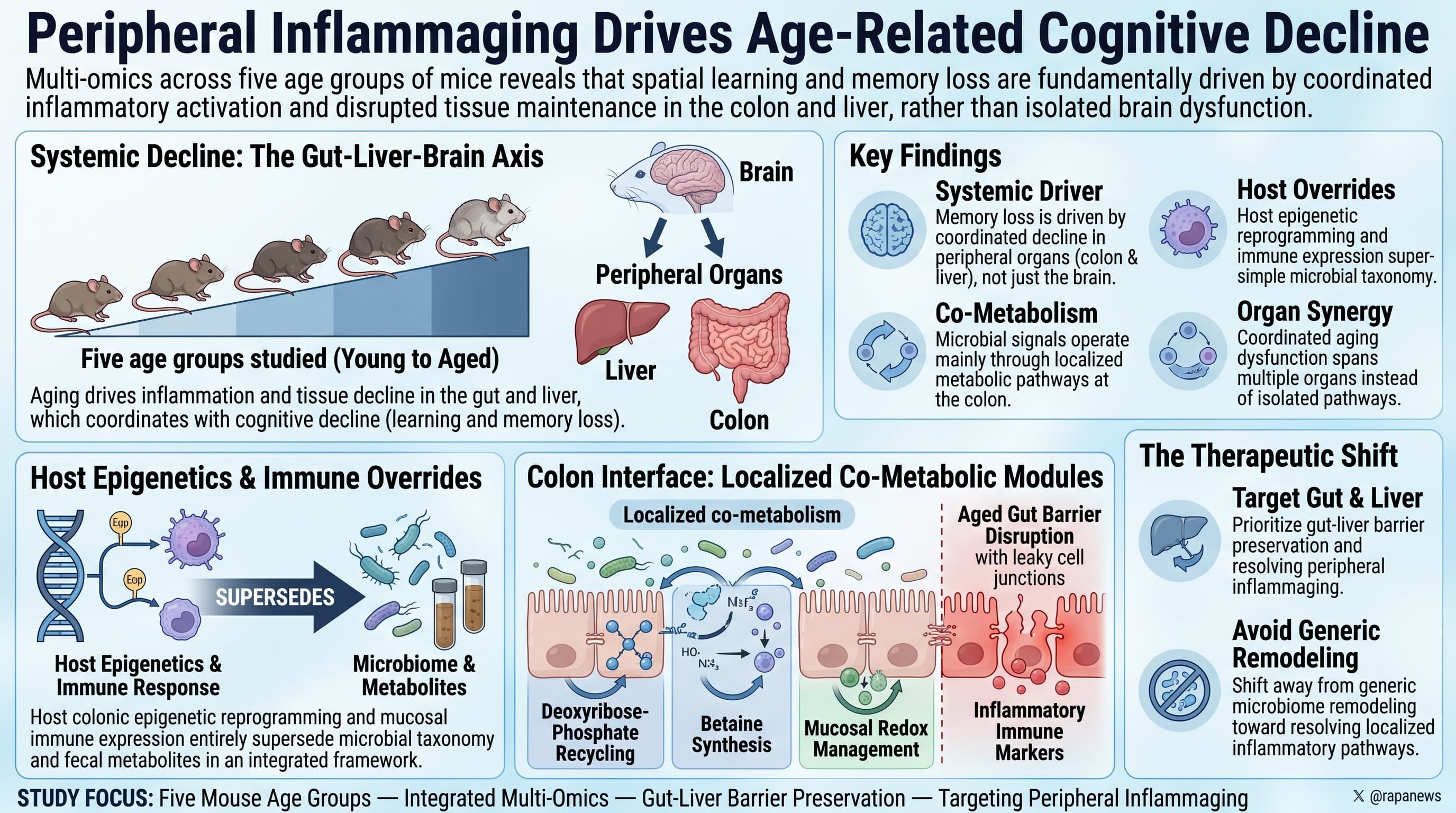
Gut Barrier Breakdown and Tissue Inflammation Overtake Gut Bacteria as Primary Drivers of Cognitive Decline

A comprehensive cross-sectional investigation across five age groups of mice demonstrates that age-related loss of spatial learning and memory is fundamentally driven by coordinated inflammatory activation and disrupted tissue maintenance across peripheral organs, especially the colon and liver, rather than by isolated brain dysfunction. While standalone microbial taxonomy and fecal metabolite profiles correlate with cognitive performance in isolation, these bacterial signals are entirely superseded by host colonic epigenetic reprogramming and mucosal immune expression when evaluated in an integrated multi-omics framework. By modeling metabolic flux at the colon interface, the research reveals that microbial contributions operate primarily through localized co-metabolic modules, demonstrating that therapeutic strategies must prioritize gut barrier preservation and resolution of peripheral inflammaging over generic microbiome remodeling.

Aging is frequently viewed as an inevitable degeneration of the brain, yet emerging systems biology suggests that neurocognitive vitality depends on a dynamic dialogue between peripheral organs, systemic immune signals, and intestinal microbes. This study examines eighty-three mice across their adult lifespan, spanning from three to twenty-eight months of age, combining behavioral spatial learning benchmarks in the Barnes maze with molecular profiling of the hippocampus, liver, colon, and gut microbiome. The primary objective was to uncover whether alterations in the gut microbiome directly dictate cognitive aging, or whether their influence is filtered through host tissue homeostasis and immune tone.

The behavioral data demonstrated a clear, non-linear decline in spatial learning and memory retention as animals advanced into old age. To understand the molecular architecture behind this loss, investigators applied machine-learning algorithms across transcriptomic and DNA methylation data from the brain, liver, and colon, alongside fecal shotgun metagenomics and untargeted metabolomics. In isolated individual analyses, each biological layer appeared important. Fecal levels of taurine-conjugated bile acids and 3-hydroxykynurenine positively tracked cognitive ability, while the genetic abundance of specific bacterial families, such as Muribaculaceae and Lachnospiraceae, correlated with superior spatial navigation.

A stark shift occurred when all data layers were integrated into a single analytical model. Standalone bacterial species counts and metabolic profiles vanished from the final predictive set. Instead, the molecular signature of cognitive decline was dominated by host-derived factors, specifically gene promoter methylation and expression profiles governing tissue maintenance, structural development, and immune regulation. The colonic epithelium exhibited the most pronounced epigenetic remodeling, with marked shifts in genes controlling mucosal integrity and vascular inflammation. Similarly, expression of the inhibitory immune checkpoint receptor LAIR1 in both the liver and the brain tracked cognitive resilience, indicating a coordinated multi-organ axis that regulates complement activation and resolves tissue injury.

To capture how intestinal microbes still participate in this network, the authors constructed a computational metabolic metamodel connecting host colonic metabolism with bacterial biochemical reactions. Rather than broad community shifts, the model isolated specific host-microbe partnerships. The most prominent co-metabolic signal centered on deoxyribose-phosphate recycling. In cognitively intact animals, host colonic cells actively broke down deoxynucleosides via the enzyme deoxyribose-phosphate aldolase, while gut bacteria operated matching reactions in reverse, forming a coupled nucleotide salvage circuit linked to cellular stress protection and energy production.

These findings challenge the simplistic assumption that replenishing young bacterial strains or indiscriminately increasing fermentation metabolites will automatically rescue the aging brain. Indeed, microbial butyrate synthesis potential was negatively associated with spatial learning in older animals, mirroring clinical observations where excessive short-chain fatty acids can exacerbate neuroinflammation in vulnerable neurological states. Intestinal microbes influence the brain predominantly by regulating local barrier integrity, gut redox tone, and systemic inflammaging. Preserving the cognitive span therefore demands therapies that protect gut epithelial barriers, support nucleotide turnover, and suppress systemic tissue inflammation.

Actionable Insights

The study highlights that cognitive resilience depends on preserving gut barrier integrity and attenuating chronic low-grade inflammation across the gut-liver-brain axis. Standardized statistical conversions demonstrate the substantial magnitude of these biological relationships. Chronological age explains forty-four percent of the variance in spatial learning capacity (Spearman rank correlation rho = -0.67, corresponding to a very large standardized effect size of Cohen’s d = -1.79).

Against this baseline decline, higher levels of fecal taurine-conjugated bile acids (rho = 0.43, Cohen’s d = 0.94) and 3-hydroxykynurenine (rho = 0.40, Cohen’s d = 0.88) show large protective associations, accounting for approximately sixteen to eighteen percent of individual performance differences. Within metabolic flux simulations, host colonic betaine synthesis capacity (rho = 0.42, Cohen’s d = 0.92) and microbial glutathione reduction (rho = 0.42, Cohen’s d = 0.91) also confer large standardized advantages for spatial navigation.

Practically, these figures indicate that lifestyle strategies should not rely on generic live probiotics or indiscriminate fiber megadosing, because microbial butyrate-producing capacity was inversely associated with late-life cognitive performance. Instead, take-home measures should prioritize dietary osmoprotectants and methyl donors like dietary betaine and choline to support cellular methylation and tissue osmotic tolerance, taurine-rich nutrition to maintain bile acid conjugation pathways, and targeted gut-barrier protection to prevent microbial endotoxin leakage and subsequent liver and brain inflammaging.

Context and Source Evaluation

  • Open Access Paper: Microbiome-host interactions in cognitive aging
  • Author: Stefano Flor
  • Institutions: Research Group Medical Systems Biology, Institute of Experimental Medicine, Christian-Albrechts-Universität zu Kiel (Kiel University) and University Hospital Schleswig-Holstein, Kiel, Germany; Leibniz Institute on Aging - Fritz Lipmann Institute, Jena, Germany; and Department of Neurology, Jena University Hospital, Jena, Germany
  • Country: Germany
  • Publication Venue: Doctoral Dissertation (Kiel University, July 2026).

Betaine regulates the gut-liver axis: a therapeutic approach for chronic liver diseases

“Betaine is a choline-derived metabolite and a methyl group donor with antioxidant, anti-inflammatory and osmoprotectant properties. Studies have shown that low betaine levels are associated with higher levels of organ damage. There have been several publications demonstrating the role of betaine supplementation in preventing the development of ALD and MASLD. This review explores the protective effects of betaine through its role as a methyl donor and its capacity to regulate the protective gut microbiota and maintain intestinal barrier integrity to prevent the development of these chronic liver diseases.”

1 Like

A summary of the above paper:

Gut Guardian: How a Common Nutrient Shields the Liver from Modern Diets and Alcohol

This narrative review from the University of Nebraska Medical Center argues that betaine (trimethylglycine), a choline-derived methyl donor found in whole grains, spinach, beets and shellfish, protects against alcohol-associated liver disease (ALD) and metabolic dysfunction-associated steatotic liver disease (MASLD) partly by acting on the gut. The authors propose that betaine preserves intestinal tight junctions by lowering S-adenosylhomocysteine (SAH), shifts gut bacteria toward short-chain fatty acid producers, and so reduces the flow of bacterial endotoxin to the liver. The supporting evidence is almost entirely from cell cultures, rodents, poultry, rabbits and fish. The authors acknowledge that no clinical trial has tested betaine on the gut-liver axis in liver disease.

The human gut and liver exist in a continuous state of biochemical communication. This relationship is entirely dependent on the integrity of the intestinal barrier, a microscopic wall of epithelial cells held together by tight junction proteins. When exposed to modern environmental stressors like high fat diets, refined sugars, and alcohol, these tight junctions degrade. This degradation creates intestinal permeability, commonly known as leaky gut. Pathogenic bacteria and their toxic byproducts then bypass the intestinal firewall, flooding into the portal vein and triggering massive inflammatory cascades in the liver. This localized inflammation recruits systemic immune cells, driving the progression of chronic liver conditions such as alcohol-associated liver disease and metabolic dysfunction-associated steatotic liver disease.

Betaine is a naturally occurring amino acid derivative found in wheat bran, spinach, and sugar beets. It operates primarily through two distinct biochemical mechanisms. First, it functions as a potent osmolyte. It helps cells maintain their fluid balance and structural integrity under severe metabolic and environmental stress. Second, it acts as a critical methyl group donor in the methionine metabolic pathway. Betaine converts homocysteine into methionine, reducing cellular levels of toxic homocysteine and S-adenosylhomocysteine. This specific methylation activity is required to synthesize and assemble the tight junction proteins zonula occludens-1, occludin, and claudin.

When betaine restores these tight junctions, the physical barrier between the gut and the liver is resealed. Endotoxin translocation halts. Betaine also profoundly reshapes the gut microbiome. It increases the abundance of longevity-associated commensal bacteria like Akkermansia muciniphila and Bifidobacterium while suppressing inflammatory pathobionts such as Desulfovibrio. This microbial shift increases the production of short chain fatty acids, which further nourish the gut lining.

The compound also acts directly on liver tissue. By maintaining the necessary ratio of S-adenosylmethionine to S-adenosylhomocysteine, betaine protects hepatocytes from lipid accumulation, oxidative damage, and apoptosis. Unlike traditional probiotics that merely attempt to seed the gut with beneficial bacteria, betaine alters the fundamental environment of the gastrointestinal tract. It optimizes pH, increases digestive enzyme activity, and creates an osmotic microenvironment where beneficial microbes thrive natively. This dual action makes it a uniquely powerful tool for intercepting metabolic disease long before irreversible liver fibrosis occurs.

Actionable Insights

First, food. Whole grain products contain two to four times more betaine than refined ones. Wheat bran, wheat germ, quinoa, spinach and beets are rich sources. Typical Western intake is under about 150 mg a day, so diet changes can easily double or triple it at no risk.

Second, supplements. In healthy adults, 4 to 6 grams a day lowers homocysteine by about 1.2 to 1.3 micromol/L, roughly a 12% drop. That is a small to moderate effect (estimated standardized effect around 0.4). The catch: at 4 grams a day or more, LDL cholesterol rises by roughly 10 to 14 mg/dL, an effect of similar size pointing the wrong way for heart health. Doses under 4 grams a day appear to lower homocysteine without the cholesterol increase.

Third, the liver claim. In the best human trial (20 g/day for a year), betaine did not reduce liver fat versus placebo. No human trial has measured gut barrier outcomes.

Regarding effect sizes, this publication is a narrative review rather than a primary clinical trial. The literature reviewed establishes that betaine definitively restores intestinal barrier proteins and normalizes liver transaminases in preclinical models, but precise real-world magnitude calculations are impossible to extract from the provided text. To achieve the physiological benefits described, individuals should consider increasing dietary intake of whole grains and spinach, or utilizing anhydrous betaine supplements to bridge the gap between the typical 150 mg daily intake and the 4 gram level. 9 to 15 gram is the therapeutic threshold.

Biomarker Data

The review does not report absolute maximum or median lifespan extensions. The authors report that betaine reduces fasting glucose, lowers insulin, corrects abnormal adipokine production, and attenuates circulating tumor necrosis factor-alpha and transaminase levels.

Liver fat in NASH (Abdelmalek 2009, the best human RCT):

  • Design: 55 biopsy-proven NASH patients, 20 g/day betaine vs placebo for 12 months.
  • Completion: only 35 of 55 finished (about 36% dropout), with 34 post-treatment biopsies.
  • Result: The published conclusion was formally corrected to state that betaine did not improve liver fat compared with placebo, though it may protect against worsening. Secondary summaries of the trial report steatosis-grade percentages that are internally inconsistent across editorials, so no reliable standardized effect size can be calculated.
  • Mechanism check: SAH was about twice normal in patients and was not reduced by betaine. Insulin, glucose, inflammatory cytokines and antioxidant status did not improve.
  • Plain-language reading: at a very high dose for a full year, the measurable benefit on liver fat was nil to marginal. [Confidence: High that the primary result was null]

Liver fat in NASH (Miglio 2000):

  • Design: 191 patients, 8 weeks, a combination product containing betaine glucuronate plus diethanolamine glucuronate and nicotinamide ascorbate vs placebo. Diagnosis by ultrasound, not biopsy.
  • Result: About a 25% reduction in ultrasound-assessed steatosis and a 6% reduction in liver size. Physician-rated “good or very good” efficacy was 48% vs 17%.
  • Effect size: relative “response” about 2.8 times placebo; absolute difference 31 percentage points, meaning roughly 1 in 3 treated patients benefited who would not have on placebo.
  • Caveat: the betaine dose was about 300 mg/day, only about twice typical dietary intake, and the product contained other active ingredients. The effect cannot be attributed to betaine. [Confidence: Low for betaine-specific benefit]

Homocysteine (healthy adults, meta-analyses):

  • 4 to 6 g/day lowers homocysteine by about 1.23 micromol/L (11.8%); a later meta-analysis found about 1.30 micromol/L.
  • Estimated standardized effect: assuming a population standard deviation of roughly 3 micromol/L, this is about d = 0.4, a small to moderate effect. (This standardization is my estimate, not a reported figure.)
  • Clinical meaning: large B-vitamin trials that lowered homocysteine two to three times more than this did not reduce heart attacks, so the clinical value of a 1.2 micromol/L drop is uncertain.

Blood lipids (the harm side, omitted by the review):

  • 6 g/day for 6 weeks raised LDL by 0.36 mmol/L (about 14 mg/dL) and triglycerides by 0.14 mmol/L relative to placebo, with the LDL rise visible by week 2.
  • A 2021 meta-analysis found pooled increases of about 14 mg/dL total cholesterol and 10 mg/dL LDL, with no change in liver enzymes, CRP or glucose.
  • Estimated standardized effect: about d = 0.4 for LDL, similar in size to the homocysteine benefit but in the adverse direction.
  • Extrapolated risk: using the statin-trial rule of thumb (about 22% relative change in major vascular events per 1 mmol/L LDL), a sustained 0.36 mmol/L rise implies roughly a 7 to 8% relative increase in vascular risk over years. This is an extrapolation, not a measured outcome. [Confidence: Medium for the lipid rise, Low for the risk extrapolation]
  • Dose threshold: subgroup analysis suggests doses under 4 g/day lower homocysteine without raising lipids. [Confidence: Medium]

Gut barrier, microbiome and endotoxin in humans: No data. Safety Data Absent for long-term high-dose use in people with liver disease.

Novelty

What this adds is synthesis, not discovery. The genuine contributions are:

  1. Explicitly framing betaine as a gut-barrier agent rather than only a hepatic methyl donor, linking the SAH-tight junction finding to the broader gut-liver axis literature.
  2. Collecting the scattered microbiome data (mostly from obesity, livestock and colitis models) into one table showing consistent enrichment of SCFA producers and Akkermansia.
  3. Clearly stating the open question: no study has examined how betaine alters the microbiome (pH, sIgA, direct substrate use), and there are no data on fungal or viral communities.
1 Like