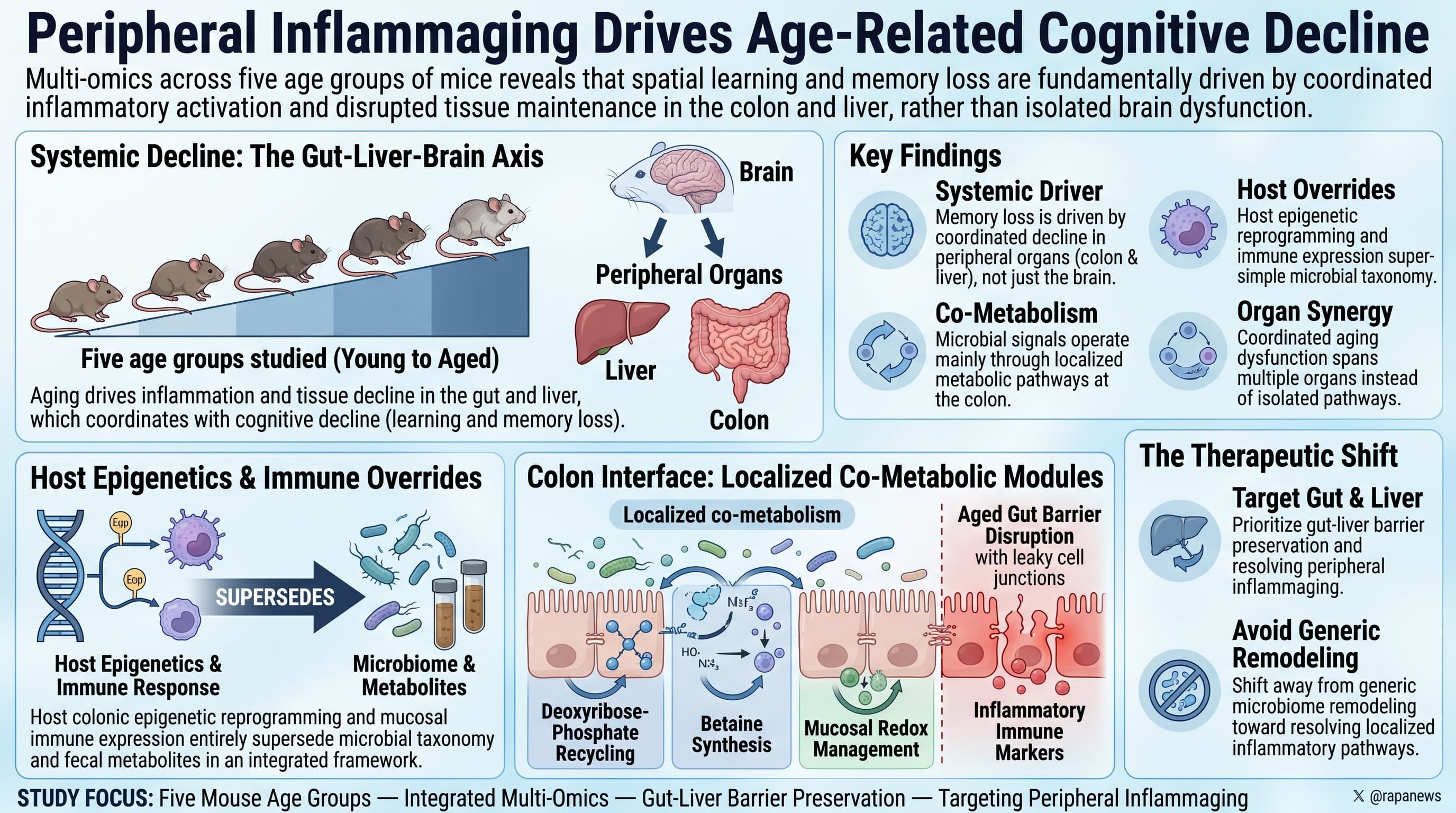
A comprehensive cross-sectional investigation across five age groups of mice demonstrates that age-related loss of spatial learning and memory is fundamentally driven by coordinated inflammatory activation and disrupted tissue maintenance across peripheral organs, especially the colon and liver, rather than by isolated brain dysfunction. While standalone microbial taxonomy and fecal metabolite profiles correlate with cognitive performance in isolation, these bacterial signals are entirely superseded by host colonic epigenetic reprogramming and mucosal immune expression when evaluated in an integrated multi-omics framework. By modeling metabolic flux at the colon interface, the research reveals that microbial contributions operate primarily through localized co-metabolic modules, demonstrating that therapeutic strategies must prioritize gut barrier preservation and resolution of peripheral inflammaging over generic microbiome remodeling.
Aging is frequently viewed as an inevitable degeneration of the brain, yet emerging systems biology suggests that neurocognitive vitality depends on a dynamic dialogue between peripheral organs, systemic immune signals, and intestinal microbes. This study examines eighty-three mice across their adult lifespan, spanning from three to twenty-eight months of age, combining behavioral spatial learning benchmarks in the Barnes maze with molecular profiling of the hippocampus, liver, colon, and gut microbiome. The primary objective was to uncover whether alterations in the gut microbiome directly dictate cognitive aging, or whether their influence is filtered through host tissue homeostasis and immune tone.
The behavioral data demonstrated a clear, non-linear decline in spatial learning and memory retention as animals advanced into old age. To understand the molecular architecture behind this loss, investigators applied machine-learning algorithms across transcriptomic and DNA methylation data from the brain, liver, and colon, alongside fecal shotgun metagenomics and untargeted metabolomics. In isolated individual analyses, each biological layer appeared important. Fecal levels of taurine-conjugated bile acids and 3-hydroxykynurenine positively tracked cognitive ability, while the genetic abundance of specific bacterial families, such as Muribaculaceae and Lachnospiraceae, correlated with superior spatial navigation.
A stark shift occurred when all data layers were integrated into a single analytical model. Standalone bacterial species counts and metabolic profiles vanished from the final predictive set. Instead, the molecular signature of cognitive decline was dominated by host-derived factors, specifically gene promoter methylation and expression profiles governing tissue maintenance, structural development, and immune regulation. The colonic epithelium exhibited the most pronounced epigenetic remodeling, with marked shifts in genes controlling mucosal integrity and vascular inflammation. Similarly, expression of the inhibitory immune checkpoint receptor LAIR1 in both the liver and the brain tracked cognitive resilience, indicating a coordinated multi-organ axis that regulates complement activation and resolves tissue injury.
To capture how intestinal microbes still participate in this network, the authors constructed a computational metabolic metamodel connecting host colonic metabolism with bacterial biochemical reactions. Rather than broad community shifts, the model isolated specific host-microbe partnerships. The most prominent co-metabolic signal centered on deoxyribose-phosphate recycling. In cognitively intact animals, host colonic cells actively broke down deoxynucleosides via the enzyme deoxyribose-phosphate aldolase, while gut bacteria operated matching reactions in reverse, forming a coupled nucleotide salvage circuit linked to cellular stress protection and energy production.
These findings challenge the simplistic assumption that replenishing young bacterial strains or indiscriminately increasing fermentation metabolites will automatically rescue the aging brain. Indeed, microbial butyrate synthesis potential was negatively associated with spatial learning in older animals, mirroring clinical observations where excessive short-chain fatty acids can exacerbate neuroinflammation in vulnerable neurological states. Intestinal microbes influence the brain predominantly by regulating local barrier integrity, gut redox tone, and systemic inflammaging. Preserving the cognitive span therefore demands therapies that protect gut epithelial barriers, support nucleotide turnover, and suppress systemic tissue inflammation.
Actionable Insights
The study highlights that cognitive resilience depends on preserving gut barrier integrity and attenuating chronic low-grade inflammation across the gut-liver-brain axis. Standardized statistical conversions demonstrate the substantial magnitude of these biological relationships. Chronological age explains forty-four percent of the variance in spatial learning capacity (Spearman rank correlation rho = -0.67, corresponding to a very large standardized effect size of Cohen’s d = -1.79).
Against this baseline decline, higher levels of fecal taurine-conjugated bile acids (rho = 0.43, Cohen’s d = 0.94) and 3-hydroxykynurenine (rho = 0.40, Cohen’s d = 0.88) show large protective associations, accounting for approximately sixteen to eighteen percent of individual performance differences. Within metabolic flux simulations, host colonic betaine synthesis capacity (rho = 0.42, Cohen’s d = 0.92) and microbial glutathione reduction (rho = 0.42, Cohen’s d = 0.91) also confer large standardized advantages for spatial navigation.
Practically, these figures indicate that lifestyle strategies should not rely on generic live probiotics or indiscriminate fiber megadosing, because microbial butyrate-producing capacity was inversely associated with late-life cognitive performance. Instead, take-home measures should prioritize dietary osmoprotectants and methyl donors like dietary betaine and choline to support cellular methylation and tissue osmotic tolerance, taurine-rich nutrition to maintain bile acid conjugation pathways, and targeted gut-barrier protection to prevent microbial endotoxin leakage and subsequent liver and brain inflammaging.
Context and Source Evaluation
- Open Access Paper: Microbiome-host interactions in cognitive aging
- Author: Stefano Flor
- Institutions: Research Group Medical Systems Biology, Institute of Experimental Medicine, Christian-Albrechts-Universität zu Kiel (Kiel University) and University Hospital Schleswig-Holstein, Kiel, Germany; Leibniz Institute on Aging - Fritz Lipmann Institute, Jena, Germany; and Department of Neurology, Jena University Hospital, Jena, Germany
- Country: Germany
- Publication Venue: Doctoral Dissertation (Kiel University, July 2026).