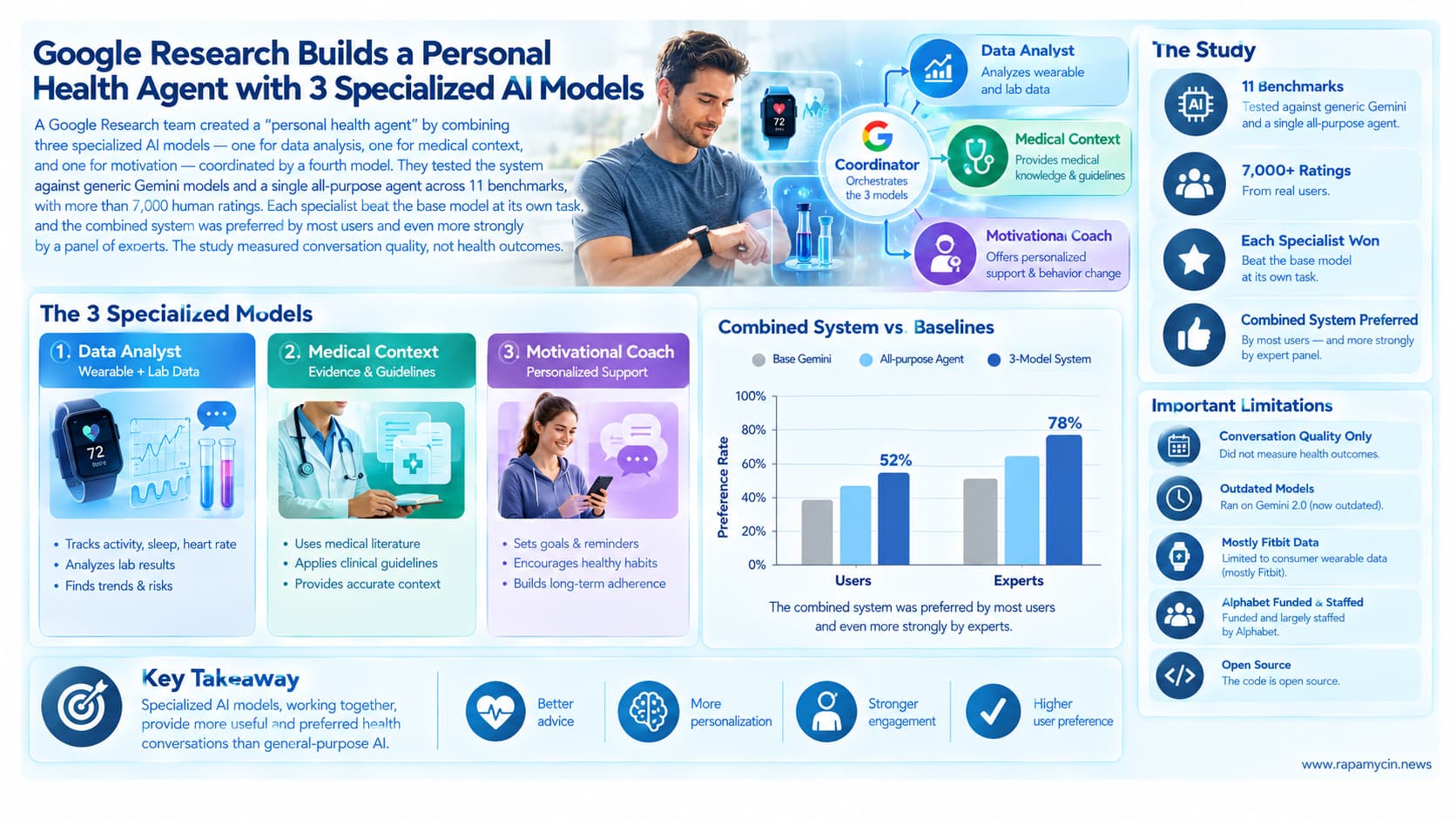
A Google Research team built a “personal health agent”: three specialized AI models coordinated by a fourth. One analyzes wearable and lab data, one supplies medical context, and one acts as a motivational health coach. They tested the system against generic Gemini models and a single all-purpose agent across 11 benchmarks, with more than 7,000 human ratings. Each specialist beat the base model at its own task. The combined system was preferred by most users and, more strongly, by a small panel of experts. The study measured conversation quality, not health outcomes. It ran on Gemini 2.0 models that are now outdated, used mostly Fitbit data, and was funded and largely staffed by Alphabet. The code is open source.
Ask a chatbot about sleep and you will get a decent paragraph on sleep hygiene. Ask whether your own sleep got worse last month, and why, and the answer usually falls apart. A good answer means pulling numbers from a wearable, running sound statistics, knowing the medicine, and turning all of it into advice a person will follow. A Google team argues that no single AI model does all of that well, and that the fix is a small team of them.
The researchers sorted 1,370 real health questions from Google Search, Gemini and Fitbit forums, plus surveys from 555 Fitbit users, into four kinds of request: general facts, questions about one’s own data, wellness advice and symptom checking. They then built three specialists on Google’s Gemini 2.0 models. A data science agent writes an analysis plan and then code to process a user’s wearable and blood test data. A domain expert agent searches the web and medical databases for clinical context. A coaching agent uses motivational interviewing to steer people toward concrete goals. An orchestrator decides which agent handles each part of a question and has the lead agent review the combined answer before the user sees it.
Each specialist beat plain Gemini at its own job. The data agent’s code passed 75.5 percent of expert-written tests on the first try, against 58.4 percent. It also got far better at noticing when data were too sparse to support a conclusion, a well-known chatbot blind spot. The expert agent named the correct diagnosis first 46 percent of the time, a modest gain over an earlier Google system. Clinicians rated 65 percent of its health summaries useful, against 30 percent for the base model.
To test the full system, 45 volunteers role-played real participants from a Fitbit metabolic health study and chatted live with three systems without knowing which was which. Nearly half picked the team version as their favorite, against about a quarter for a single all-purpose agent. Three health experts who reviewed the transcripts were firmer, ranking it best in two of every three conversations.
The claim of “the most comprehensive evaluation thus far” is fair as far as it goes. But the study measured how good the conversations looked, not whether anyone’s health changed. No one was followed over time. Volunteers were acting out someone else’s health profile, only three experts rated the final system, and the data came almost entirely from Fitbit devices. The authors are almost all Alphabet employees, and they used their own model throughout.
There are practical costs as well. The team approach averaged about three and a half minutes per reply, against 36 seconds for the single agent. In a safety review, clinicians judged 15 percent of the expert agent’s summaries capable of mild harm and 2 percent capable of moderate to severe harm.
The most useful part of the work may be the open code and benchmarks. Anyone can now test whether a committee of older models still beats one newer, smarter model. In late 2026, with Gemini 2.0 well behind the frontier, that is an ongoing question.
Relevance to a Longevity Biohacker
The practical value is architectural. The open-source framework (Apache 2.0) can, in principle, be pointed at your own wearable and lab exports and run on a newer model. The lab panel is basic (lipids, CMP, CBC, insulin; 28 markers), and the system was not built for longevity-specific inputs such as CGM traces, ApoB-focused lipidology, epigenetic clocks, VO2max testing or medication stacks. The most transferable lesson is procedural: force any AI analyst to state its data sufficiency, timeframe and statistical test before trusting a number it gives you about your own body.
Actionable Insights
This paper is about software, so the take-homes are about using AI health tools well.
- Make the AI check your data first. Plain Gemini flagged missing or insufficient wearable data about 5 times in 100. The structured agent did so about 67 times in 100. When you hand a chatbot your wearable export, ask how many valid days it actually analyzed.
- Treat AI symptom guesses as leads, not diagnoses. Even the improved agent put the right condition first in fewer than half of cases (46 in 100).
- Specialized prompting improves factual knowledge only slightly. Accuracy on board-exam questions rose from 81.8 to 83.6 percent, about 2 extra correct answers per 100.
- Expect real error rates. About 1 in 6 AI health summaries carried some potential for harm, and 1 in 50 carried moderate to severe potential.
- Don’t read meaning into weak correlations in your own data. The paper’s example correlation of 0.13 between daily steps and deep sleep explains under 2 percent of the day-to-day variation.
Context and Source
- Open Access paper: The anatomy of a personal health agent
- Institution: Google Research, Mountain View, California, with Google DeepMind, Vituity (Emeryville, California) and Columbia University (New York)
- Country: United States
- Journal: Nature (published online 21 October 2026)
-
Funding: Alphabet Inc. Most authors are current or former Alphabet employees.
Impact evaluation: Nature’s Journal Impact Factor is 56.1 (2025 JCR data year, released June 2026). The impact score of this journal is 56.1, evaluated against a typical high-end range of 0 to 60+ for top general science, therefore this is an Elite impact journal.