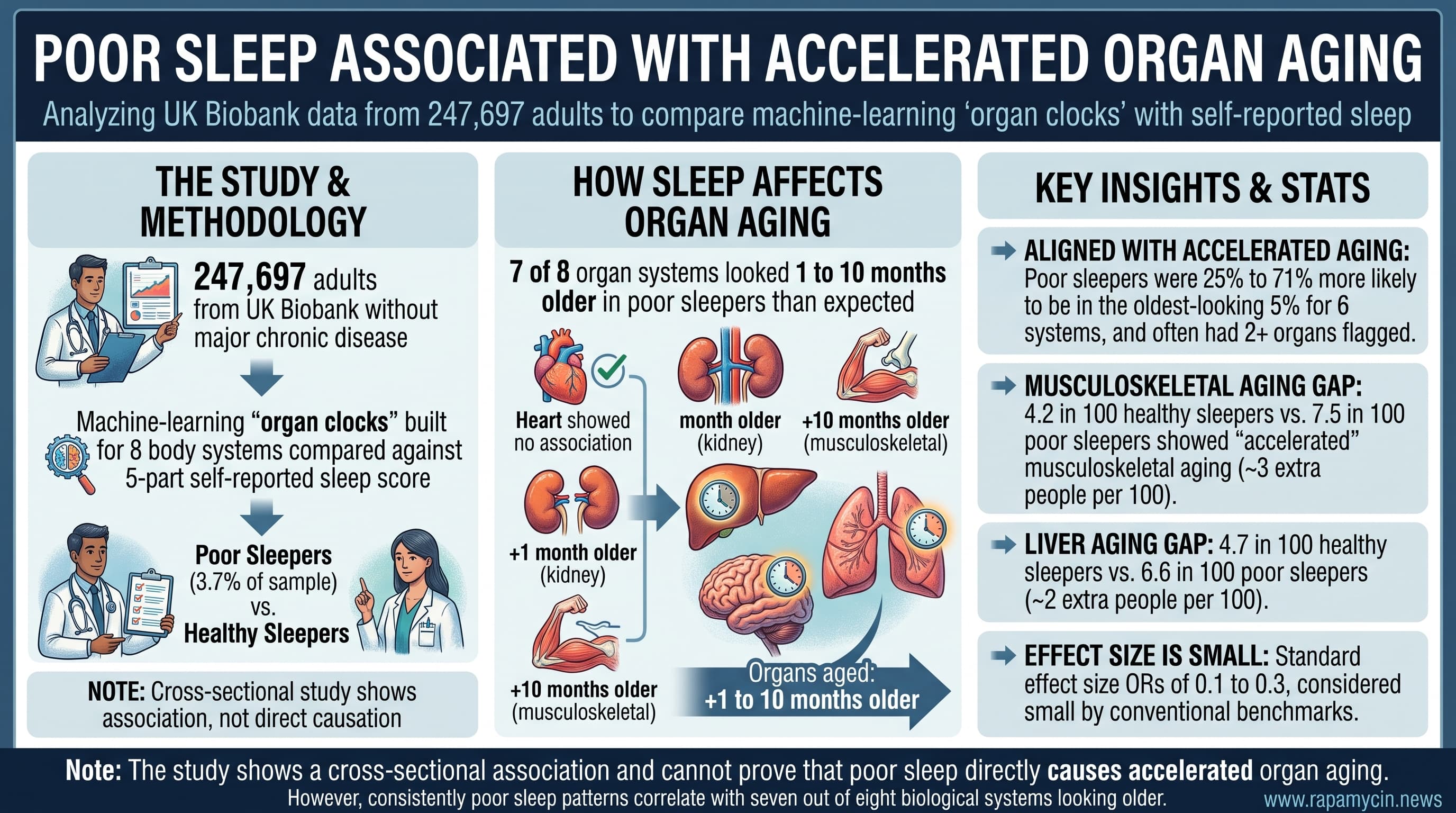
Researchers used UK Biobank data from 247,697 adults without major chronic disease to build machine-learning “organ clocks” for eight body systems, then compared these against a five-part self-reported sleep score. People with poor sleep patterns (3.7% of the sample) had organs that looked roughly one to ten months older than expected for seven of the eight systems. They were also 25% to 71% more likely to fall into the oldest-looking 5% for six systems, and more likely to have two or more organs flagged at once. The heart showed no association. The study is cross-sectional, so it shows an association and cannot show that bad sleep causes organs to age.
Your liver, lungs and muscles may be keeping score of how you sleep. That is the suggestion from an analysis of nearly 250,000 middle-aged British adults, none of whom had a major chronic illness when they enrolled.
The team, based at the Karolinska Institutet in Stockholm and Tianjin Medical University in China, used blood and urine tests, body measurements, lung-function readings and, for a subset, brain scans to build “organ clocks”. Each clock estimates how old an organ system looks physiologically, which is then compared with the person’s actual age. Eight systems were assessed: cardiovascular, lungs, liver, kidneys, muscle and bone, immune, metabolic and brain.
Sleep was scored from five questions: sleeping 7 to 8 hours, being a morning person, rarely having insomnia, not snoring, and rarely nodding off during the day. People with one healthy trait or none were classed as poor sleepers. Only 3.7% fell into that group.
Poor sleepers looked older on seven of the eight clocks. The largest gaps were in muscle and bone (about 10 months), metabolism (about 8 months), brain (about 8 months) and lungs (about 7 months). For most systems, poor sleepers were 1.25 to 1.7 times as likely to land in the oldest-looking 5%, and they were more likely to have several organs flagged at once. The heart was the exception and showed no link. The intermediate group fell in between, which hints at a gradient rather than a cliff edge.
The big idea is that sleep may act on the whole body, not on one organ at a time. That fits laboratory evidence that sleep loss drives inflammation and disrupts circadian control of tissue repair.
But this is a snapshot. Sleep and most organ measures were taken at the same visit, so the study cannot tell whether poor sleep ages organs or whether ageing organs ruin sleep. Snoring, one of the five ingredients, is closely tied to excess weight and sleep apnoea, and body size feeds directly into several of the organ clocks. Long sleep and daytime sleepiness can be early signs of illness. The differences are consistent, but they are measured in months, not years.
The findings add to a large body of evidence that sleep matters for healthy ageing. Whether improving your sleep would turn any of these clocks back has not been tested.
Actionable insights
These are reasonable habits that fit the data. The paper did not test whether changing sleep changes organ age, so treat them as sensible bets, not proven treatments.
- Aim for 7 to 8 hours. Both shorter and longer sleep were linked to older-looking organs.
- Take snoring seriously. Persistent loud snoring can signal obstructive sleep apnoea, which is treatable. It is worth raising with a doctor, especially if you also feel sleepy during the day.
- Address chronic insomnia. Cognitive behavioural therapy for insomnia is the standard first-line treatment (this comes from the wider literature, not from this paper).
- Keep a regular schedule that leans earlier, and treat frequent daytime dozing as a health signal rather than a quirk.
How big is the effect? Compared with healthy sleepers, poor sleepers’ organs looked about 1 month (kidney) to 10 months (muscle and bone) older. In absolute terms, about 4.2 in 100 healthy sleepers had “accelerated” musculoskeletal aging, against 7.5 in 100 poor sleepers. That is about 3 extra people per 100. For the liver the gap was about 2 per 100 (4.7 vs 6.6). Converted to a standard effect size, the odds ratios correspond to roughly 0.1 to 0.3, which is small by conventional benchmarks.
Context and source
- Open Access Paper: Association of sleep patterns with organ aging: a large community-based study
- Journal: GeroScience (Springer Nature), 2026.
- Institutions: Karolinska Institutet (Sweden) and Tianjin Medical University General Hospital (China), with co-authors at the University of Pennsylvania and Rush University Medical Center (USA)
- Countries: Sweden and China, with data from the United Kingdom
- Impact evaluation: The impact score of this journal is approximately 5.4 (Journal Impact Factor, evaluated against a typical high-end range of 0 to 60+ for top general science, therefore this is a Medium impact journal.