Hey there, desertshores, sending buckets of gratitude for all this information, including the tools we need to implement both supplements on a weight basis. I have a couple of issues that Rapamycin AND GlyNac could potentially help. When I had my frist knee replacement, I ended up being a member of the 4% who develop a rogue scar tissue called "Arthrofibrosis’ that becomes harder than bone eventually. I did seek help from a revision specialist up here in Toronto. He said medicine does not yet have a solution for Arthrofibrosis, but he had a couple of ideas that might help. 24 hrs after the surgery, during which he cleaned out the Arthrofibrosis already present (took 3 hours), I was sent to our cancer hospital around the corner for radiation of the inflammatory cells around the knee joint. Those had been located by imaging a few weeks before. He removed the scar laden ligaments and tendons and installed a rotating metal hinge for balance. For just over a year, I was optimistic, but now I have searing pain down the shin below that knee - the scar tissue has regenerated. It’s apparently an autoimmune reaction. The body overreacts to foreign materials and tries to coat them in the scar tissue for protection. I have been taking Rapamycin, and hoped it would prevent that immune system response. It’s not as bad this time (yet), and I’m hoping it will not reach the level where I have to limp. That affects hips and back - adds to the pain big time. Fingers crossed.
Tha other issue I’m dealing with is something called “Fuchs Dystrophy” that can result in blindness because of faulty cells in the endothelial layer of the Cornea. The only cure (so far) is Cornea transplants. But, with my autoimmune response, the Cornea from another person could be rejected as well. From what I have read, I’m hoping GlyNac can help with the endothelial cells so that I may not have to go the transplant route. I am currently taking GlyNac in the proper doses, thanks to you. Thank you, thank you, thank you!!! This information is vital. I’m so grateful that this post was still visible - it has made a huge difference in my level of hope. By the way, do you have a preferred brand of Glycine and NAC? As you no doubt know, some of them are better than others. Thank you again!!! Lynn
FWIW…
This has been post on this forum before on other threads
In my view and opinion use NACET( that is what I use) instead of NAC. As the bioavailability is much higher
A quick AI-generated answer.
Please verify critical facts.
NACET (N-Acetyl-L-Cysteine Ethyl Ester) exhibits significantly superior oral bioavailability compared to standard NAC (N-Acetylcysteine) due to its lipophilic structure. While standard NAC has a low oral bioavailability ranging from 4% to 10% , NACET demonstrates bioavailability rates of approximately 58.5% to 60% .
Key differences in absorption and efficacy include:
- Cellular Penetration : NACET’s lipophilicity allows it to easily cross biological membranes, including the blood-brain barrier , which standard NAC struggles to penetrate efficiently.
- Mechanism : NACET acts as a prodrug that is rapidly converted into NAC and cysteine intracellularly, leading to more efficient glutathione synthesis and higher intracellular antioxidant concentrations.
- Clinical Relevance : Although preclinical data strongly favor NACET, direct comparative pharmacokinetic studies in humans are limited, meaning the exact clinical magnitude of this advantage in human subjects remains less defined than in animal models.
AI-generated answer.
Please verify critical facts.
Thank you for this clarification, and for the AI generated answer, Joseph! This is very helpful !! I will for sure be checking into NACET.
What is your estimation of the difference in number of mg, please? I’m basically a 50 kg person (pretty small) - just wondering if I might take less or more NACET. Thank you for posting this information - had never heard of NACET before!!
FWIW…
I use the dosing from the original Baylor study/trials
Quick AI-generated answer.
Please verify critical facts.
The original Baylor College of Medicine clinical trials, led by Dr. Rajagopal Sekhar, determined GlyNAC dosing using a weight-based formula calculated as 1.33 mmol per kilogram of body weight for glycine and 0.81 mmol per kilogram of body weight for NAC.
In practical terms, this translates to approximately 100 mg of glycine and 100 mg of NAC per kilogram of body weight per day. For a typical 70 kg (154 lb) adult, this results in a daily dose of roughly 7 to 10 grams of glycine and 5 to 7 grams of NAC .
The dosing calculation involves:
- Glycine: 1.33 mmol/kg/day (approx. 100 mg/kg/day )
- NAC: 0.81 mmol/kg/day (approx. 100 mg/kg/day )
These high doses were administered in divided doses over 16 to 24 weeks to effectively reverse markers of aging and restore glutathione levels.
AI-generated answer.
Please verify critical facts.
And…
A quick dosing calculator;
Two published paper on GlyNAC
1st
https://pubmed.ncbi.nlm.nih.gov/33783984/
2nd
Here’s a question:
I have switched to taking my glycine at night for any potential sleep benefits. I also hear NAC might disturb sleep for some.
That means I’m now taking NAC early and glycine late…. It occurred to me to ask if splitting them up is ok, or do they need to be taken at the same time?
I agree but as previously discussed in the thread a long time ago, I don’t think anyone has been able to find a single brand of NAC-ET that doesn’t include Molybdenum and Selenium in it. Many of us don’t need any extra of those so we can’t really increase the dose of NACET unless we want to risk getting an excess of those as well. It’s very unfortunate NACET isn’t sold as a standalone supplement (unless someone knows something I don’t).
Yes it has been discussed, NACET{the compound by itself], not NAC-ET{the brand / trademark] is available.
NACET is available by itself, just look.
In one of the previous thread I did post at least one supplier.
The use of Molybdenum and Selenium was also discussed as to why it is required, when taking either NAC or NACET
Also in my view and opinion you would also require copper
FWIW…
AI-generated answer.
Please verify critical facts.
Selenium and Molybdenum are added to NAC supplements to support the full biochemical pathway of glutathione metabolism and sulfur processing, rather than just NAC’s role in glutathione production.
- Selenium is an essential structural component of glutathione peroxidase enzymes, which recycle oxidized glutathione back into its active form; without adequate selenium, the glutathione produced by NAC cannot be effectively reused to neutralize free radicals.
- Molybdenum is a cofactor for sulfite oxidase , the enzyme responsible for converting sulfite (a byproduct of NAC and cysteine metabolism) into harmless sulfate for excretion; sufficient molybdenum prevents sulfite accumulation, which can cause headaches or intolerance in some individuals.
While NAC alone increases intracellular glutathione levels, combining it with these trace minerals ensures the antioxidant system functions completely by supporting both glutathione recycling and sulfur byproduct clearance .
AI-generated answer.
Please verify critical facts.
In the end the only thing that matters is who lives the longest.
My soapbox…and boring quotes
“If you wait until you are ready, it is almost certainly too late.”
~ Seth Godin
“I am not the waiting type”
~Joseph
Was it this one perhaps? I see the website is claiming each batch is tested but I’ll have to see if that’s legit. I’m not familiar with this brand.
https://www.etsy.com/listing/4503099319/pure-nacet-powder-n-acetyl-l-cysteine
Saw that one too, but not nit buying supplements off Etsy unless I’m willing to test them myself.
If people are wondering if they should supplement, there is a LC/MS-MS test flor glutathione levels offered at Labcorp
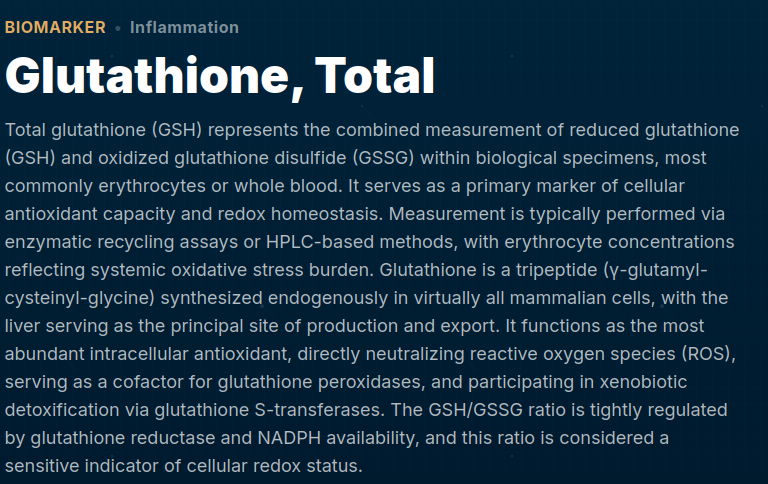
I have difficult time finding Glutathione test at Lacorp. GoodLab also doesn’t offer it.
Google gave me this: Test Name: Glutathione, Total (Labcorp Test Code: 007700)
I couldn’t find the one you suggested when scrolling back. I think it might have been another thread. I forget what I didn’t like about it now that it’s been awhile
The test is from labcorp. I use a testing company called fitomics to get it.
I just got the testing done. Can’t seem to find normal value range. Mine came in at 269 ug/dl. Report calls it optimal. It is also RBC Glutathione (as opposed to total Glutathione). A few years ago did a Genova methylation test and Glutathione was reported at 1160 (>669). So I have no basis for comparison. All learning process I guess. Cheers.
Petootie75, you’ve asked a very pertinent question. I tried to find an answer by using ChatGPT. But, it’s just a logical conclusion based on NACET’s better bioavailability since the original research did not use NACET. ChatGPT emphasized that it is unknown whether NACET would perform the same as did NAC in the Baylor RCT.
Using the Baylor 16-week RCT protocol of 100 mg/kg/day each of glycine and NAC as the reference, and the experimental NACET range of 25–50 mg/kg/day we discussed, the table is:
| Body weight | Glycine/day | NAC/day | Proposed NACET range/day |
|---|---|---|---|
| 100 lb | 4.5 g | 4.5 g | 1.1–2.3 g |
| 110 lb | 5.0 g | 5.0 g | 1.25–2.5 g |
| 120 lb | 5.4 g | 5.4 g | 1.35–2.7 g |
| 130 lb | 5.9 g | 5.9 g | 1.5–3.0 g |
| 140 lb | 6.4 g | 6.4 g | 1.6–3.2 g |
| 150 lb | 6.8 g | 6.8 g | 1.7–3.4 g |
FWIW…
Taking either NAC or NACET would require adding Selenium and Molybdenum
Quick AI search
Please verify critical facts
1. The Selenium–Glutathione Connection
The Mechanism: NAC provides the rate-limiting amino acid precursor (L-cysteine) required to synthesize glutathione (GSH), one of the body’s primary intracellular antioxidants.
Role of Selenium: Selenium acts as an active site cofactor in glutathione peroxidase (GPx). GPx utilizes reduced glutathione to neutralize harmful peroxides (like hydrogen peroxide) into water. During this reaction, glutathione becomes oxidized (GSSG).
Why it matters: Without sufficient selenium, glutathione production increases via NAC, but the enzymatic machinery needed to convert that glutathione into active peroxide neutralization fails to function efficiently, leaving cellular tissues vulnerable to oxidative stress.
2. The Molybdenum–Sulfite Connection
The Mechanism: Breakdown of sulfur-containing amino acids (like NAC, cysteine, and methionine) produces sulfites (\text{SO}_3^{2-}), which are toxic in high concentrations.
Role of Molybdenum: Molybdenum serves as an essential cofactor for sulfite oxidase, the enzyme located in the mitochondrial intermembrane space that oxidizes sulfite into non-toxic sulfate (\text{SO}_4^{2-}), which can then be safely excreted by the kidneys.
Why it matters: Inadequate molybdenum levels can bottleneck sulfite oxidase activity, leading to a buildup of sulfites. This buildup commonly presents as brain fog, headaches, rapid heart rate, or sensitivity/intolerance symptoms when supplementing with NAC or other sulfur compounds
Quick AI search
Please verify critical facts
Yes but it is incredibly easy to get enough of those without even trying. The idea of being forced to take more and effectively megadosing them is not something I am comfortable with if I want to take 200 mg of GLY-NACET daily (4 capsules for most brands).