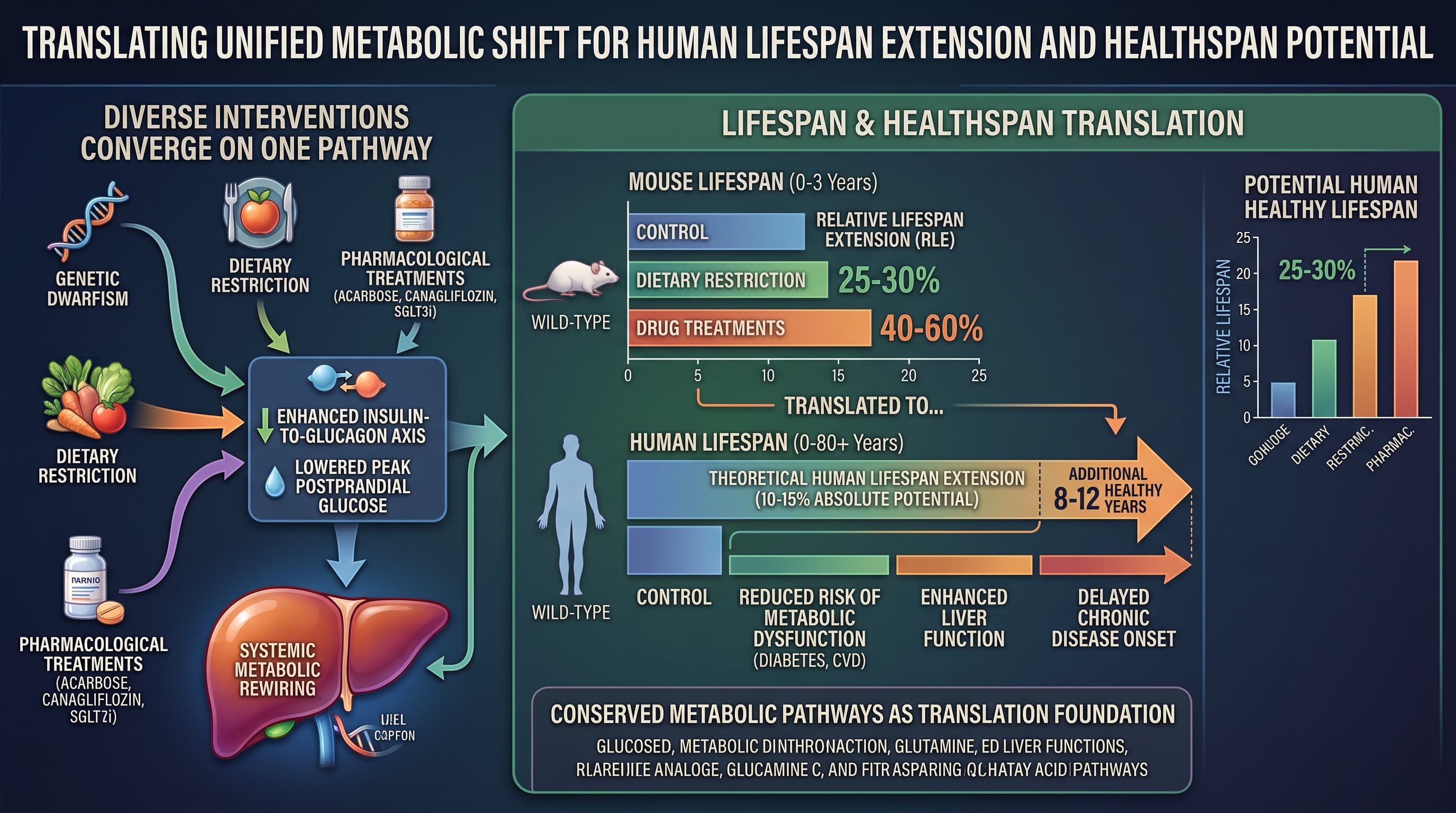
A unified metabolic shift characterizes multiple lifespan-extending interventions in mice, including genetic dwarfism, dietary restriction, and pharmacological treatments like acarbose and canagliflozin. This shift involves the systemic downregulation of hepatic glycolysis and the simultaneous upregulation of amino acid catabolism, specifically through the alanine, glutamine, and asparagine pathways. This metabolic rewiring is driven by an enhanced insulin-to-glucagon axis, and treating wild-type mice with a glucagon analog successfully replicates this anti-aging metabolic signature.
What do a 40 percent calorie cut, two diabetes drugs and two mutant mouse lines have in common? A University of Michigan team argues that all of them push the liver away from burning sugar and toward burning amino acids, and that the hormone glucagon may be the messenger.
The starting point is an old puzzle. Acarbose, canagliflozin, calorie restriction, the Snell dwarf mutation and growth hormone receptor knockout all extend mouse lifespan, and all dampen growth-related signaling through mTOR and MEK-ERK. Yet large omics surveys have struggled to find shared molecular changes across them. The authors suspected earlier work missed modest but consistent shifts because strict statistical filters discarded them. So they returned to published liver proteomics and looked only at enzymes that control glycolysis and at those that feed alanine, glutamine and asparagine into the Krebs cycle.
The pattern they report is consistent. Across the five long-lived models, several glycolytic control enzymes, including pyruvate kinase and glucokinase, sit lower, often by roughly a fifth to a half. Enzymes that turn amino acids into Krebs cycle fuel, such as Oat, Gpt1 and Adss1, sit higher, in some cases by about 40 to 90 percent. Gluconeogenesis, the making of new glucose, is not broadly switched on, apart from one key enzyme, Pck1, which rises in every model. Western blots and PCR confirmed much of this, though not all, and several RNA and protein results disagreed, hinting at regulation after transcription.
Two experiments make the story more interesting. Trametinib, a MEK inhibitor that extends mouse lifespan, reproduced the whole pattern within 45 days. But it did not reproduce the protein changes in cultured liver cells, pointing to a signal from elsewhere in the body. The team tested glucagon, which rises when insulin and glucose fall. A glucagon analogue given daily for 30 days to 12-month-old mice reproduced most of the liver shifts. Pancreatic glucagon and its precursor RNA were also higher in Snell and growth hormone receptor knockout mice and in canagliflozin-treated mice, reaching 40 to 60 fold for the precursor RNA in Snell animals.
The authors propose that the insulin-glucagon axis is a shared regulator of the metabolic shift behind slower aging. That is a hypothesis, not a demonstration. No mouse here was followed to death, no glucagon receptor was blocked, and no metabolic flux was measured. The work rests on single time points in small groups, and the proteomic screen used uncorrected significance thresholds by design. Mice were killed at 12 months, so the work says what the liver looks like in mid-life, not what it does late in life. Canagliflozin extends lifespan only in males, yet many of its liver effects appeared in both sexes, a mismatch that complicates any tidy story.
Still, the idea has appeal. It links very different interventions through one hormonal axis and hands researchers a testable target. Drugs that activate glucagon receptors, some already in obesity trials alongside GLP-1 agonists, could in principle be tested for effects on aging.
Insights
This is a mouse liver study with a clue about how long-lived bodies handle fuel.
The clue: slow-aging mice made about 20 to 45 percent less of some sugar-burning enzymes and about 40 to 90 percent more of some amino acid-burning enzymes. Pck1, a key glucose-making enzyme, rose roughly 20 percent with acarbose, about 60 to 110 percent with canagliflozin, about 90 to 150 percent with calorie restriction, and roughly fivefold with trametinib. A glucagon analogue raised it about threefold. Those are large biochemical shifts, but they are changes in enzyme levels, not in health or years lived.
Translating the lifespan benefits observed in the background mouse cohorts to human equivalents suggests an absolute lifespan extension potential of approximately 10 to 15 percent, assuming highly conserved metabolic pathways. This would theoretically yield an additional 8 to 12 years of healthy lifespan in humans, driven primarily by delayed onset of metabolic dysfunction and age-related pathology.
Context/Source
- Open Access Paper: Regulation of alanine glutamine asparagine catabolism is common to mouse models that extend lifespan.
- Authors: Jiexian Chen, Richard A. Miller and Gonzalo Garcia.
- Institution: Department of Pathology, University of Michigan Medical School, and University of Michigan Geriatrics Center, Ann Arbor.
- Country: United States.
- Journal: npj Aging (Nature Portfolio, in partnership with the Japanese Society of Anti-Aging Medicine).
- Impact evaluation: The impact score of this journal is 13.0, evaluated against a typical high-end range of 0-60+ for top general science, therefore this is a High impact journal.