The Translational Protocol (Rigorous Extrapolation)
Human Equivalent Dose (HED), body-surface-area normalization
Method: FDA guidance (2005) for converting animal dose to HED uses body surface area, via the Km factors. The formula is:
HED (mg/kg) = Animal dose (mg/kg) x (Animal Km / Human Km)
Km factors used: mouse Km = 3, human (adult 60 kg) Km = 37. The scaling ratio is therefore 3 / 37 = 0.081.
Step 1, convert the mouse dietary dose to mg/kg body weight per day. The healthspan (longevity-relevant) cohort was dosed in feed, not by body weight: low 0.1 g/kg feed (100 mg/kg diet) and high 0.5 g/kg feed (500 mg/kg diet). Converting diet concentration to ingested dose uses the standard mouse food factor of about 0.15 kg feed per kg body weight per day (a 28 to 30 g mouse eating roughly 4 g/day):
- Low: 100 mg/kg diet x 0.15 = about 15 mg/kg/day
- High: 500 mg/kg diet x 0.15 = about 75 mg/kg/day
Step 2, apply the BSA ratio:
- Low: 15 mg/kg/day x (3/37) = 1.22 mg/kg/day HED. For a 60 kg adult that is about 73 mg/day; for 70 kg about 85 mg/day.
- High: 75 mg/kg/day x (3/37) = 6.08 mg/kg/day HED. For 60 kg about 365 mg/day; for 70 kg about 426 mg/day.
For completeness, the separate 2-week intestinal-uptake cohort was gavaged by body weight at 7.5 and 100 mg/kg:
- 7.5 mg/kg x (3/37) = 0.61 mg/kg HED, about 36 to 43 mg/day.
- 100 mg/kg x (3/37) = 8.11 mg/kg HED, about 486 to 568 mg/day.
Interpretation, and this is the useful part. The approved clinical dose is 600 mg twice daily, 1200 mg/day, which is about 20 mg/kg for a 60 kg adult. Every one of the longevity-relevant human-equivalent doses above (roughly 73 to 426 mg/day) sits below the standard approved lipid dose. In other words, the mouse healthspan exposure translates, by BSA, to a fraction of what humans already take safely for cholesterol. This is unusual and favorable on paper. The important counterpoint is that BSA HED is a starting point for first-in-human dose selection, not a claim that efficacy transfers at that exposure. It answers “what human dose gives comparable mg per unit surface area,” not “what human dose reproduces the biology.” Interspecies differences in PEPT1 expression, diet, protein intake, and half-life (see PK) can move the true pharmacodynamically equivalent dose in either direction. [Confidence: Medium for the arithmetic, Low that the biological effect transfers at this dose]
Note on a discrepancy in the paper: the authors call the 7.5 mg/kg mouse gavage dose “akin to the recommended prescribed dose in humans.” On a strict mg/kg basis that is not correct (human clinical is about 20 mg/kg, and the BSA mouse-equivalent of the clinical dose is about 247 mg/kg). Treat their framing as loose.
Pharmacokinetics (PK/PD)
- Oral bioavailability: high but not cleanly quantified in the labels; gemfibrozil is well absorbed orally, with absorption improved when taken about 30 minutes before meals. Precise absolute bioavailability figure is not consistently reported.
- Time to peak (Tmax): about 1 to 2 hours.
- Elimination half-life: short, about 1.5 hours. This is a key practical point. A 1.5 hour half-life means twice-daily dosing barely maintains exposure, and any “restriction-mimetic” mTOR suppression would be intermittent rather than continuous. Rapamycin’s long half-life is part of why intermittent dosing works; gemfibrozil has the opposite profile.
- Protein binding: about 99 percent.
- Metabolism: hepatic, to largely inactive metabolites, including the pharmacologically important gemfibrozil 1-O-beta-glucuronide. Renal excretion about 70 percent, fecal about 6 percent.
- PD readout: the pharmacodynamic effect of interest here (mTOR pathway suppression via reduced amino acid uptake) is not a validated clinical endpoint and is not measured in routine practice. [Confidence: High for PK values, they are well established]
Safety and Toxicity
Acute toxicity (LD50): low acute toxicity. Reported acute oral LD50 values are about 4786 mg/kg in rat and about 3162 mg/kg in mouse. Acute overdose is not the concern with this drug.
NOAEL: a clean NOAEL is not stated in the FDA label or the IARC monograph. Carcinogenicity studies are instead expressed as multiples of the human dose. In rats, 250 mg/kg (about 1.7x the human exposure) increased hepatic neoplastic nodules; long-term rat exposure at 0.2 and 1.3x human AUC produced dose-related benign and malignant liver tumors in high-dose males. In mice at 0.1 and 0.7x human exposure there was no statistically significant tumor increase. The rodent liver tumors are driven by peroxisome proliferation, a rodent-specific PPAR-alpha phenomenon not observed in human liver, so the human carcinogenic relevance is considered low (IARC Group 3, not classifiable). Effective NOAEL for the tumor endpoint is therefore best described as below about 1.3x human exposure in the rat, with the mechanism likely not translating to humans. [Confidence: Medium]
Phase I safety profile, longevity indication: there is no Phase I or any clinical trial of gemfibrozil as a longevity or healthspan agent. What exists instead is large-scale cardiovascular RCT and post-marketing data, which is arguably more informative than a Phase I would be:
- Helsinki Heart Study (primary prevention, about 4081 men, 5 years, plus open-label follow-up). At 5 years all-cause mortality was essentially equal (44 vs 43 deaths). At 8.5-year cumulative follow-up all-cause mortality was higher in the group originally given gemfibrozil, 4.9 percent vs 4.1 percent, hazard ratio 1.20, with an excess of non-cardiac deaths (65 vs 45). This is the single most important translational fact in this entire brief. The only long-term human mortality data on the drug trend toward higher all-cause mortality, the opposite of a longevity signal.
- VA-HIT (secondary prevention, low HDL): reduced cardiovascular events, with all-cause mortality not significantly changed. So the human mortality picture is, at best, neutral, and at worst mildly unfavorable over long follow-up.
Organ signals and warnings:
- Hepatic: contraindicated in hepatic impairment. Rodent hepatocarcinogen (mechanism likely non-translatable). Can raise liver enzymes.
- Renal: can worsen renal function, particularly with baseline serum creatinine above 2.0 mg/dL; alternative therapy advised in that group. Predominantly renally excreted.
- Hepatobiliary: increases cholesterol saturation of bile and raises gallstone risk. In the Helsinki substudy gallstone prevalence was 7.5 percent vs 4.9 percent (about a 55 percent relative excess), with more gallbladder surgery.
- Musculoskeletal: myopathy and rhabdomyolysis, sharply increased when combined with statins.
- Common nuisance effects: dyspepsia (about 20 percent), abdominal pain, nausea, diarrhea, fatigue, rash. Case reports of reversible impotence.
CYP450 and transporter interactions (the defining liability of this drug):
- Strong inhibitor of CYP2C8, largely via its glucuronide metabolite. This drives major interactions with CYP2C8 substrates.
- Inhibitor of OATP1B1 (hepatic uptake transporter) and of UGT-mediated glucuronidation.
- Weak on CYP3A4.
- Repaglinide: contraindicated. Gemfibrozil can raise repaglinide exposure many-fold, risking severe hypoglycemia.
- Statins: simvastatin co-administration is contraindicated; other statins carry increased myopathy and rhabdomyolysis risk (gemfibrozil was central to the cerivastatin withdrawal). Fibrate of choice with statins is fenofibrate, not gemfibrozil.
- Dasabuvir: contraindicated.
- Warfarin: potentiated, reduce dose and monitor INR.
- Colchicine: increased myopathy risk.
Safety Data Absent: a formal NOAEL number as such, and any human safety data specific to low-dose, longevity-intent chronic use.
Biomarker Verification (target engagement)
The paper verifies target engagement through a specific, layered readout. For a specialist wanting to know “did the drug actually hit PEPT1 and quiet mTOR,” these are the markers used:
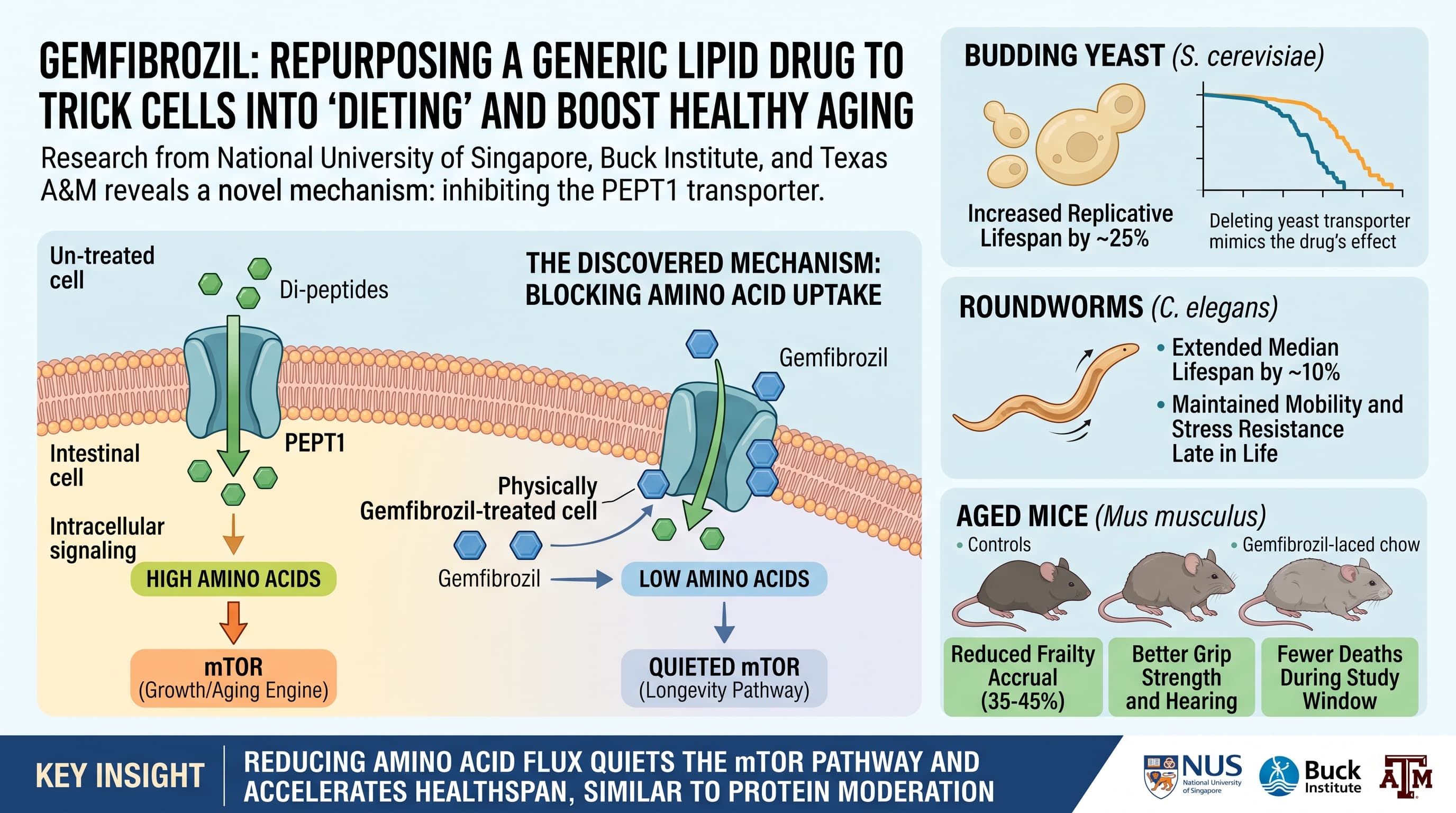
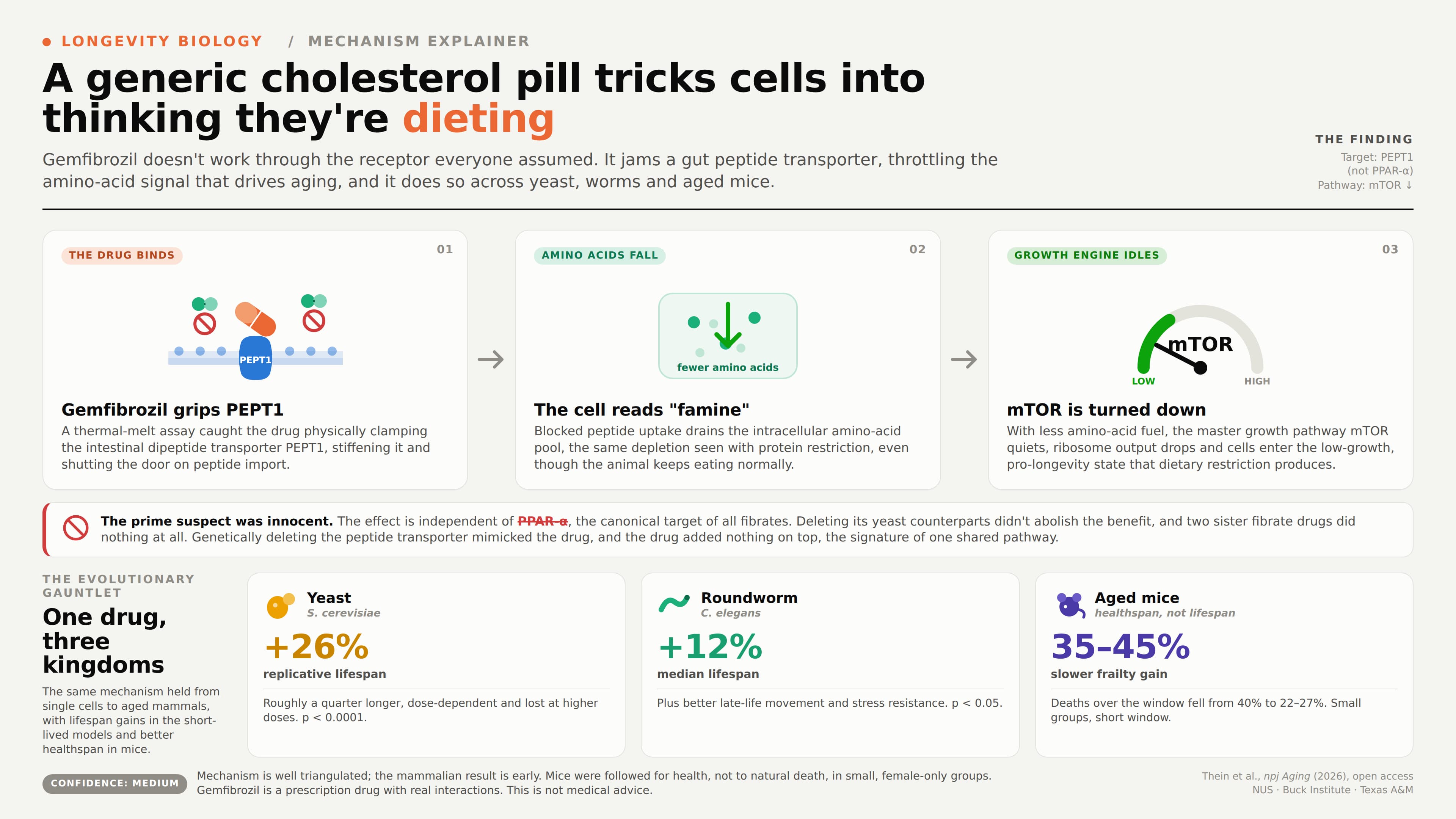
- Direct binding: cellular thermal shift assay (CETSA) showed PEPT1 melting temperature rising from 59.3 C to 62.85 C, a 3.55 C thermostabilization. PPAR-alpha showed essentially no shift (52.32 vs 52.26 C). This is the cleanest engagement proof, and it is what distinguishes the real target from the assumed one.
- Transporter function: reduced uptake of the fluorescent dipeptide reporter beta-Ala-Lys-AMCA in yeast, worm gut, human PC3 cells, and mouse jejunum.
- Downstream metabolite signature: lowered intracellular amino acid pools by HPLC and metabolomics, with dose-dependent decreases in glycine, threonine, alanine, and valine in mouse gastrocnemius muscle.
- Downstream phosphoprotein signature (the mTOR readout): reduced phosphorylation of the mTORC1 substrates p70S6K, ribosomal protein S6, and 4E-BP1 in PC3 cells, plus reduced mTOR translocation to LAMP2-positive lysosomes.
- Proteome/translation: decreased ribosomal protein abundance and reduced global protein synthesis by proteomics and ribosome profiling.
Practical translation problem: none of these are validated or convenient human target-engagement assays. In a human, you cannot readily measure PEPT1 occupancy. The nearest accessible surrogates would be a fasting plasma amino acid panel (looking for the glycine, threonine, alanine, valine drop) and mTOR-pathway phosphoproteins in PBMCs, both nonspecific and neither validated for this purpose. So while target engagement is well demonstrated in the lab, it is essentially unverifiable in a living human with current clinical tools.
Feasibility and ROI
Sourcing: prescription drug (Rx). Generic gemfibrozil 600 mg tablets are widely available in the United States. It is a controlled-quality, FDA-approved product, which is a genuine advantage over gray-market longevity compounds.
Cost: trivial. Cash and discount pricing for generic gemfibrozil 600 mg runs roughly 9 to 50 US dollars for a typical 60-tablet supply, with retail around 80 dollars. At the approved 1200 mg/day that is about a month; at the much lower projected longevity HED it would last far longer, though the 600 mg tablet size makes low-dose administration (73 to 426 mg/day) impractical without compounding or tablet splitting.
Cost vs effect (marginal gain): the cost side is negligible, on the order of tens of dollars per month. The effect side is the problem. There is no human efficacy evidence for longevity, the mechanism-equivalent human dose is unvalidated, the half-life is short (working against sustained mTOR suppression), and the only long-term human mortality data are neutral to unfavorable (Helsinki 8.5-year HR 1.20). ROI on current evidence is poor, not because the drug is expensive but because the numerator (expected benefit) is unproven and possibly negative, while there are concrete liabilities (gallstones, myopathy with statins, CYP2C8 interactions, renal caution). A cheap intervention with an unproven and possibly adverse mortality effect is not a good buy. [Confidence: Medium to High]
PART 5: Strategic FAQ
Ten questions a skeptical longevity specialist would put to the lead author, each with the best answer available from the paper plus external evidence.
Your title says “promotes longevity,” but did any mouse actually live longer?
No. The mouse experiment measured frailty and tracked mortality over a fixed multi-month window in already-aged (20-month) female mice. There is no survival curve to natural death and no reported median or maximum mouse lifespan. The genuine lifespan extension is in yeast (about +26 percent replicative) and worms (about +12 percent median). Calling the mammalian result “longevity” overstates it; it is a healthspan and frailty result. [Confidence: High]
Human beings have taken this drug for decades. What do the long-term human mortality data show?
They do not support a longevity benefit. In the Helsinki Heart Study 8.5-year follow-up, all-cause mortality was higher in the gemfibrozil arm (hazard ratio 1.20), driven by non-cardiac deaths. VA-HIT showed cardiovascular event reduction with neutral all-cause mortality. This is the strongest reason for skepticism, and the paper does not engage with it. Any human longevity claim has to explain why the existing long-term human data trend the opposite way. [Confidence: High]
You attribute everything to PEPT1. How solidly is PPAR-alpha excluded?
Reasonably well for the model organisms. Deleting the yeast PPAR-alpha orthologs did not abolish the benefit, two sister fibrates (fenofibrate, clofibrate) failed to extend lifespan, and CETSA showed no thermal stabilization of PPAR-alpha by gemfibrozil. The caveat is that “not the dominant driver in yeast and worms” does not fully exclude a contributory PPAR-alpha role in mammals, and the authors acknowledge downstream PPAR-alpha effects may still matter for lipids. [Confidence: Medium to High]
The healthspan cohort was small, female-only, and single-strain. Why should this replicate?
It may not, and that is the correct default expectation. Single-sex, single-strain (C57BL/6J) effects in aging biology frequently fail to replicate across sex and genetic background, which is exactly why the NIA Interventions Testing Program uses genetically heterogeneous mice of both sexes at multiple sites. The group sizes were not even clearly stated, and the standout mortality numbers rest on a handful of animals with no reported survival statistic. This needs an ITP-style replication before it means anything for humans. [Confidence: High]
Given a 1.5-hour half-life, can this drug plausibly produce sustained mTOR suppression like rapamycin?
This is a real mechanistic tension. Gemfibrozil clears fast, so twice-daily dosing gives intermittent, spiky exposure. mTOR-based longevity strategies (rapamycin) generally rely on either sustained or deliberately pulsed suppression with a long-half-life agent. Whether brief daily dips in amino acid uptake are enough to move aging biology in a large mammal is unproven, and the short half-life argues for skepticism. [Confidence: Medium]
What is the human-equivalent longevity dose, and is it even distinguishable from the lipid dose?
By BSA normalization the mouse healthspan doses map to roughly 73 to 426 mg/day in an adult, which is below the approved 1200 mg/day lipid dose. So in principle a sub-lipid-lowering dose might suffice, but this is an untested extrapolation. The practical problem is that 600 mg tablets cannot deliver 73 to 426 mg/day precisely without compounding, and there is no human PK/PD anchor for what exposure reproduces the mouse biology. [Confidence: Medium]
How would you confirm target engagement in a human? Is there a biomarker?
Honestly, there is no practical one. In the lab, engagement was shown by CETSA thermostabilization of PEPT1, reduced dipeptide-reporter uptake, a fall in specific amino acids (glycine, threonine, alanine, valine), and reduced phosphorylation of p70S6K, S6, and 4E-BP1. In a human you cannot easily measure PEPT1 occupancy; a plasma amino acid panel and PBMC mTOR phosphoproteins are the closest surrogates and neither is validated for this. Target engagement is therefore currently unverifiable in humans. [Confidence: High]
What are the concrete safety liabilities that would worry you in a chronic longevity protocol?
Four stand out. Gallstone risk (about 55 percent relative excess in the Helsinki substudy), myopathy and rhabdomyolysis (especially with statins, simvastatin contraindicated), renal function worsening in anyone with creatinine above 2.0 mg/dL, and a broad CYP2C8 and OATP1B1 interaction footprint. The rodent liver tumors are likely a peroxisome-proliferation artifact that does not translate, so that one worries me less. [Confidence: High]
If the mechanism is really about restricting peptide and amino acid uptake, why not just moderate dietary protein?
That is the fair challenge, and the paper’s own framing supports it. The drug is described as a chemical shortcut for what protein moderation does through the same PEPT1-to-mTOR axis. Dietary protein moderation has human data, no gallstone or myopathy liability, and no drug interactions. For most people the food-based lever is the more defensible intervention, with the paper cautioning that older, frailer, or sub-65 sarcopenia-risk individuals need adequate protein. The drug’s theoretical advantage would only be for someone who cannot or will not modulate protein, which is a narrow case. [Confidence: Medium to High]
What single experiment would move you from skeptic to interested?
A properly powered lifespan study (survival to natural death) in genetically heterogeneous mice of both sexes, at multiple sites, at a defined body-weight dose with measured plasma exposure and a target-engagement biomarker (amino acid panel, mTOR phosphoproteins), showing a median lifespan increase that survives the short-lived-control critique.
Interaction Check against common longevity-stack items
General principle: gemfibrozil’s risk is defined by CYP2C8 inhibition, OATP1B1 and UGT inhibition, a shared mTOR pharmacodynamic axis, and shared gut and renal and hepatobiliary stress. Assess each stack item against those.
- Rapamycin (sirolimus): PK interaction is modest, since rapamycin is a CYP3A4 and P-gp substrate and gemfibrozil is weak on CYP3A4. The real concern is pharmacodynamic: both suppress mTOR, so additive immunosuppression, impaired wound healing, stomatitis, and metabolic effects are plausible, and rapamycin’s tendency to worsen lipids interacts messily with a lipid drug. Caution, mainly additive mTOR effect. No human data on the combination. [Confidence: Low, theoretical]
- SGLT2 inhibitors (empagliflozin, canagliflozin, dapagliflozin): these are cleared substantially by UGT glucuronidation, which gemfibrozil inhibits, so modestly increased SGLT2i exposure is possible (canagliflozin is the most UGT-dependent). Additive volume and renal effects also warrant attention given gemfibrozil’s renal caution. Mild to moderate caution, monitor for exaggerated SGLT2i effect and renal function. [Confidence: Low to Medium]
- Metformin: minimal PK interaction. Metformin is renally cleared via OCT2 and MATE transporters, not by CYP or UGT, so gemfibrozil does not meaningfully alter its exposure. Shared caution is renal, since both accumulate or add risk in renal impairment. Overall low concern. [Confidence: Medium]
- Acarbose: no systemic PK interaction, since acarbose acts locally in the gut and is minimally absorbed. Both, however, act in the gut lumen (acarbose blocks carbohydrate digestion, gemfibrozil inhibits intestinal PEPT1), so additive gastrointestinal effects (flatulence, diarrhea, cramping) are likely. Low systemic concern, expect additive GI intolerance. [Confidence: Medium]
- 17-alpha estradiol: Safety Data Absent for this specific combination. 17-alpha-estradiol is a weak, largely non-feminizing estrogen cleared by sulfation, glucuronidation, and CYPs; gemfibrozil’s UGT inhibition could in theory raise its levels, but there are no data. Treat as unknown. [Confidence: Low]
- PDE5 inhibitors (sildenafil, tadalafil, vardenafil): these are primarily CYP3A4 substrates (sildenafil also CYP2C9), and gemfibrozil is weak on CYP3A4 and not a strong 2C9 inhibitor, so the expected interaction is minor. Watch for slightly increased PDE5i exposure and additive vasodilatory or hypotensive effects, otherwise low concern. [Confidence: Low to Medium]
Net interaction verdict: within a typical longevity stack, the sharpest flags are the rapamycin pharmacodynamic overlap (additive mTOR suppression) and any concurrent statin (myopathy, and simvastatin is outright contraindicated). SGLT2 inhibitors deserve monitoring on UGT and renal grounds. Metformin, acarbose, 17-alpha-estradiol, and PDE5 inhibitors are lower systemic concern, with additive gut effects for acarbose and no data at all for 17-alpha-estradiol.