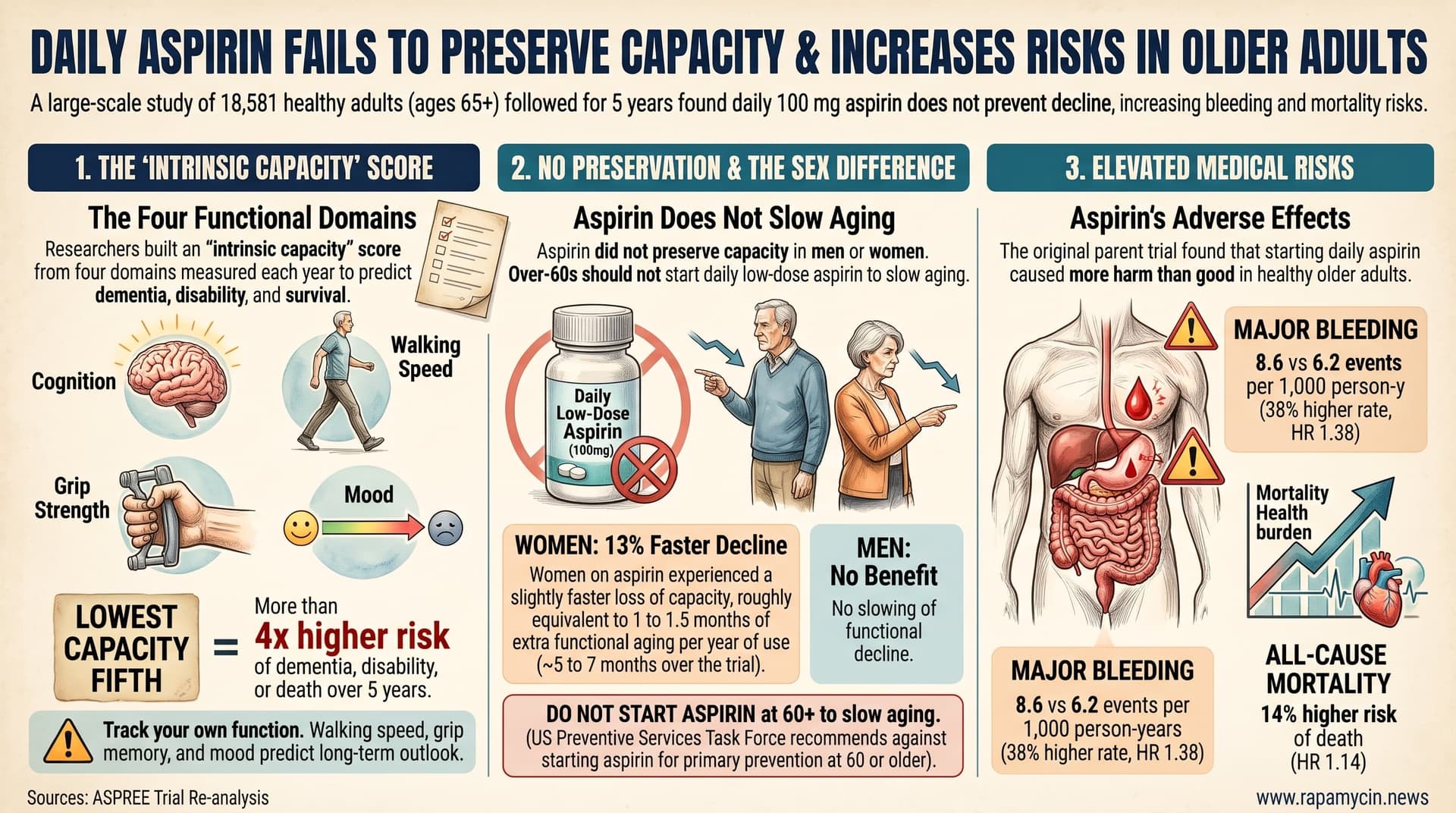
Researchers re-analyzed ASPREE, a large randomized trial of daily 100 mg aspirin versus placebo in 18,581 healthy adults aged 65 and older from Australia and the United States. They built an “intrinsic capacity” score from four domains measured each year: cognition, walking speed, grip strength and mood. They then checked the score against frailty, epigenetic clocks and the trial’s main outcome of dementia- and disability-free survival. The score behaved well. People in the lowest fifth had more than four times the risk of dementia, disability or death over about five years compared with those in the highest fifth. Aspirin did not slow the decline in capacity in either sex. In women, it was associated with a slightly faster decline.
Inflammation that simmers quietly in the body for years, often called inflammaging, is one of the leading suspects behind age-related decline. If it drives frailty, memory loss and weakness, a cheap anti-inflammatory drug might slow all of them. Aspirin is the obvious candidate. A new analysis of one of the largest aspirin trials ever run in older people says it does not work that way, and may slightly harm older women.
The data come from ASPREE, which randomized more than 19,000 healthy Australians and Americans, most of them over 70, to take either 100 mg of aspirin or an identical placebo every day. Its main results, published in 2018, showed that aspirin did not extend life free of dementia or disability. It increased serious bleeding, and overall deaths were slightly higher in the aspirin group. Critics countered that death and dementia are blunt, late-stage outcomes. Perhaps aspirin preserves function in subtler ways that take longer to show up as diagnoses.
To test that idea, a team led by Joanne Ryan at Monash University in Melbourne turned to a measure the World Health Organization calls intrinsic capacity. It is a single score that captures how well a person thinks, moves, grips and feels. Using yearly test results, the researchers combined memory and processing-speed tests, a short timed walk, hand-grip strength and a depression questionnaire into one number for each participant, every year, for up to seven years.
They first asked whether the score meant anything. It did. Capacity was lower in older participants and tracked closely with a 67-item frailty index. In women, lower capacity also lined up with faster aging on several epigenetic clocks, the DNA-based estimates of biological age. Most importantly, it predicted the future. People in the lowest fifth of capacity at the start were roughly four and a half times more likely to develop dementia, become disabled or die over the next five years than those in the top fifth.
Then came the aspirin test. Capacity fell steadily in everyone, as expected with age. Aspirin did not change that slope in men. In women, the aspirin group declined slightly faster than the placebo group. The researchers describe the difference as equivalent to one to two extra months of aging. A formal test of whether men and women truly responded differently came close to significance but did not reach it, so the sex difference should be treated as a lead to follow up, not a settled fact.
The authors point to a plausible culprit: anemia. Aspirin causes small, often unnoticed blood losses, and earlier ASPREE work found it raised the risk of anemia by about a fifth. Low hemoglobin has been linked to weaker muscles, slower walking, poorer cognition and lower mood, with women often more affected. However, this study did not directly test whether hemoglobin explains the result.
The practical message is plain. For healthy people in their 70s, daily low-dose aspirin is not a longevity or healthspan drug. If inflammaging is a real target, aspirin at this dose is the wrong tool.
Actionable insights
The headline finding is a null result, so the practical value lies mostly in what not to do, plus a useful self-monitoring tool.
Do not start daily low-dose aspirin to slow aging if you are over 60. It did not preserve capacity in men or women. The parent trial found more major bleeding (8.6 vs 6.2 events per 1,000 person-years, HR 1.38) and slightly higher all-cause mortality (HR 1.14). The US Preventive Services Task Force already recommends against starting aspirin for primary prevention at 60 or older. [Confidence: High]
Women saw a small extra decline. Women on aspirin lost capacity roughly 13% faster than women on placebo. That works out to about 1 to 1.5 months of extra functional aging per year of use, or roughly 5 to 7 months over the trial. It is too small to notice day to day, and the statistical evidence for a sex-specific effect is borderline.
If you take aspirin for a medical reason, such as a prior heart attack or stroke, this study does not apply. Do not stop without talking to your clinician.
If you take aspirin for any reason, especially as a woman, check hemoglobin and ferritin periodically.
Track your own function. Walking speed, grip strength, memory and mood predicted a roughly four-fold difference in risk of dementia, disability or death. They are cheap to measure at home or in a clinic.
Context and source
- Open Access Paper: Validation of an intrinsic capacity index and the effects of aspirin in older males and females: secondary analysis of a randomized controlled trial
- Institutions: School of Public Health and Preventive Medicine, Monash University (lead); University of Basel; Cedars-Sinai Health Sciences University; Hennepin Healthcare and Hennepin Healthcare Research Institute; Epigenetic Clock Development Foundation
- Country: Australia (lead), with Switzerland and the United States
- Journal: GeroScience (Springer). DOI 10.1007/s11357-026-02624-x
- Impact evaluation: The impact score of this journal is 6.0, evaluated against a typical high-end range of 0 to 60+ for top biomedical journals, therefore this is a Medium impact journal.