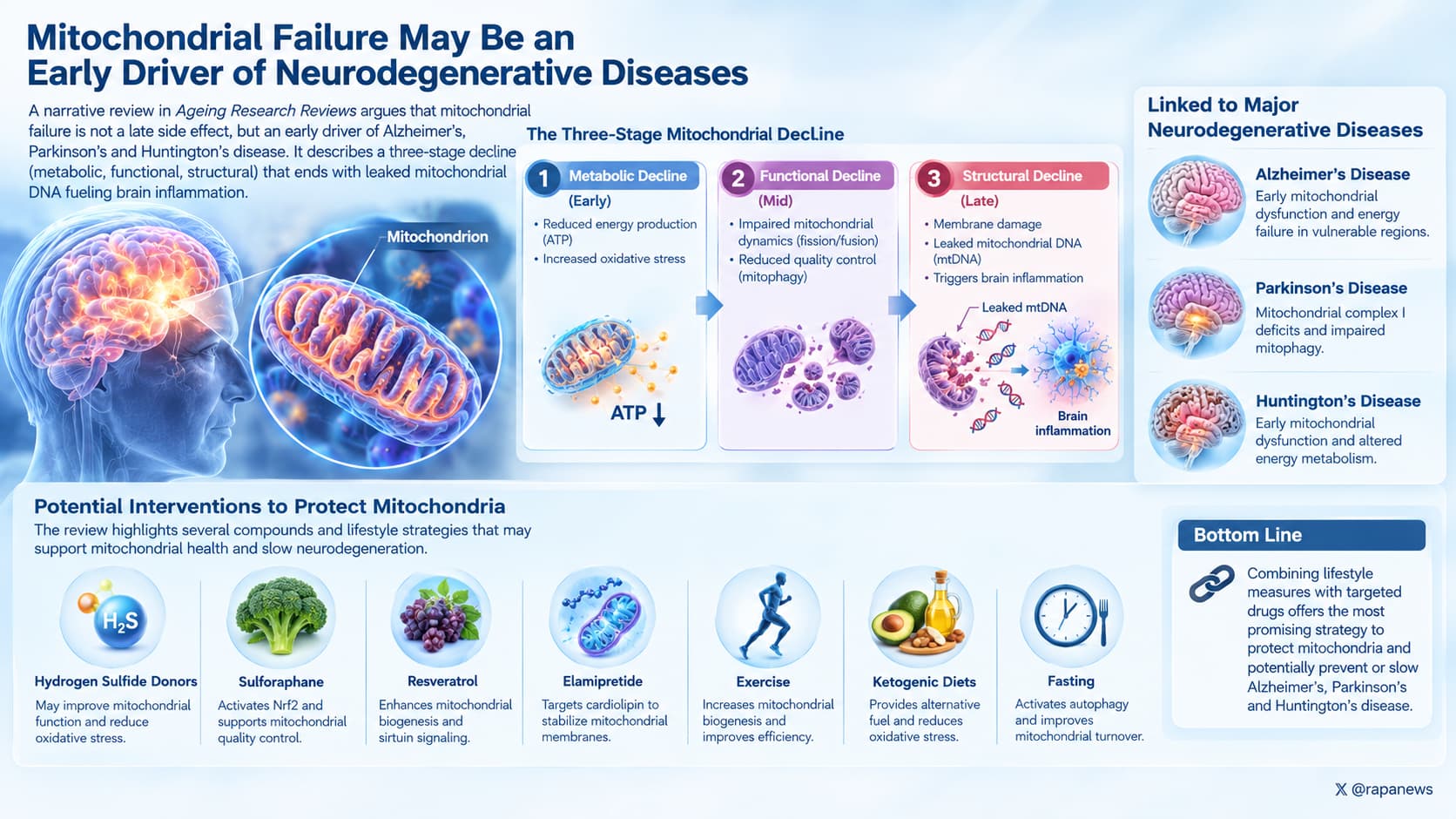
A narrative review in Ageing Research Reviews argues that mitochondrial failure is an early driver of Alzheimer’s, Parkinson’s and Huntington’s disease, not a late side effect. It describes a three-stage decline (metabolic, functional, structural) that ends with leaked mitochondrial DNA fueling brain inflammation. It then surveys hydrogen sulfide donors, sulforaphane, resveratrol, elamipretide, exercise, ketogenic diets and fasting, and recommends combining lifestyle measures with targeted drugs.
For decades, the hunt for the cause of Alzheimer’s, Parkinson’s and Huntington’s disease has centered on the sticky proteins that pile up in dying brains. A new review in Ageing Research Reviews argues that the field has been studying the wreckage. The trouble, the authors say, starts earlier, inside the mitochondria that supply neurons with energy.
Neurons are among the hungriest cells in the body. They burn large amounts of ATP to fire signals and maintain connections, and they are not replaced once lost. The review, from a team led by Zhiguo Wang at the General Hospital of Northern Theater Command in Shenyang, China, lays out a three-stage model of decline. First come metabolic faults: energy output drops and reactive oxygen species rise. Next, the cleanup system for worn-out mitochondria, known as mitophagy, begins to stall, and damaged organelles accumulate. Finally the mitochondria swell, fragment and leak their own DNA into the cell, where immune sensors treat it as a sign of infection and trigger chronic inflammation. That inflammation damages more mitochondria, and the loop feeds itself.
Each disease enters this loop through a different door. In Alzheimer’s, amyloid and tau disrupt the respiratory chain, with complex IV repeatedly implicated. In Parkinson’s, the weak point is complex I, along with inherited faults in the PINK1 and Parkin genes that govern mitophagy. In Huntington’s, the mutant huntingtin protein interferes with mitochondrial transport and calcium handling.
The second half of the paper surveys possible treatments: hydrogen sulfide donors, the plant compounds sulforaphane and resveratrol, the cardiolipin-binding peptide elamipretide, exercise, ketogenic diets and fasting. The authors conclude that the best approach will pair lifestyle measures for broad metabolic support with drugs aimed at specific defects.
That conclusion deserves caution. This is a narrative review, not a systematic one. Across 15 pages it reports no effect size from any human trial in a neurodegenerative disease. Much of the supporting evidence comes from mice and cultured cells. The claim that mitochondrial failure comes first rests largely on animal models and on snapshots of human tissue, which cannot show which event came first. The review itself concedes that the toxic proteins damage mitochondria in turn, so the direction of cause is hard to pin down.
Some of the therapeutic optimism also outruns the trial record. Elamipretide, as the authors acknowledge, failed one Phase 3 trial in mitochondrial muscle disease (though passed another clinical trial), and the review cites no trial of it in Alzheimer’s, Parkinson’s or Huntington’s. Two other results go unmentioned. High-dose coenzyme Q10 showed no benefit in a 600-person Parkinson’s trial. A year-long resveratrol trial in Alzheimer’s patients found faster brain shrinkage in the treated group.
The mitochondrial hypothesis remains a serious and productive idea. This review mostly shows how far it still sits from a proven therapy.
Actionable Insights
Exercise is the only intervention here with solid human data. A pooled analysis of 353 studies (5,973 people) found training raises muscle mitochondrial content by about 23 to 27 percent, with sprint intervals roughly 3.9 times more time-efficient than steady endurance work. That is muscle, not brain.
For brain outcomes the picture is mixed. In a 130-person Parkinson’s trial, home cycling three times weekly for six months held motor worsening to 1.3 points versus 5.6 with stretching. That 4.2-point gap on a 132-point scale is a small to moderate effect. In mild cognitive impairment, a 296-person trial found aerobic exercise no better than stretching. Observational studies link physical activity to about 20 percent lower dementia risk, which cannot prove cause.
One 26-person, 12-week ketogenic diet trial in Alzheimer’s showed a 3.1-point gain in daily function on a scale that runs to 78, a moderate effect, with no significant change in cognition.
The practical reading is to train consistently, include some high-intensity work, and treat everything else as still unproven.
Context and Source
- Paywalled Paper: Mitochondrial dysfunction in neurodegenerative diseases: Mechanisms and therapeutic advances
- Institutions: Department of Nuclear Medicine, General Hospital of Northern Theater Command, Shenyang (corresponding); Shenzhen Institute for Advanced Study, University of Electronic Science and Technology of China; Department of Hepatobiliary Surgery, Hainan Provincial People’s Hospital; Department of Biological Science, Jining Medical University.
- Country: China
- Journal: Ageing Research Reviews, volume 122 (2026), article 103312, online 20 August 2026.
- Impact evaluation: The impact score of this journal is 12.4, evaluated against a typical high-end range of 0-60+ for top general science, therefore this is a High impact journal.