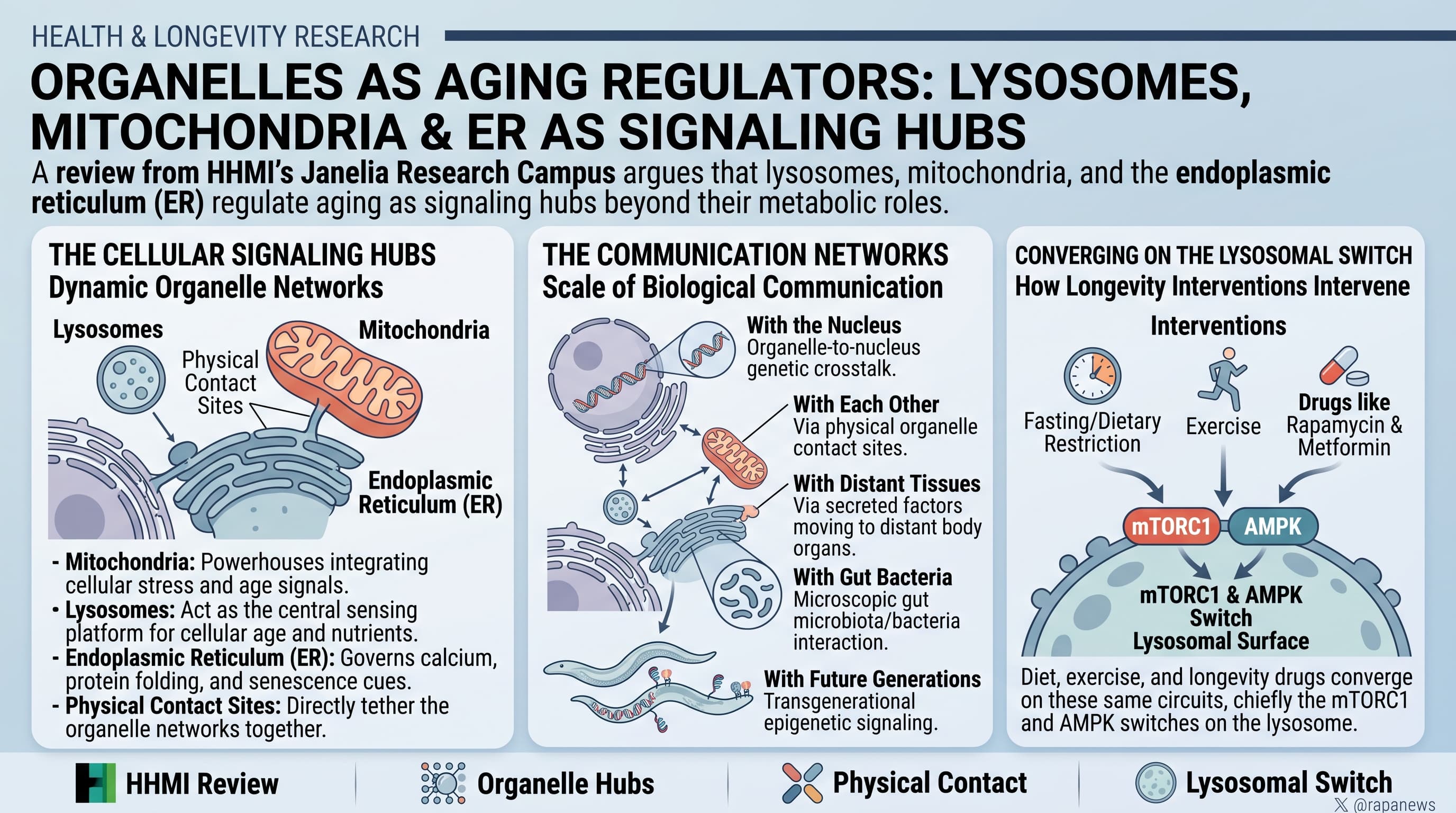
A review from HHMI’s Janelia Research Campus argues that lysosomes, mitochondria, and the endoplasmic reticulum (ER) regulate aging as signaling hubs, in addition to their metabolic roles. They communicate with the nucleus, with each other through physical contact sites, with distant tissues through secreted factors, with gut bacteria, and, in worms, with future generations through epigenetic marks. The authors propose that dietary restriction, fasting, rapamycin, metformin, and exercise converge on these same circuits, chiefly the mTORC1 and AMPK switch on the lysosomal surface.
For most of the last century, biologists treated the compartments inside our cells as specialist workshops. Mitochondria made energy, lysosomes took out the trash, and the endoplasmic reticulum folded proteins. A new review from Meng Wang’s laboratory at the Howard Hughes Medical Institute’s Janelia Research Campus argues that this picture is too tidy. Aging, it says, is better understood as a breakdown in how these compartments talk to one another and to the nucleus.
The review, published in Nature Cell Biology, pulls together about 200 studies. Its central claim is that organelles are signaling hubs as well as metabolic machines. The lysosome is the clearest example. Its surface is where two master nutrient sensors, mTORC1 and AMPK, are switched on, apparently competing for the same docking platform. When lysosomes lose acidity or spring leaks with age, the damage goes beyond failed waste disposal. In yeast, a less acidic lysosome starves mitochondria of iron and cripples them. In worms, boosting fat breakdown inside the lysosome sends lipid messengers to the nucleus and to neurons, and the animals live longer.
Mitochondria tell a similar story. Mild mitochondrial stress, of the kind produced by slightly throttling the respiratory chain, triggers protective gene programs and extends lifespan in worms, flies and, in a few studies, mice. Metabolites from the mitochondrial energy cycle, such as alpha-ketoglutarate and citrate, double as raw material for the chemical tags that control which genes are active. The endoplasmic reticulum follows the same rule of moderation. A brief, mild stress response is protective, while a chronic one accompanies cancer, diabetes and neurodegeneration.
The most striking material concerns distance. Stress in a worm’s neurons can switch on mitochondrial defenses in its gut. Stressed mouse muscle releases the hormones GDF15 and FGF21, which alter fat, liver and brain metabolism. Gut bacteria produce compounds, including colanic acid and short-chain fatty acids, that reshape host mitochondria. Most surprising of all, worms that experience starvation or neuronal mitochondrial stress can pass a longevity benefit to descendants for several generations, through changes in histone packaging and mitochondrial DNA levels.
The authors then recast familiar interventions in this light. Dietary restriction, fasting, rapamycin, metformin and exercise all appear to act on the same lysosome and mitochondria circuits, mostly by turning mTORC1 down and AMPK up.
Readers should keep the evidence base in view. This is a narrative review with no new experiments and no pooled statistics. The bulk of the lifespan findings come from the nematode C. elegans, an animal that lives about three weeks, and a large share of the lysosomal work comes from the authors’ own laboratory. The transgenerational results have no demonstrated counterpart in mammals. Human evidence is limited to associations and short biomarker studies. The review also lists metformin as lifespan extending in mice without mentioning that a larger, multi-site mouse trial failed to confirm the effect.
What the paper offers is a map. It gives researchers a framework in which lysosomal acidity, membrane repair and the contact points between organelles become candidate drug targets. Whether fixing them slows human aging remains untested.
Actionable Insights
This paper tests nothing new in people, so it cannot tell you to add anything to your regimen. Its practical value is in showing which existing habits have the deepest mechanistic support.
Exercise is the strongest case. It is the only intervention in the review with consistent human data showing better mitochondrial function. Large observational studies outside this review link regular activity to roughly 20 to 30 percent lower death rates over follow-up.
For the compounds, the review gives no effect sizes. The original mouse studies it cites report modest numbers:
- Metformin: about 6 percent longer average life in one study, roughly seven to eight extra weeks for a mouse.
- Nicotinamide riboside: about 5 percent when started in old age.
- Spermidine: about 10 percent.
- Alpha-ketoglutarate: 10 to 17 percent, in females only.
- Rapamycin: 9 to 26 percent depending on dose and timing.
Metformin and nicotinamide riboside both failed to extend lifespan in the larger NIA Interventions Testing Program.
Dose matters in both directions. The same stress pathways that protect when mildly activated cause harm when chronically active, and high-dose metformin shortened mouse lifespan by about 14 percent.
Human trials of urolithin A and nicotinamide riboside show changes in muscle biomarkers, with no evidence yet on lifespan.
Context and Source
- Paywalled Paper: Organellar insights in ageing and longevity
- Institution: HHMI Janelia Research Campus, Ashburn, Virginia
- Country: USA
- Journal: Nature Cell Biology, (published online 17 April 2026)
- Impact evaluation: The impact score of this journal is 19.1 (Journal Impact Factor), evaluated against a typical high-end range of 0 to 60+ for top general science, therefore this is a High impact journal.