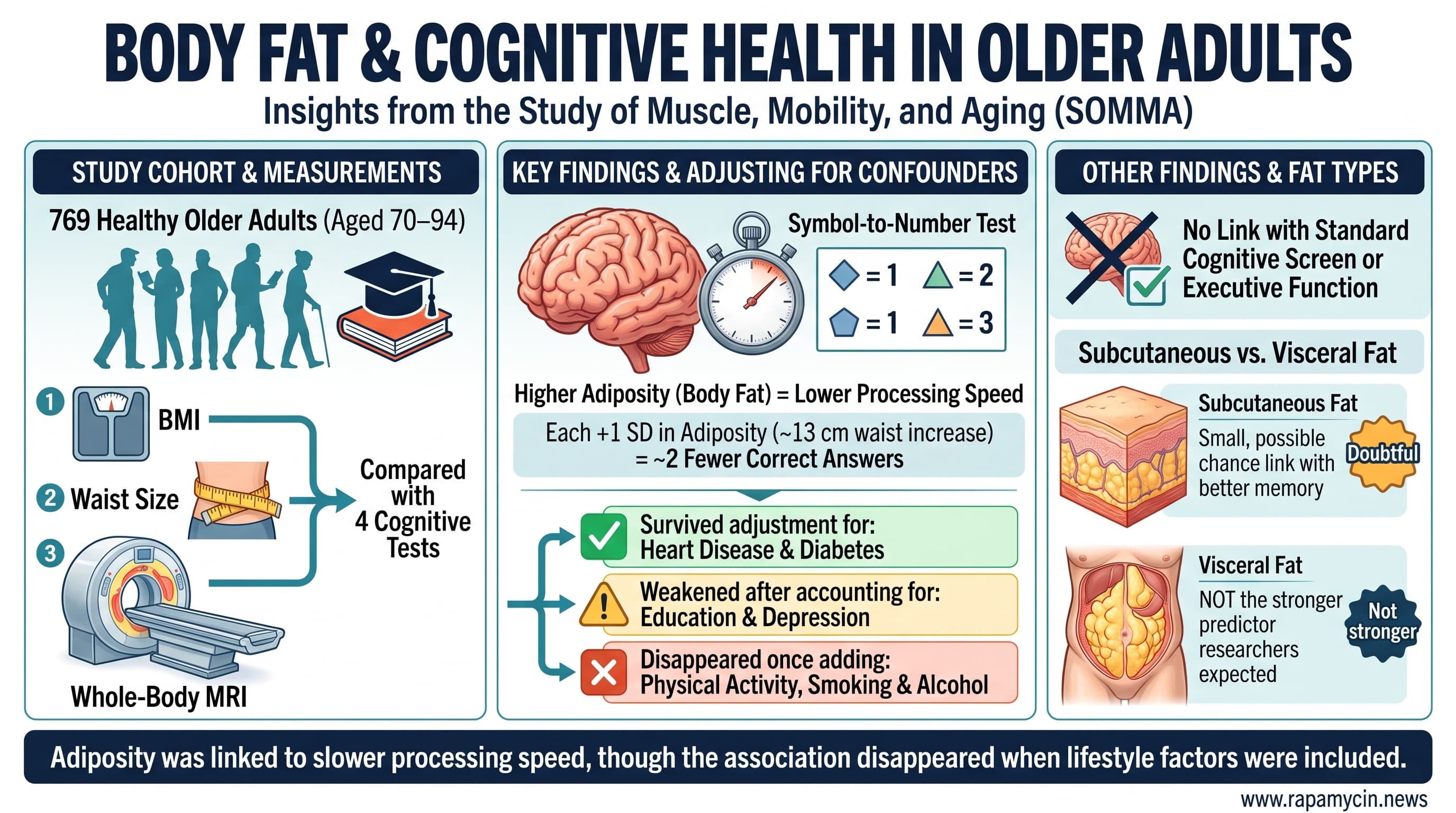
Researchers in the Study of Muscle, Mobility and Aging measured body fat in 769 healthy adults aged 70 to 94 using BMI, waist size and whole-body MRI, then compared it with four cognitive tests. The participants were mostly white and highly educated. People with more body fat scored lower on a processing speed test that times how quickly someone matches symbols to numbers. Each standard deviation increase in adiposity, roughly 13 centimeters of waist, corresponded to about two fewer correct answers. The link survived adjustment for heart disease and diabetes, weakened after accounting for education and depression, and disappeared once physical activity, smoking and alcohol were added.
Midlife obesity is one of the better-established modifiable risk factors for dementia. After 70, the picture gets murky. Some studies find that heavier older adults do worse on cognitive tests. Others find no link, and a few find that extra weight seems protective. Part of the confusion comes from BMI, a crude measure that cannot tell fat from muscle or belly fat from hip fat, and that becomes less meaningful as people shrink and lose muscle with age.
A team led by researchers at the University of Pittsburgh tried to cut through that confusion with better tools. They drew on the Study of Muscle, Mobility and Aging, a deeply characterized group of adults aged 70 and older recruited in Pittsburgh and Winston-Salem, North Carolina. Each participant had a whole-body MRI scan that separated visceral fat, which wraps the internal organs, from subcutaneous fat, which sits under the skin. Participants also completed four cognitive tests covering general screening, processing speed, executive function and verbal memory.
The clearest result involved processing speed. On the Digit Symbol Coding Test, where people match symbols to numbers as fast as they can for a set time, those with more body fat completed fewer items. This held for BMI, waist circumference and most MRI fat measures. Adjusting for heart disease and diabetes changed the picture only slightly.
The association then shrank as more factors were added. Accounting for education and depressive symptoms trimmed it further. Adding physical activity, smoking and alcohol erased it entirely. In the final model, no measure of fat significantly predicted processing speed.
That pattern can be read two ways. One reading is that the fat link was never really about fat, and that people who move more are both leaner and quicker. The other is that physical activity sits on the causal pathway, so that extra fat leads to less movement, which in turn affects brain health. A single snapshot in time cannot separate these possibilities.
Other results cut against expectations. The researchers predicted that visceral fat, the metabolically nastier depot, would be the stronger culprit. It was not. Subcutaneous fat measures tracked processing speed at least as closely. In the fully adjusted model, more subcutaneous fat was linked to slightly better delayed word recall, a finding the authors themselves treat as exploratory.
Body fat showed no relationship with Montreal Cognitive Assessment scores. The authors suggest this widely used screen may be too blunt to detect subtle differences in healthy, well-educated people, most of whom scored near the top of its range.
The participants were healthier, more active and more educated than typical older Americans, and nearly nine in ten were white. People with dementia, severe obesity or limited mobility were excluded. The findings speak to a fortunate slice of the aging population.
The big idea is that in healthy older adults, body fat relates most to how fast the brain works, not to memory or reasoning. That relationship appears closely tied to lifestyle, especially how much people move. For anyone past 70, the practical lesson points toward staying active rather than chasing a number on the scale.
Actionable Insights
This study is a cross-sectional snapshot, so it shows association, not cause. [Confidence: Medium]
- Prioritize movement. Once physical activity, smoking and alcohol were accounted for, the link between body fat and processing speed shrank by about two thirds and lost significance. Activity appears to be the more important lever.
- Waist size is a reasonable cheap marker. In the less adjusted models, each 13 centimeters (about 5 inches) of extra waist matched about 2 fewer correct answers on the speed test. That is roughly the drop seen across 2 to 3 years of age in this cohort.
- Do not fear all fat after 70. Subcutaneous fat was not worse than visceral fat, and it was weakly linked to slightly better memory. Aggressive weight loss in late life risks losing muscle.
- Ask for a sensitive test. A processing speed test may pick up subtle changes that a standard cognitive screen misses.
How big is the effect? Small. Body fat explained about 2 percent of the differences in processing speed before lifestyle adjustment, and well under 1 percent after. Safety Data Absent for any weight-loss strategy in this age group.
Context and Source
- Paywalled Paper: Adiposity and Cognitive Performance in Older Men and Women from the Study of Muscle, Mobility and Aging (SOMMA)
- Institution: University of Pittsburgh (lead and corresponding, Division of Endocrinology and Metabolism), with Chatham University, California Pacific Medical Center Research Institute (San Francisco Coordinating Center), University of California San Francisco, Wake Forest University and the AdventHealth Translational Research Institute
- Country: United States
- Journal: The Journals of Gerontology, Series A: Biological Sciences and Medical Sciences
- Impact evaluation: Journal Impact Factor; 2025 CiteScore 8.2, evaluated against a typical high-end range of 0 to 60+ for top general science, therefore this is a Medium impact journal. It ranks 4th of 49 gerontology journals.