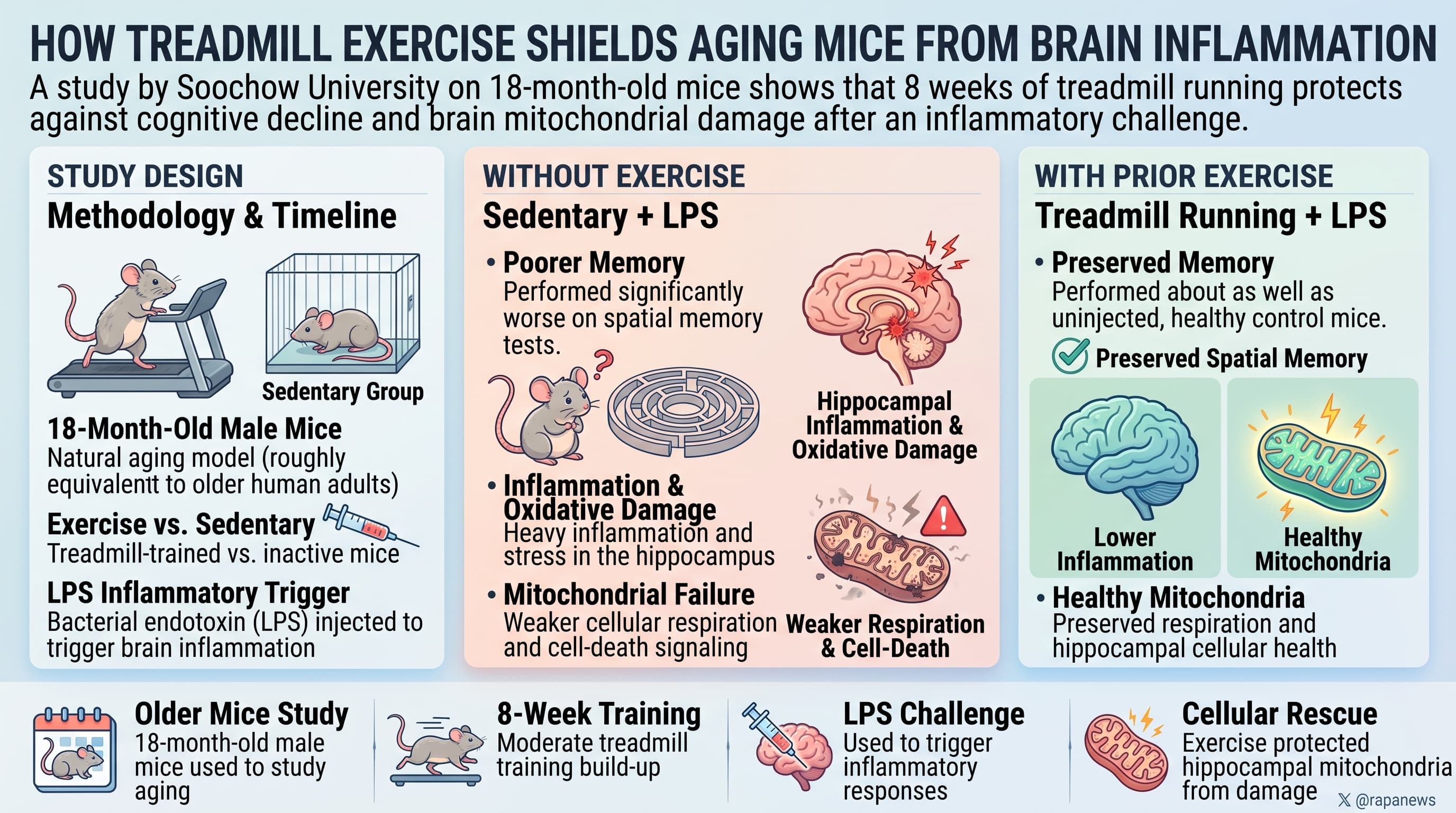
Researchers at Soochow University put 18-month-old male mice through eight weeks of moderate treadmill running, then injected them with bacterial endotoxin (LPS) to trigger brain inflammation. Sedentary mice given LPS performed worse on a spatial memory test and showed more hippocampal inflammation, oxidative damage, and cell-death signaling, along with weaker mitochondrial respiration. Mice that had exercised beforehand performed about as well as uninjected controls, and their hippocampal mitochondria looked healthier on nearly every marker measured.
Older adults often come out of an infection mentally foggier than they went in. A new mouse study asks whether being physically fit beforehand can blunt that hit, and whether mitochondria are part of the explanation.
The team took 32 male mice aged 18 months, old by mouse standards, and split them into four groups of eight. Two groups ran on a treadmill for 40 minutes a day, five days a week, for eight weeks. Two stayed sedentary. A day after the final session, one sedentary group and one trained group received a single injection of lipopolysaccharide, a bacterial cell-wall component that provokes a strong inflammatory response. Three hours later, all mice began six days of testing in the Morris water maze, where they must remember the location of a hidden platform.
Sedentary mice given LPS did poorly. On the final memory test they spent about 27 percent of their time in the correct quadrant of the pool, which is close to what random swimming would produce, compared with about 37 percent for untreated controls. Trained mice given the same injection scored about 38 percent, the same as healthy controls.
The hippocampus, the brain region central to this kind of memory, showed the same pattern. In sedentary LPS mice, inflammatory proteins rose and microglia, the brain’s immune cells, shifted into their activated shape. Markers of oxidative damage and programmed cell death went up, while levels of BDNF, a protein that supports learning, fell by roughly 40 percent. Prior exercise prevented most of these changes.
The authors then looked at mitochondria. Using high-resolution respirometry, they found that hippocampal tissue from sedentary LPS mice had about 30 percent lower maximal respiratory capacity. In trained mice the capacity was preserved, and in fact sat slightly above control levels. Protein markers suggested that exercise also kept the cell’s cleanup machinery (autophagy) running, kept the energy sensor AMPK active, and held the balance between mitochondrial fission and fusion steady.
The authors’ big idea is that mitochondrial fitness acts as a buffer. A brain whose mitochondria are in good order may absorb an inflammatory challenge without tipping into a self-reinforcing loop of oxidative stress, inflammation, and cell death.
That idea is plausible but not shown here. The study never tests whether the mitochondrial changes cause the memory protection. Nobody blocked autophagy or AMPK to see whether the benefit disappeared. Everything was measured at one time point, about eight days after the injection, in whole tissue that mixes neurons, microglia, and astrocytes. Most molecular results come from three animals per group.
There are other constraints. All the exercise happened before the insult, so this is evidence about resilience, not recovery. The mice were all male. The treadmill running was forced. And the claim to be “the first evidence” of this effect is hard to square with earlier work in aged rats showing that wheel running protected against infection-induced memory loss.
So the result adds mechanistic detail to a familiar message. Regular aerobic exercise appears to leave the aging brain better equipped to ride out an inflammatory episode, and healthier mitochondria travel with that protection. Whether they drive it is still an open question.
Actionable Insights
The practical message is one you have heard before: build an aerobic base before you need it. In this study the exercise was done before the inflammatory insult, so the finding concerns preparedness, not rescue once illness strikes.
The dose was modest: 40 minutes of moderate effort, five days a week, for eight weeks. That is 200 minutes weekly, close to standard human guidelines of 150 to 300 minutes.
How big was the effect? Sedentary mice given endotoxin spent about 27 percent of their time searching in the right place, versus 37 percent for healthy controls. Exercised mice given endotoxin scored about 38 percent. In plain terms, the deficit was fully erased. Expressed as a standardized effect size (Cohen’s d, which counts how many “typical spreads” separate two groups), the benefit was roughly 2 to 3. Anything above 0.8 is conventionally called large.
Do not expect that in people. Tiny, uniform groups of lab mice routinely produce inflated effect sizes. Human trials of exercise for cognition in adults over 50 report benefits near 0.3, which is real but small.
Context/Source
- Paywalled Paper: Exercise-induced alleviation of memory impairment in aged mice with neuroinflammation is linked with modulation of mitochondrial homeostasis in the hippocampus
- Institution: School of Physical Education and Sports Science, Soochow University, Suzhou, with co-authors at Suzhou TCM Hospital, Suzhou Gaobo Vocational College, and Shenzhen Longhua District Central Hospital
- Country: China
- Journal: The Journals of Gerontology, Series A
- Impact evaluation: The impact score of this journal is 4.6, evaluated against a typical high-end range of 0–60+ for top general science, therefore this is a Medium impact journal." Within gerontology specifically it is a well-regarded, top-quartile specialty title.